

Abstract
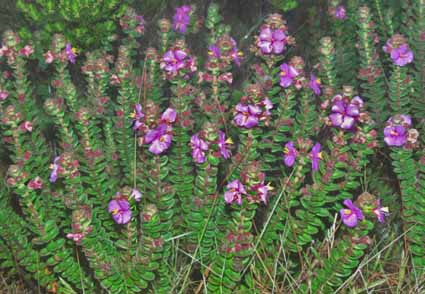
During recent field expeditions to the Chapada Diamantina (Bahia, Brazil), nine new endemic species of Melastomataceae were collected and are here described and illustrated: Marcetia auricularia, Marcetia santosiae, Marcetia unguiculata, Microlicia ascendens, Microlicia barbata, Microlicia daneui, Microlicia piatensis, Microlicia prostrata, and Microlicia tetramera. We provide photos of living and dry specimens, geographic distribution maps, notes on habitat and phenology for each species, and recommended conservation assessments. Marcetia auricularia, Marcetia unguiculata and Microlicia daneui were collected within a full protection conservation unit, the Chapada Diamantina National Park. Populations of Marcetia santosiae, Microlicia ascendens, Microlicia barbata, Microlicia prostrata, and Microlicia tetramera grow in a sustainable use conservation unit, the Serra do Barbado APA; no protection is afforded to Microlicia piatensis, as it occurs outside all conservation units in the Chapada Diamantina.
References
<p align="justify"><span style="color: #000000;"><span style="font-family: Times New Roman, serif;"><span style="font-size: small;">Almeda, F., Michelangeli, F.A. & Goldenberg, R. (2022) Conclusion and future prospects. In: Goldenberg, R., Michelangeli, F.A. & Almeda, F. (Eds.) Systematics, Evolution, and Ecology of Melastomataceae. Springer, Cham, Switzerland, pp. 791–793.</span></span></span>
<p align="justify"><span style="color: #000000;"><span style="font-family: Times New Roman, serif;"><span style="font-size: small;">Almeda, F., Pacifico, R. & Fidanza, K. (in press) A new Marcetia (Melastomataceae) from Chapada Diamantina, Bahia, Brazil. Rhodora.</span></span></span>
<p align="justify"><span style="color: #000000;"><span style="font-family: Times New Roman, serif;"><span style="font-size: small;">Bachman, S., Moat, J., Hill, A.W., de la Torre, J. & Scott, B. (2011) Supporting red list threat assessments with GeoCAT: Geospatial conservation assessment tool. ZooKeys 150: 117–126. https://doi.org/10.3897/zookeys.150.2109</span></span></span>
<p align="justify"><span style="color: #000000;"><span style="font-family: Times New Roman, serif;"><span style="font-size: small;">Candolle, A.P. (1828) Prodromus systematis naturalis regni vegetabilis. Treuttel et Würtz, Paris, 494 pp.</span></span></span>
<p align="justify"><span style="color: #000000;"><span style="font-family: Times New Roman, serif;"><span style="font-size: small;">Canhos, D.A.L., Almeida, E.A., Assad, A.L., Cunha Bustamante, M.M.D., Canhos, V.P., Chapman, A.D., Giovanni, R., Imperatriz-Fonseca, V.L., Lohmannm<span lang="en-GB">,</span> L.L., Maia, L.C., Miller, J.T., Nelson, G., Peterson, A.T., Pirani, J.R., Souza, S., Stehmann, J.R. & Thiers, B. (2022) speciesLink: rich data and novel tools for digital assessments of biodiversity. Biota Neotropica 22: e20221394. https://doi.org/10.1590/1676-0611-bn-2022-1394</span></span></span>
<p align="justify"><span style="color: #000000;"><span style="font-family: Times New Roman, serif;"><span style="font-size: small;">Carmo, A., Pacifico, R., Gonçales-Silva, R., Sbais, P.G., Fidanza, K. & Souza, L.A. (2019) Epidermal micromorphology and venation patterns of Microlicieae (Melastomataceae) leaves: Looking for new characters for the taxonomy of this neotropical tribe. Flora 261: 151–494. https://doi.org/10.1016/j.flora.2019.151494 </span></span></span>
<p align="justify"><span style="color: #000000;"><span style="font-family: Times New Roman, serif;"><span style="font-size: small;">Colli-Silva, M., Vasconcelos, T.N.C. & Pirani, J.R. (2019) Outstanding plant endemism levels strongly support the recognition of campo rupestre provinces in mountaintops of eastern South America. Journal of Biogeography 46: 1723–1733. https://doi.org/10.1111/jbi.13585</span></span></span>
<p align="justify"><span style="color: #000000;"><span style="font-family: Times New Roman, serif;"><span style="font-size: small;">Conceição, A.A., Rapini, A., Carmo, F.F., Brito, J.C., Silva, G.A., Neves, S.P.S & Jacobi, C.M. (2016) Rupestrian Grassland Vegetation, Diversity, and Origin. In: Fernandes, G.W. (ed.) Ecology and Conservation of Mountaintop Grasslands in Brazil. Springer Nature, Switzerland, pp. 105–127. https://doi.org/10.1007/978-3-319-29808-5_6 </span></span></span>
<p align="justify"><span style="color: #000000;"><span style="font-family: Times New Roman, serif;"><span style="font-size: small;">CNCFlora (2022) Marcetia bahiana in Lista Vermelha da flora brasileira, versão 2012. Centro Nacional de Conservação da Flora. Available from: http://cncflora.jbrj.gov.br (acessed 15 July 2022)</span></span></span>
<p align="justify"><span style="color: #000000;"><span style="font-family: Times New Roman, serif;"><span style="font-size: small;">Diniz, D.O. & Silva, M.J. (2020) Microlicia D.Don (Microlicieae, Melastomataceae) no Parque Nacional da Chapada dos Veadeiros, Estado de Goiás, Brasil. Hoehnea 47: e322019. https://doi.org/10.1590/2236-8906-32/2019</span></span></span>
<p align="justify"><span style="color: #000000;"><span style="font-family: Times New Roman, serif;"><span style="font-size: small;">Fernandes, G.W., Barbosa, N.P.U., Alberton, B., Barbieri, A., Dirzo, R., Goulart, F., Guerra, T.J., Morellato, R.P.C. & Solar, R.R.C. (2018) The deadly route to collapse and the uncertain fate of Brazilian rupestrian grasslands. Biodiversity Conservation 27: 2587–2603. https://doi.org/10.1007/s10531-018-1556-4 </span></span></span>
<p align="justify"><span style="color: #000000;"><span style="font-family: Times New Roman, serif;"><span style="font-size: small;">Flora e Funga do Brasil (2022) Jardim Botânico do Rio de Janeiro. Available from: http://floradobrasil.jbrj.gov.br (accessed 30 August 2022)</span></span></span>
<p align="justify"><span style="color: #000000;"><span style="font-family: Times New Roman, serif;"><span style="font-size: small;">Freitas, J.G., Santos, A.K.A. & Oliveira, R.P. (2012) Tibouchina bracteolata and T. comosa (Melastomataceae, Melastomeae): two new species to the Chapada Diamantina, Bahia, Brazil. Systematic Botany 37: 189–196. https://doi.org/10.1600/036364412X616756 </span></span></span>
<p align="justify"><span style="color: #000000;"><span style="font-family: Times New Roman, serif;"><span style="font-size: small;">Freitas, J.G., dos Santos, A.K.A., Guimarães, P.J.F. & Oliveira, R.P. (2016) Flora da Bahia: Meslastomataceae – Tibouchina s.l. Sitientibus série Ciências Biológicas 16: 1–46. https://doi.org/10.13102/scb1111</span></span></span>
<p align="justify"><span style="color: #000000;"><span style="font-family: Times New Roman, serif;"><span style="font-size: small;">Giulietti, A.M., Queiroz, L.P., Silva, T.R.S., França, F., Guedes, M.L. & Amorim, A.M. (2006) Flora of Bahia. Sitientibus série Ciências Biológicas 6: 169–173. https://doi.org/10.13102/scb8174</span></span></span>
<p align="justify"><span style="color: #000000;"><span style="font-family: Times New Roman, serif;"><span style="font-size: small;">Gleason, H.A. (1931) Studies on the flora of northern South America-XV. Recent collections of Melastomataceae from Peru and Amazonian Brazil. Bulletin of the Torrey Botanical Club 58: 215–262. https://doi.org/10.2307/2480704</span></span></span>
<p align="justify"><span style="color: #000000;"><span style="font-family: Times New Roman, serif;"><span style="font-size: small;">Harley, R.M. & Simmons, M.A. (1986) Florula of Mucugê. Royal Botanic Gardens, Kew, London, 238 pp.</span></span></span>
<p align="justify"><span style="color: #000000;"><span style="font-family: Times New Roman, serif;"><span style="font-size: small;">Hoehne, F.C. (1922) Melastomatáceas dos Hervários: Horto “Oswaldo Cruz”, Museu Paulista, Commissão de Linhas Telegráficas Estratégicas de Mato Grosso ao Amazonas, Jardim Botânico do Rio de Janeiro, etc. Anexos das Memórias do Instituto Butantan 1: 1–197.</span></span></span>
<p align="justify"><span style="color: #000000;"><span style="font-family: Times New Roman, serif;"><span style="font-size: small;">IUCN (2022) Guidelines for Using the IUCN Red list Categories and Criteria. Version 15. Prepared by the Standards and Petitions Subcommittee. Available from: http://www.iucnredlist.org/documents/RedListGuidelines.pdf (accessed 30 August 2022)</span></span></span>
<p align="justify"><span style="color: #000000;"><span style="font-family: Times New Roman, serif;"><span style="font-size: small;">Koschnitzke, C. & Martins<span lang="en-GB">,</span> A.B. (1999) New combinations and a new species in the Brazilian genus Chaetostoma DC. (Microlicieae: Melastomataceae). Novon 9: 202–204. https://doi.org/10.2307/3391799</span></span></span>
<p align="justify"><span style="color: #000000;"><span style="font-family: Times New Roman, serif;"><span style="font-size: small;">Koschnitzke, C. & Martins<span lang="en-GB">,</span> A.B. (2007) Nomenclatural alterations in Microlicieae (Melastomataceae). Novon 17: 472–475. http:// doi.org/10.3417/1055-3177(2007)17[472:NAIMM]2.0.CO;2</span></span></span>
<p align="justify"><span style="color: #000000;"><span style="font-family: Times New Roman, serif;"><span style="font-size: small;">Lima, C.C.U. & Nolasco, M.C. (2015) Chapada Diamantina: A remarkable landscape dominated by mountains and plateaus. In: Vieira, B., Salgado, A. & Santos, L. (eds.) Landscapes and Landforms of Brazil. World Geomorphological Landscapes. Springer Nature, Dordrecht, 403 pp. https://doi.org/10.1007/978-94-017-8023-0_19 </span></span></span>
<p align="justify"><span style="color: #000000;"><span style="font-family: Times New Roman, serif;"><span style="font-size: small;">Markgraf, F. (1927) Melastomataceae. In: Pilger, R. (ed.) Plantae Luetzelburgianae brasiliensis VII. Notizblatt des Botanischen Gartens und Museums zu Berlin-Dahlem 10: 43–54. https://doi.org/10.2307/3994816</span></span></span>
<p align="justify"><span style="color: #000000;"><span style="font-family: Times New Roman, serif;"><span style="font-size: small;">Martins, A.B. (1989) Revisão taxonômica do gênero Marcetia DC. (Melastomataceae). PhD thesis, Universidade Estadual de Campinas, Campinas, Brazil, 277 pp.</span></span></span>
<p align="justify"><span style="color: #000000;"><span style="font-family: Times New Roman, serif;"><span style="font-size: small;">Martins, A.B. (1995a) Notas nomenclaturais e taxonômicas em Melastomataceae. Acta Botanica Brasilica 9: 147–148. https://doi.org/10.1590/S0102-33061995000100007</span></span></span>
<p align="justify"><span style="color: #000000;"><span style="font-family: Times New Roman, serif;"><span style="font-size: small;">Martins, A.B. (1995b) Marcetia. In: Stannard, B.L. (ed.) Flora of the Pico das Almas, Chapada Diamantina – Bahia, Brazil. Royal Botanic Gardens, Kew, London, pp. 450–454.</span></span></span>
<p align="justify"><span style="color: #000000;"><span style="font-family: Times New Roman, serif;"><span style="font-size: small;">Martins, A.B. & Almeda, F. (2017) A monograph of the Brazilian endemic genus Lavoisiera (Melastomataceae; Microlicieae). Phytotaxa 315: 1–194. https://doi.org/10.11646/phytotaxa.315.1.1</span></span></span>
<p align="justify"><span style="color: #000000;"><span style="font-family: Times New Roman, serif;"><span style="font-size: small;">Martins, E. (1991) A tribo Microlicieae no estado de São Paulo. Masters dissertation, Universidade Estadual de Campinas, Campinas, Brazil, 135 pp.</span></span></span>
<p align="justify"><span style="color: #000000;"><span style="font-family: Times New Roman, serif;"><span style="font-size: small;">Matsumoto, K. & Martins, A.B. (2005) Melastomataceae nas formações campestres do município de Carrancas, Minas Gerais. Hoehnea 32: 389–420.</span></span></span>
<p align="justify"><span style="color: #000000;"><span style="font-family: Times New Roman, serif;"><span style="font-size: small;">Naudin, C. (1845) Description de genres nouveaux, et rectification de quelques anciens genres appartenant à la famille des Mélastomacées. Additions a la flore du Brésil Méridional. Annales de Sciences Naturelles sér. 3, 12: 169–192.</span></span></span>
<p align="justify"><span style="color: #000000;"><span style="font-family: Times New Roman, serif;"><span style="font-size: small;">Pacifico, R., Fidanza, K. & Almeda, F. (2017) Two new species of Microlicia (Melastomataceae) from Rupestrian Grasslands of Serra do Cipó, Minas Gerais, Brazil. Phytotaxa 316: 39–50. https://doi.org/10.11646/phytotaxa.316.1.3</span></span></span>
<p align="justify"><span style="color: #000000;"><span style="font-family: Times New Roman, serif;"><span style="font-size: small;">Pacifico, R., Almeda, F., Frota, A. & Fidanza, K. (2020a) Areas of endemism on Brazilian mountaintops revealed by taxonomically verified records of Microlicieae (Melastomataceae). Phytotaxa 450: 119–148. https://doi.org/10.11646/phytotaxa.450.2.1 </span></span></span>
<p align="justify"><span style="color: #000000;"><span style="font-family: Times New Roman, serif;"><span style="font-size: small;">Pacifico, R., Almeda, F., Rodrigues, L.J.G. & Fidanza, K. (2020b) Novelties in Microlicia (Melastomataceae: Microlicieae) from the Bolivian Cerrado. Phytotaxa 433: 225–234. https://doi.org/10.11646/phytotaxa.433.3.4 </span></span></span>
<p align="justify"><span style="color: #000000;"><span style="font-family: Times New Roman, serif;"><span style="font-size: small;">Pacifico<span lang="en-GB">,</span> R. & Almeda, F. (2022) Lavoisiereae: A Neotropical tribe with remarkable endemism on eastern Brazilian mountaintops. In: Goldenberg, R., Michelangeli, F.A. & Almeda, F. (eds.) Systematics, Evolution, and Ecology of Melastomataceae. Springer Nature, Cham, pp. 385–408. https://doi.org/10.1007/978-3-030-99742-7_19</span></span></span>
<p align="justify"><span style="color: #000000;"><span style="font-family: Times New Roman, serif;"><span style="font-size: small;">Pacifico, R.B. & Fidanza, K. (2018) Flora da Serra do Cipó: Microlicieae (Melastomataceae). Boletim de Botânica 36: 25–95. https://doi.org/10.11606/issn.2316-9052.v36i0p25-95</span></span></span>
<p align="justify"><span style="color: #000000;"><span style="font-family: Times New Roman, serif;"><span style="font-size: small;">Pataro, L., Romero, R. & Roque, N. (2013) Four new species of Microlicia (Melastomataceae) from Chapada Diamantina, Bahia, Brazil. Kew Bulletin 68: 285–293. https://doi.org/10.1007/s12225-013-9448-y </span></span></span>
<p align="justify"><span style="color: #000000;"><span style="font-family: Times New Roman, serif;"><span style="font-size: small;">Pataro, L., Romero, R. & Roque, N. (2017) Microlicieae (Melastomataceae) no município de Mucugê, Chapada Diamantina, Bahia, Brasil. Rodriguésia 68: 1287–1311. https://doi.org/10.1590/2175-7860201768412</span></span></span>
<p align="justify"><span style="color: #000000;"><span style="font-family: Times New Roman, serif;"><span style="font-size: small;">QGIS Development Team (2022) QGIS Geographic Information System. Open Source Geospatial Foundation. Available from: https://qgis.org (accessed 18 August 2022)</span></span></span>
<p align="justify"><span style="color: #000000;"><span style="font-family: Times New Roman, serif;"><span style="font-size: small;">Romero, R. & Woodgyer, E.M. (2018) Six new species of Microlicia (Melastomataceae) from Bahia, Brazil. Kew Bulletin 73: 22. https://doi.org/10.1007/s12225-018-9747-4</span></span></span>
<p align="justify"><span style="color: #000000;"><span style="font-family: Times New Roman, serif;"><span style="font-size: small;">Romero, R., Versiane, A.F.A. & Woodgyer, E.M. (2022a) Miscellaneous taxonomic and nomenclatural notes on Microlicia D.Don (Melastomataceae). Phytotaxa 559: 99–131. https://doi.org/10.11646/phytotaxa.559.2.1 </span></span></span>
<p align="justify"><span style="color: #000000;"><span style="font-family: Times New Roman, serif;"><span style="font-size: small;">Romero, R., Fontelas, J.C., Moreira, K.V.C., Ferreira-Alves, R., Oliveira, L.F.A. & Versiane, A.F.A. (2022b) Microlicia in Flora e Funga do Brasil. Jardim Botânico do Rio de Janeiro. Available from: https://floradobrasil.jbrj.gov.br/FB30751 (accessed 20 October 2022)</span></span></span>
<p align="justify"><span style="color: #000000;"><span style="font-family: Times New Roman, serif;"><span style="font-size: small;">Saint-Hilaire, A. (1833) Voyage dans le district des diamants et sur le littoral du Brésil. Volume 1. Libraire-Gide, Paris, 402 pp.</span></span></span>
<p align="justify"><span style="color: #000000;"><span style="font-family: Times New Roman, serif;"><span style="font-size: small;">Santos, A.K.A. & Silva, T.R.S. (2005) A família Melastomataceae no município de Rio de Contas, Bahia, Brasil. Sitientibus Série Ciências Biológicas 5: 76–92. https://doi.org/10.13102/scb8218</span></span></span>
<p align="justify"><span style="color: #000000;"><span style="font-family: Times New Roman, serif;"><span style="font-size: small;">Santos, A.K.A., Martins, A.B. & Silva, T.R.S. (2008) Marcetia candolleana (Melastomeae – Melastomataceae), a new species from Bahia (Brazil). Kew Bulletin 63: 315–318. https://doi.org/10.1007/s12225-008-9021-2</span></span></span>
<p align="justify"><span style="color: #000000;"><span style="font-family: Times New Roman, serif;"><span style="font-size: small;">Santos, A.K.A., Martins, A.B. & Silva, T.R.S. (2013) Two new species of Marcetia (Melastomataceae) from the Chapada Diamantina, Bahia, Brazil. Systematic Botany 38: 714–722. https://doi.org/10.1600/036364413X670377</span></span></span>
<p align="justify"><span style="color: #000000;"><span style="font-family: Times New Roman, serif;"><span style="font-size: small;">Santos, A.K.A. (2022) Marcetia in Flora e Funga do Brasil. Jardim Botânico do Rio de Janeiro. Available from: https://floradobrasil.jbrj.gov.br/FB9646 (accessed 30 August 2022)</span></span></span>
<p align="justify"><span style="color: #000000;"><span style="font-family: Times New Roman, serif;"><span style="font-size: small;">Silveira, F.A.O., Negreiros, D., Barbosa, N.P.U., Buisson, E., Carmo, F.F., Carstensen, D.W., Conceição, A.A., Cornelissen, T.G., Echternacht, L, Fernandes, G.W., Garcia, Q.S., Guerra, T.J., Jacobi, C.M., Lemos-Filho, J.P., Le Stradic, S., Morellato, L.P.C., Neves, F.S., Oliveira, R.S., Schaefer, C.E., Viana, P.L. & Lambers, H. (2016) Ecology and evolution of plant diversity in the endangered campo rupestre: a neglected conservation priority. Plant and Soil 403: 129–152. https://doi.org/10.1007/s11104-015-2637-8</span></span></span>
<p align="justify"><span style="color: #000000;"><span style="font-family: Times New Roman, serif;"><span style="font-size: small;">Stannard, B.L. (ed.) (1995) Flora of the Pico das Almas, Chapada Diamantina – Bahia, Brazil. Kew, Royal Botanic Gardens, London, 853 pp.</span></span></span>
<p align="justify"><span style="color: #000000;"><span style="font-family: Times New Roman, serif;"><span style="font-size: small;">Thiers, B. (2022) [continuously updated] Index Herbariorum: A global directory of public herbaria and associated staff. New York Botanical Garden’s Virtual Herbarium. Available from: http:// sweetgum.nybg.org/science/ih/ (accessed August 30 2022). </span></span></span>
<p align="justify"><span style="color: #000000;"><span style="font-family: Times New Roman, serif;"><span style="font-size: small;">Ule, E. (1908) Beiträge zur Flora von Bahia. I. Botanische Jahrbücher für Systematik, Pflanzengeschichte und Pflanzengeographie 42: 191–238.</span></span></span>
<p align="justify"><span style="color: #000000;"><span style="font-family: Times New Roman, serif;"><span style="font-size: small;">Versiane, A.F.A., Santos, M.L.D. & Romero, R. (2016) Melastomataceae da Serra dos Pireneus, Goiás, Brasil. Rodriguésia 67: 721–759. https://doi.org/10.1590/2175-7860201667314</span></span></span>
<p align="justify"><span style="color: #000000;"><span style="font-family: Times New Roman, serif;"><span style="font-size: small;">Versiane, A.F.A., Romero, R., Reginato, M., Welker, C.A.D., Michelangeli, F.A. & Goldenberg, R. (2021) Phylogenetic analyses of Microlicieae (Melastomataceae), with emphasis on the re-circumscription of the large genus Microlicia. Botanical Journal of the Linnean Society 197: 35–60. https://doi.org/10.1093/botlinnean/boab011</span></span></span>
<p align="justify"><span style="color: #000000;"><span style="font-family: Times New Roman, serif;"><span style="font-size: small;">Wurdack, J.J. (1983) Certamen Melastomataceis XXXVI. Phytologia 53: 121–137. https://doi.org/10.5962/bhl.part.12598</span></span></span>
<p align="justify"><span style="color: #000000;"><span style="font-family: Times New Roman, serif;"><span style="font-size: small;">Wurdack, J.J. (1984) Certamen Melastomataceis XXXVII. Phytologia 55: 131–147.</span></span></span>
<p align="justify"><span style="color: #000000;"><span style="font-family: Times New Roman, serif;"><span style="font-size: small;">Wurdack, J.J. (1988) Certamen Melastomataceis XXXVIII. Phytologia 64: 293–301.</span></span></span>
<p align="justify"><span style="color: #000000;"><span style="font-family: Times New Roman, serif;"><span style="font-size: small;">Wurdack, J.J. (1995) New species of Melastomataceae from Bahia, Brazil. Kew Bulletin 50: 822–825. https://doi.org/10.2307/4110248</span></span></span>
<p align="justify"><span style="color: #000000;"><span style="font-family: Times New Roman, serif;"><span style="font-size: small;">Zappi, D.C., Lucas, E., Stannard, B.L., Nic Lughadha, E., Pirani, J.R., Queiroz, L.P., Atkins, S., Hind, D.J.N., Giulietti, A.M., Harley, R.M. & Carvalho, A.M. (2003) Lista das plantas vasculares de Catolés, Chapada Diamantina, Bahia, Brasil. Boletim de Botânica 21: 345–398. https://doi.org/10.11606/issn.2316-9052.v21i2p345-398</span></span></span>