

Abstract
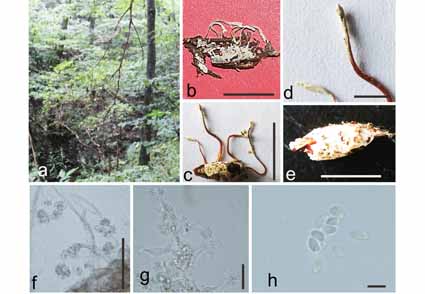
Entomopathogenic fungi have evolved in concert with insects for a long time and possess unique insecticidal properties and significant biological control, and medicinal potential. However, they are frequently overlooked and many previously unknown species have yet to be discovered and described. Cordyceps yaoluopingensis, a new species from Yaoluoping Nature Reserve in Anhui Province, China is defined as a new species based on morphology and molecular phylogenetic analyses. The new species has shorter synnemata, longer phialides and larger ovoid or fusiform conidia. Phylogenetic analysis using the six loci ITS, LSU, SSU, tef1-α, rpb1 and rpb2 established the uniqueness of the new species.
References
<p align="justify"><span style="color: #000000;"><span style="font-family: Times New Roman, serif;"><span style="font-size: small;">Cao, S.Q., Li, C.R., Huang, B., Fan, M.Z. & Li, Z.Z. (2010) Cordyceps cardinalis, a new species in China and its Isaria anamorph. Journal of Anhui Agricultural University 37 (4): 712–715. https://doi.org/10.1080/00949651003724790</span></span></span>
<p align="justify"><span style="color: #000000;"><span style="font-family: Times New Roman, serif;"><span style="font-size: small;">Castillo, L.P., Osorio, A. Vargas, N., Sanjuan, T., Grajales, A. & Restrepo, S. (2018) Genetic diversity of the entomopathogenic fungus Cordyceps tenuipes in forests and butterfly gardens in Quindio, Colombia. Fungal Biology 122 (9): 891–899. https://doi.org/10.1016/j.funbio.2018.05.003</span></span></span>
<p align="justify"><span style="color: #000000;"><span style="font-family: Times New Roman, serif;"><span style="font-size: small;">Castlebury, L.A., Rossman, A.Y., Sung, G.H., Hyten, A.S. & Spatafora, J.W. (2004) Multigene phylogeny reveals new lineage for Stachybotrys chartarum, the indoor air fungus Mention of trade names or commercial products in this article is solely for the purpose of providing specific information and does not imply recommendation or endorsement by the USDA. Mycological Research 108 (8): 864–872. https://doi.org/10.1017/S0953756204000607</span></span></span>
<p align="justify"><span style="color: #000000;"><span style="font-family: Times New Roman, serif;"><span style="font-size: small;">Cheek, M., Lughadha, E.N., Kirk, P.M., Lindon, H. & Niskanen, T. (2020) New scientific discoveries: Plants and fungi. Plants People Planet 2 (5): 371–388. https://doi.org/10.1002/ppp3.10148</span></span></span>
<p align="justify"><span style="color: #000000;"><span style="font-family: Times New Roman, serif;"><span style="font-size: small;">Chen, W., Han, Y., Liang, J. & Liang, Z. (2021) Taxonomic and phylogenetic characterizations reveal four new species of Simplicillium (Cordycipitaceae, Hypocreales) from Guizhou, China. Scientific Reports 11 (1): 15300. https://doi.org/10.1038/s41598-021-94893-z</span></span></span>
<p align="justify"><span style="color: #000000;"><span style="font-family: Times New Roman, serif;"><span style="font-size: small;">Chen, W., Liu, C., Han, Y.F., Liang, J.D., Tian, W.Y. & Liang, Z.Q. (2019a) Three novel insect-associated species of Simplicillium (Cordycipitaceae, Hypocreales) from Southwest China. MycoKeys 58: 83–102. https://doi.org/10.3897/mycokeys.58.37176</span></span></span>
<p align="justify"><span style="color: #000000;"><span style="font-family: Times New Roman, serif;"><span style="font-size: small;">Chen, Z., Wang, Y., Dai, Y., Chen, K., Xu, L. & He, Q. (2019b) Species diversity and seasonal fluctuation of entomogenous fungi of Ascomycota in Taibaoshan Forest Park in western Yunnan. Biodiversity Science 27 (9): 993–1001. https://doi.org/ 10.17520/biods.2019135</span></span></span>
<p align="justify"><span style="color: #000000;"><span style="font-family: Times New Roman, serif;"><span style="font-size: small;">Dhanasekaran, V., Mostert, L., Jeewon, R., Hyde, K. & Crous, P. (2004) Pleurostomophora, an anamorph of Pleurostoma (Calosphaeriales), a new anamorph genus morphologically similar to Phialophora. Studies in Mycology 50 (2): 50.</span></span></span>
<p align="justify"><span style="color: #000000;"><span style="font-family: Times New Roman, serif;"><span style="font-size: small;">Fan, M.Z., Wang, B., Ding, D.G., Zhang, L., Wang, L.M. & Yu, Z.N. (1998) Investigation on the Resources of Entomogenous Fungi in Yaoluoping Nature Preservation. Journal of Anhui Agricultural University 25.</span></span></span>
<p align="justify"><span style="color: #000000;"><span style="font-family: Times New Roman, serif;"><span style="font-size: small;">Gao, L. (2004) Investigation,Analysis and Protection of Some Special Plants in Yaolouping Natural Safeguard Areas. Journal of Anhui Agricultural Sciences 06: 1184–1186. https://doi.org/10.13989/j.cnki.0517-6611.2004.06.040</span></span></span>
<p align="justify"><span style="color: #000000;"><span style="font-family: Times New Roman, serif;"><span style="font-size: small;">Gao, L., Xu, R.-S., Cao, J.X. & Zhou, Z.Y. (2002) A preliminary study on the flore of Yaoluoping National Resources Reserve. Joural of Biology. 06: 32–34. https://doi.org/10.13989/j.cnki.0517-6611.2004.06.040</span></span></span>
<p align="justify"><span style="color: #000000;"><span style="font-family: Times New Roman, serif;"><span style="font-size: small;">Hall, T., Biosciences, I. & Carlsbad, C. (2011) BioEdit: An important software for molecular biology. GERF Bulletin of Biosciences 2 (1): 60–61.</span></span></span>
<p align="justify"><span style="color: #000000;"><span style="font-family: Times New Roman, serif;"><span style="font-size: small;">He, Y., Wu, W. & Li, N. (2016) A Checklist of Macrofungi in Yaoluoping Nature Reserve, Anhui. Journal of Resources and Ecology 7 (2): 144–150. https://doi.org/10.5814/j.issn.1674-764x.2016.02.010</span></span></span>
<p align="justify"><span style="color: #000000;"><span style="font-family: Times New Roman, serif;"><span style="font-size: small;">Huang, Y., Wang, X., Feng, Z., Cui, H., Zhu, Z., Xia, C., Han, X., Liu, W. & Liu, Y. (2020) Cordyceps cicadae Prevents Renal Tubular Epithelial Cell Apoptosis by Regulating the SIRT1/p53 Pathway in Hypertensive Renal Injury. Evidence-Based Complementary and Alternative Medicine 2020: 1–13. https://doi.org/10.1155/2020/7202519</span></span></span>
<p align="justify"><span style="color: #000000;"><span style="font-family: Times New Roman, serif;"><span style="font-size: small;">Hyde, K., Xu, J., Rapior, S., Jeewon, R., Lumyong, S., Niego, A.G., Abeywickrama, P., Vishvakeerthi, J., Brahmanage, R., Brooks, S., Chaiyasen, A., Chethana, K., Chomnunti, P., Chepkirui, C., Chuankid, B., de Silva, N., Doilom, M., Faulds, C., Gentekaki, E. & M. Stadler. (2019) The amazing potential of fungi: 50 ways we can exploit fungi industrially. Fungal Diversity 97: 1–136. https://doi.org/10.1007/s13225-019-00430-9</span></span></span>
<p align="justify"><span style="color: #000000;"><span style="font-family: Times New Roman, serif;"><span style="font-size: small;">Jayasiri, S.C., Hyde, K.D., Ariyawansa, Bhat, J., Buyck, B., Cai, L., Dai, Y.C., Abd-Elsalam, K.A., Ertz, D., Hidayat, I., Jeewon, R., Jones, E.B.G., Bahkali, A.H., Karunarathna, S.C., Liu, J.K., Luangsa-Ard, J.J., Lumbsch, H.T., Maharachchikumbura, S.S.N., McKenzie, E.H.C., Moncalvo, J.M., Ghobad-Nejhad, M., Nilsson, H., Pang, K.L., Pereira, O.L., Phillips, A.J.L., Raspe, O. Rollins, A.W., Romero, A.I., Etayo, J., Selcuk, F., Stephenson, S.L., Suetrong, S., Taylor, J.E., Tsui, C.K.M., Vizzini, A., Abdel-Wahab, M.A., Wen, T.C., Boonmee, S., Dai, D.Q., Daranagama, D.A., Dissanayake, A.J., Ekanayaka, A.H., Fryar, S.C., Hongsanan, S., Jayawardena, R.S., Li, W.J., Perera, R.H., Phookamsak, R., De Silva, N.I., Thambugala, K.M., Tian, Q., Wijayawardene, N.N., Zhao, R.L., Zhao, Q., Kang, J.C. & Promputtha, I. (2015) The Faces of Fungi database: fungal names linked with morphology, phylogeny and human impacts. Fungal Diversity 74 (1): 3–18. https://doi.org/10.1007/s13225-015-0351-8</span></span></span>
<p align="justify"><span style="color: #000000;"><span style="font-family: Times New Roman, serif;"><span style="font-size: small;">Katoh, K. & Standley, D.M. (2013) MAFFT multiple sequence alignment software version 7: improvements in performance and usability. Molecular Biology and Evolution 30 (4): 772–780. https://doi.org/10.1093/molbev/mst010</span></span></span>
<p align="justify"><span style="color: #000000;"><span style="font-family: Times New Roman, serif;"><span style="font-size: small;">Kepler, R.M., Luangsa-ard, J.J., Hywel-Jones, N.L., Quandt, C.A., Sung, G.H., Rehner, S.A., Aime, M.C., Henkel, T.W., Sanjuan, T., Zare, R., Chen, M.J., Li, Z.Z., Rossman, A.Y., Spatafora, J.W. & Shrestha, B. (2017) A phylogenetically-based nomenclature for Cordycipitaceae (Hypocreales). IMA Fungus 8 (2): 335–353. https://doi.org/10.5598/imafungus.2017.08.02.08 </span></span></span>
<p align="justify"><span style="color: #000000;"><span style="font-family: Times New Roman, serif;"><span style="font-size: small;">Kepler, R.M., Sung, G.H., Ban, S., Nakagiri, A., Chen, M.J., Huang, B., Li, Z. & Spatafora, J.W. (2012) New teleomorph combinations in the entomopathogenic genus Metacordyceps. Mycologia 104 (1): 182–197. https://doi.org/10.3852/11-070</span></span></span>
<p align="justify"><span style="color: #000000;"><span style="font-family: Times New Roman, serif;"><span style="font-size: small;">Kobayasi & Shimizu. (1982) Key to the taxa of the genera Cordyceps and Torrubiella. Transactions of the Mycological Society of Japan 23: 329–364.</span></span></span>
<p align="justify"><span style="color: #000000;"><span style="font-family: Times New Roman, serif;"><span style="font-size: small;">Kobayasi, Y. (1941) The genus Cordyceps and its allies. Science reports of the Tokyo Bunrika Daigaku 5: 53–260.</span></span></span>
<p align="justify"><span style="color: #000000;"><span style="font-family: Times New Roman, serif;"><span style="font-size: small;">Li, C.R., Zuo, D.P., Nam, S.H., Pu, S.C., Fan, M.Z. & Li, Z.Z. (2007) Cordyceps takaomontana and its anamorph Paecilomyces tenuipes. Mycosystema 26 (2): 217–220. https://doi.org/10.13346/j.mycosystema.2007.02.012</span></span></span>
<p align="justify"><span style="color: #000000;"><span style="font-family: Times New Roman, serif;"><span style="font-size: small;">Li, L.Q., Song, A.X., Yin, J., Siu, K.C., Wong, W.T. & J. Wu. (2020) Anti-inflammation activity of exopolysaccharides produced by a medicinal fungus Cordyceps sinensis Cs-HK1 in cell and animal models. International Journal of Biological Macromolecules 149: 1042–1050. https://doi.org/10.1016/j.ijbiomac.2020.02.022</span></span></span>
<p align="justify"><span style="color: #000000;"><span style="font-family: Times New Roman, serif;"><span style="font-size: small;">Li, T.H., Deng, C.Y. & Song, B. (2008) A distinct species of Cordyceps on coleopterous larvae hidden in twigs. Mycotaxon 103: 365–369.</span></span></span>
<p align="justify"><span style="color: #000000;"><span style="font-family: Times New Roman, serif;"><span style="font-size: small;">Liang, Z., He, X., Han, Y., Cai, S. & Liang, J. (2008) A new species of Isaria isolated from an infected locust. Mycotaxon 105: 29–36.</span></span></span>
<p align="justify"><span style="color: #000000;"><span style="font-family: Times New Roman, serif;"><span style="font-size: small;">Liang, Z.Q., Liu, A.Y., Liu, M.H. & Kang, J.C. (2003) The genus Cordyceps and its allies from the Kuankuoshui Reserve in Guizhou III. Fungal Diversity 14: 95–101.</span></span></span>
<p align="justify"><span style="color: #000000;"><span style="font-family: Times New Roman, serif;"><span style="font-size: small;">Maharachchikumbura, S., Hyde, K., Jones, E., McKenzie, E., Bhat, D.J., Dayarathne, M., Huang, S.K., Norphanphoun, C., Senanayake, I., Perera, R., Shang, Q.J., Xiao, Y.P., D’souza, M., Hongsanan, S., Jayawardena, R., Daranagama, D., Konta, S., Goonasekara, I., Zhuang, W.Y. & Wijayawardene, N. (2016) Families of Sordariomycetes. Fungal Diversity 79: 1–317. https://doi.org/10.1007/s13225-016-0369-6.</span></span></span>
<p align="justify"><span style="color: #000000;"><span style="font-family: Times New Roman, serif;"><span style="font-size: small;">Mains, E.B. (1958) North American Entomogenous Species of Cordyceps. Mycologia 50 (2): 169–222.</span></span></span>
<p align="justify"><span style="color: #000000;"><span style="font-family: Times New Roman, serif;"><span style="font-size: small;">Miller, M., Pfeiffer, W.T. & Schwartz, T. (2010) Creating the CIPRES Science Gateway for Inference of Large Phylogenetic Trees. Vol. 14.</span></span></span>
<p align="justify"><span style="color: #000000;"><span style="font-family: Times New Roman, serif;"><span style="font-size: small;">Mongkolsamrit, S., Noisripoom, W., Thanakitpipattana, D., Wutikhun, T., Spatafora, J.W. & Luangsa-ard, J.J. (2018) Disentangling cryptic species with Isaria-like morphs in Cordycipitaceae. Mycologia 110 (1): 230–257. https://doi.org/10.1080/00275514.2018.1446651</span></span></span>
<p align="justify"><span style="color: #000000;"><span style="font-family: Times New Roman, serif;"><span style="font-size: small;">Mongkolsamrit, S., Noisripoom, W., Tasanathai, K., Khonsanit, A., Thanakitpipattana, D., Himaman, W., Kobmoo, N. & Luangsa-ard, J.J. (2020) Molecular phylogeny and morphology reveal cryptic species in Blackwellomyces and Cordyceps (Cordycipitaceae) from Thailand. Mycological Progress 19 (9): 957–983. https://doi.org/10.1007/s11557-020-01615-2</span></span></span>
<p align="justify"><span style="color: #000000;"><span style="font-family: Times New Roman, serif;"><span style="font-size: small;">Mueller, G.M. & Schmit, J.P. (2007) Fungal biodiversity: what do we know? What can we predict? Biodiversity and Conservation 16 (1): 1–5.</span></span></span>
<p align="justify"><span style="color: #000000;"><span style="font-family: Times New Roman, serif;"><span style="font-size: small;">Nylander, J. (2004) MrModeltest V2. Program Distributed by the Author. Bioinformatics 24: 581–583.</span></span></span>
<p align="justify"><span style="color: #000000;"><span style="font-family: Times New Roman, serif;"><span style="font-size: small;">Rambaut, A.S., Xie, D., Drummond, A.J. (2013) Tracer version 1.6. University of Edinburgh. [Online]. [Accessed on 19.11.2016] available at. http://tree.bio.ed.ac.uk/software/tracer.</span></span></span>
<p align="justify"><span style="color: #000000;"><span style="font-family: Times New Roman, serif;"><span style="font-size: small;">Ronquist, F., Teslenko, M., Van der, M.P., Ayres, D.L., Darling, A., Höhna, S., Larget, B., Liu, L., Suchard, M.A. & Huelsenbeck, J.P. (2012) MrBayes version 3.2: efficient Bayesian phylogenetic inference and model choice across a large model space. Systematic Biology 61: 539–542. https://doi.org/10.1093/sysbio/sys029</span></span></span>
<p align="justify"><span style="color: #000000;"><span style="font-family: Times New Roman, serif;"><span style="font-size: small;">Rossman, A.Y., Samuels, G.J., Rogerson, C.T. & R. Lowen. (1999) Genera of Bionectriaceae, Hypocreaceae and Nectriaceae (Hypocreales, Ascomycetes). Studies in Mycology 42: 1–248.</span></span></span>
<p align="justify"><span style="color: #000000;"><span style="font-family: Times New Roman, serif;"><span style="font-size: small;">Saccardo, P.A. (1878) Enumeratio Pyrenomycetum Hypocreaceorum hucusque cognitorum systemate carpologico dispositorum. Michelia 1: 277–325.</span></span></span>
<p align="justify"><span style="color: #000000;"><span style="font-family: Times New Roman, serif;"><span style="font-size: small;">Samson, R. (1974) Paecilomyces and some allied Hyphomycetes. Studies in Mycology 6.</span></span></span>
<p align="justify"><span style="color: #000000;"><span style="font-family: Times New Roman, serif;"><span style="font-size: small;">Samson, R., Evans, H.C. & Latgé, J.P. (1988) Atlas of Entomopathogenic Fungi. Vol. 82. https://doi.org/10.1007/978-3-662-05890-9</span></span></span>
<p align="justify"><span style="color: #000000;"><span style="font-family: Times New Roman, serif;"><span style="font-size: small;">Schoch, C.L., Seifert, K.A., Huhndorf, S., Robert, V., Spouge, J.L., Levesque, C.A., Chen, W., Bergeron, M.J., Hamelin, R.C., Vialle, A. & Fungal Barcoding Consortium. (2012) Nuclear ribosomal internal transcribed spacer (ITS) region as a universal DNA barcode marker for Fungi. Proceedings of the National Academy of Science 109: 6241–6246. https://doi.org/10.1073/pnas.1117018109</span></span></span>
<p align="justify"><span style="color: #000000;"><span style="font-family: Times New Roman, serif;"><span style="font-size: small;">Shrestha, B., Tanaka, E., Hyun, M.W., Han, J., Kim, C.S., Jo, J.W., Han, S., Oh, J. & Sung, G. (2016) Coleopteran and Lepidopteran Hosts of the Entomopathogenic Genus Cordyceps sensu lato. Journal of Mycology 2016 (2): 1–14. https://doi.org/10.1155/2016/7648219</span></span></span>
<p align="justify"><span style="color: #000000;"><span style="font-family: Times New Roman, serif;"><span style="font-size: small;">Song, B., Lin, Q.Y., Li, T.H., Shen, Y.H., Li, J.J. & Luo, D.X. (2006) Known species of Cordyceps from China and their distribution. Journal of Fungal Research 4 (4): 10–26.</span></span></span>
<p align="justify"><span style="color: #000000;"><span style="font-family: Times New Roman, serif;"><span style="font-size: small;">Stamatakis, A. (2014) RAxML version 8: a tool for phylogenetic analysis and post-analysis of large phylogenies. Bioinformatics 30: 1312–1313. https://doi.org/10.1093/bioinformatics/btu033</span></span></span>
<p align="justify"><span style="color: #000000;"><span style="font-family: Times New Roman, serif;"><span style="font-size: small;">Sung, G.H., Hywel-Jones, N.L., Sung, J.M., Luangsa-ard, J.J., Shrestha, B. & Spatafora, J.W. (2007a) Phylogenetic classification of Cordyceps and the clavicipitaceous fungi. Studies in Mycology 57: 5–59. https://doi.org/10.3114/sim.2007.57.01</span></span></span>
<p align="justify"><span style="color: #000000;"><span style="font-family: Times New Roman, serif;"><span style="font-size: small;">Sung, G.H., Sung, J.M., Hywel-Jones, N.L. & Spatafora, J.W. (2007b) A multi-gene phylogeny of Clavicipitaceae (Ascomycota, Fungi): identification of localized incongruence using a combinational bootstrap approach. Molecular Phylogenetics and Evolution 44 (3): 1204–1223. https://doi.org/10.1016/j.ympev.2007.03.011</span></span></span>
<p align="justify"><span style="color: #000000;"><span style="font-family: Times New Roman, serif;"><span style="font-size: small;">Tasanathai, K., Thanakitpipattana, D., Noisripoom, W., Khonsanit, A., Kumsao, J. & Luangsa-ard, J.J. (2016) Two new Cordyceps species from a community forest in Thailand. Mycological Progress 15 (3): 28. https://doi.org/10.1007/s11557-016-1170-3</span></span></span>
<p align="justify"><span style="color: #000000;"><span style="font-family: Times New Roman, serif;"><span style="font-size: small;">Teng, S.C. (1934) Notes on Hypocreales from China. Sinensia 4: 269–299.</span></span></span>
<p align="justify"><span style="color: #000000;"><span style="font-family: Times New Roman, serif;"><span style="font-size: small;">Vilgalys, R. & Hester, M. (1990) Rapid genetic identification and mapping of enzymatically amplified ribosomal DNA from several Cryptococcus species. Journal of Bacteriology 172 (8): 4238–4246. https://doi.org/10.1128/jb.172.8.4238-4246.1990</span></span></span>
<p align="justify"><span style="color: #000000;"><span style="font-family: Times New Roman, serif;"><span style="font-size: small;">Wang, S.B., Bao, B.F., Fan, M.Z. & Li, Z.Z. (2003) Community structure and species diversity of insect-borne fungi in the Yaoluoping National Nature Reserve. Chinese Journal of Applied Ecology 20 (9): 2262. https://doi.org/10.1007/978-3-642-02298-2_32</span></span></span>
<p align="justify"><span style="color: #000000;"><span style="font-family: Times New Roman, serif;"><span style="font-size: small;">Wang, Y.B., Wang, Y., Fan, Q., Duan, D.E., Zhang, G.D., Dai, R.Q., Dai, Y.D., Zeng, W.B., Chen, Z.H., Li, D.D., Tang, D.X., Xu, Z.H., Sun, T., Nguyen, T.T., Tran, N.L., Dao, V.M., Zhang, C.M., Huang, L.D., Liu, Y.J., Zhang, X.M., Yang, D.R., Sanjuan, T., Liu, X.Z., Yang, Z.L. & Yu, H. (2020) Multigene phylogeny of the family Cordycipitaceae (Hypocreales): new taxa and the new systematic position of the Chinese cordycipitoid fungus Paecilomyces hepiali. Fungal Diversity 103 (1): 1–46. https://doi.org/10.1007/s13225-020-00457-3</span></span></span>
<p align="justify"><span style="color: #000000;"><span style="font-family: Times New Roman, serif;"><span style="font-size: small;">White, T.J., Bruns, T., Lee, S. & Taylor, J. (1990) Amplification and direct sequencing of fungal ribosomal RNA genes for phylogenetics: PCR-protocols and applications-A laboratory manual. PCR Protocols: A Guide to Methods and Applications 315–322. https://doi.org/10.1016/B978-0-12-372180-8.50042-1</span></span></span>
<p align="justify"><span style="color: #000000;"><span style="font-family: Times New Roman, serif;"><span style="font-size: small;">Wijayawardene, N.N., Hyde, K.D., Rajeshkumar, K.C., Hawksworth, D.L., Madrid, H., Kirk, P.M., Braun, U., Singh, R.V., Crous, P.W., Kukwa, M., Lücking, R., Kurtzman, C.P., Yurkov, A., Haelewaters, D., Aptroot, A., Lumbsch, H.T., Timdal, E., Ertz, D., Etayo, J., Phillips, A.J.L., Groenewald, J.Z., Papizadeh, M., Selbmann, L., Dayarathne, M.C., Weerakoon, G., Jones, E.B.G., Suetrong, S., Tian, Q., Castañeda-Ruiz, R.F., Bahkali, A.H., Pang, K.-L., Tanaka, K., Dai, D.Q., Sakayaroj, J. Hujslová, M., Lombard, L., Shenoy, B.D., Suija, A., Maharachchikumbura, S.S.N., Thambugala, K.M., Wanasinghe, D.N., Sharma, B.O., Gaikwad, S., Pandit, G., Zucconi, L., Onofri, S., Egidi, E., Raja, H.A., Kodsueb, R., Cáceres, M.E.S., Pérez-Ortega, S., Fiuza, P.O., Monteiro, J.S., Vasilyeva, L.N., Shivas, R.G., Prieto, M., Wedin, M., Olariaga, I., Lateef, A.A., Agrawal, Y., Fazeli, S.A.S., Amoozegar, M.A., Zhao, G.Z., Pfliegler, W.P., Sharma, G., Oset, M., Abdel-Wahab, M.A., Takamatsu, S., Bensch, K., de Silva, N.I., De Kesel, A., Karunarathna, A., Boonmee, S., Pfister, D.H., Lu, Y.Z., Luo, Z.L., Boonyuen, N., Daranagama, D.A., Senanayake, I.C., Jayasiri, S.C., Samarakoon, M.C., Zeng, X.Y., Doilom, M., Quijada, L., Rampadarath, S., Heredia, G., Dissanayake, A.J., Jayawardana, R.S., Perera, R.H., Tang, L.Z., Phukhamsakda, C., Hernández-Restrepo, M., Ma, X., T., Saowaluck, G., L.F.P., Weerahewa, D. & Karunarathna, S.C. (2017) Notes for genera: Ascomycota. Fungal Diversity 86: 1–594. https://doi.org/10.1007/s13225-017-0386-0</span></span></span>
<p align="justify"><span style="color: #000000;"><span style="font-family: Times New Roman, serif;"><span style="font-size: small;">Xiang, X.Y., Wu, G.L., Lu, K.Q., Yang, J.X., Bao, X. & Shen, S.Q. (2013) Community distribution of macrofungi in Yaoluoping Nature Reserve. Guihaia 33 (02): 258–262.</span></span></span>
<p align="justify"><span style="color: #000000;"><span style="font-family: Times New Roman, serif;"><span style="font-size: small;">Xie, Z. & Wu, K. (1995) The Vegetation Types and Their Distributions In Yaoluoping Natural Reserve of Anhui Province. Journal of East China Normal University (Natural Science) 03: 93–100.</span></span></span>
<p align="justify"><span style="color: #000000;"><span style="font-family: Times New Roman, serif;"><span style="font-size: small;">Yan, J.Q. & Bau, T. (2015) Cordyceps ningxiaensis sp. nov., a new species from dipteran pupae in Ningxia Hui Autonomous Region of China. Nova Hedwigia 100 (1): 251–258. https://doi.org/10.1127/nova_hedwigia/2014/0222</span></span></span>
<p align="justify"><span style="color: #000000;"><span style="font-family: Times New Roman, serif;"><span style="font-size: small;">Yang, Y., Cai, S., Zheng, Y., Lu, X., Xu, X. & Han, Y. (2009) Metarhizium taii var. chongqingensis nov., anamorph of Cordyceps chongqingensis sp. nov. isolated from a low altitude area in Chongqing, China. Current Microbiology 58 (6): 635. https://doi.org/10.1007/s00284-009-9382-2</span></span></span>
<p align="justify"><span style="color: #000000;"><span style="font-family: Times New Roman, serif;"><span style="font-size: small;">Zimmermann, G. (2007) Review on safety of the entomopathogenic fungi Beauveria bassiana and Beauveria brongniartii. Biocontrol Science and Technology 17: 553–596. https://doi.org/10.1080/09583150701309006</span></span></span>
<p align="justify"><span style="color: #000000;"><span style="font-family: Times New Roman, serif;"><span style="font-size: small;">Castillo, L.P., Osorio, A. Vargas, N., Sanjuan, T., Grajales, A. & Restrepo, S. (2018) Genetic diversity of the entomopathogenic fungus Cordyceps tenuipes in forests and butterfly gardens in Quindio, Colombia. Fungal Biology 122 (9): 891–899. https://doi.org/10.1016/j.funbio.2018.05.003</span></span></span>
<p align="justify"><span style="color: #000000;"><span style="font-family: Times New Roman, serif;"><span style="font-size: small;">Castlebury, L.A., Rossman, A.Y., Sung, G.H., Hyten, A.S. & Spatafora, J.W. (2004) Multigene phylogeny reveals new lineage for Stachybotrys chartarum, the indoor air fungus Mention of trade names or commercial products in this article is solely for the purpose of providing specific information and does not imply recommendation or endorsement by the USDA. Mycological Research 108 (8): 864–872. https://doi.org/10.1017/S0953756204000607</span></span></span>
<p align="justify"><span style="color: #000000;"><span style="font-family: Times New Roman, serif;"><span style="font-size: small;">Cheek, M., Lughadha, E.N., Kirk, P.M., Lindon, H. & Niskanen, T. (2020) New scientific discoveries: Plants and fungi. Plants People Planet 2 (5): 371–388. https://doi.org/10.1002/ppp3.10148</span></span></span>
<p align="justify"><span style="color: #000000;"><span style="font-family: Times New Roman, serif;"><span style="font-size: small;">Chen, W., Han, Y., Liang, J. & Liang, Z. (2021) Taxonomic and phylogenetic characterizations reveal four new species of Simplicillium (Cordycipitaceae, Hypocreales) from Guizhou, China. Scientific Reports 11 (1): 15300. https://doi.org/10.1038/s41598-021-94893-z</span></span></span>
<p align="justify"><span style="color: #000000;"><span style="font-family: Times New Roman, serif;"><span style="font-size: small;">Chen, W., Liu, C., Han, Y.F., Liang, J.D., Tian, W.Y. & Liang, Z.Q. (2019a) Three novel insect-associated species of Simplicillium (Cordycipitaceae, Hypocreales) from Southwest China. MycoKeys 58: 83–102. https://doi.org/10.3897/mycokeys.58.37176</span></span></span>
<p align="justify"><span style="color: #000000;"><span style="font-family: Times New Roman, serif;"><span style="font-size: small;">Chen, Z., Wang, Y., Dai, Y., Chen, K., Xu, L. & He, Q. (2019b) Species diversity and seasonal fluctuation of entomogenous fungi of Ascomycota in Taibaoshan Forest Park in western Yunnan. Biodiversity Science 27 (9): 993–1001. https://doi.org/ 10.17520/biods.2019135</span></span></span>
<p align="justify"><span style="color: #000000;"><span style="font-family: Times New Roman, serif;"><span style="font-size: small;">Dhanasekaran, V., Mostert, L., Jeewon, R., Hyde, K. & Crous, P. (2004) Pleurostomophora, an anamorph of Pleurostoma (Calosphaeriales), a new anamorph genus morphologically similar to Phialophora. Studies in Mycology 50 (2): 50.</span></span></span>
<p align="justify"><span style="color: #000000;"><span style="font-family: Times New Roman, serif;"><span style="font-size: small;">Fan, M.Z., Wang, B., Ding, D.G., Zhang, L., Wang, L.M. & Yu, Z.N. (1998) Investigation on the Resources of Entomogenous Fungi in Yaoluoping Nature Preservation. Journal of Anhui Agricultural University 25.</span></span></span>
<p align="justify"><span style="color: #000000;"><span style="font-family: Times New Roman, serif;"><span style="font-size: small;">Gao, L. (2004) Investigation,Analysis and Protection of Some Special Plants in Yaolouping Natural Safeguard Areas. Journal of Anhui Agricultural Sciences 06: 1184–1186. https://doi.org/10.13989/j.cnki.0517-6611.2004.06.040</span></span></span>
<p align="justify"><span style="color: #000000;"><span style="font-family: Times New Roman, serif;"><span style="font-size: small;">Gao, L., Xu, R.-S., Cao, J.X. & Zhou, Z.Y. (2002) A preliminary study on the flore of Yaoluoping National Resources Reserve. Joural of Biology. 06: 32–34. https://doi.org/10.13989/j.cnki.0517-6611.2004.06.040</span></span></span>
<p align="justify"><span style="color: #000000;"><span style="font-family: Times New Roman, serif;"><span style="font-size: small;">Hall, T., Biosciences, I. & Carlsbad, C. (2011) BioEdit: An important software for molecular biology. GERF Bulletin of Biosciences 2 (1): 60–61.</span></span></span>
<p align="justify"><span style="color: #000000;"><span style="font-family: Times New Roman, serif;"><span style="font-size: small;">He, Y., Wu, W. & Li, N. (2016) A Checklist of Macrofungi in Yaoluoping Nature Reserve, Anhui. Journal of Resources and Ecology 7 (2): 144–150. https://doi.org/10.5814/j.issn.1674-764x.2016.02.010</span></span></span>
<p align="justify"><span style="color: #000000;"><span style="font-family: Times New Roman, serif;"><span style="font-size: small;">Huang, Y., Wang, X., Feng, Z., Cui, H., Zhu, Z., Xia, C., Han, X., Liu, W. & Liu, Y. (2020) Cordyceps cicadae Prevents Renal Tubular Epithelial Cell Apoptosis by Regulating the SIRT1/p53 Pathway in Hypertensive Renal Injury. Evidence-Based Complementary and Alternative Medicine 2020: 1–13. https://doi.org/10.1155/2020/7202519</span></span></span>
<p align="justify"><span style="color: #000000;"><span style="font-family: Times New Roman, serif;"><span style="font-size: small;">Hyde, K., Xu, J., Rapior, S., Jeewon, R., Lumyong, S., Niego, A.G., Abeywickrama, P., Vishvakeerthi, J., Brahmanage, R., Brooks, S., Chaiyasen, A., Chethana, K., Chomnunti, P., Chepkirui, C., Chuankid, B., de Silva, N., Doilom, M., Faulds, C., Gentekaki, E. & M. Stadler. (2019) The amazing potential of fungi: 50 ways we can exploit fungi industrially. Fungal Diversity 97: 1–136. https://doi.org/10.1007/s13225-019-00430-9</span></span></span>
<p align="justify"><span style="color: #000000;"><span style="font-family: Times New Roman, serif;"><span style="font-size: small;">Jayasiri, S.C., Hyde, K.D., Ariyawansa, Bhat, J., Buyck, B., Cai, L., Dai, Y.C., Abd-Elsalam, K.A., Ertz, D., Hidayat, I., Jeewon, R., Jones, E.B.G., Bahkali, A.H., Karunarathna, S.C., Liu, J.K., Luangsa-Ard, J.J., Lumbsch, H.T., Maharachchikumbura, S.S.N., McKenzie, E.H.C., Moncalvo, J.M., Ghobad-Nejhad, M., Nilsson, H., Pang, K.L., Pereira, O.L., Phillips, A.J.L., Raspe, O. Rollins, A.W., Romero, A.I., Etayo, J., Selcuk, F., Stephenson, S.L., Suetrong, S., Taylor, J.E., Tsui, C.K.M., Vizzini, A., Abdel-Wahab, M.A., Wen, T.C., Boonmee, S., Dai, D.Q., Daranagama, D.A., Dissanayake, A.J., Ekanayaka, A.H., Fryar, S.C., Hongsanan, S., Jayawardena, R.S., Li, W.J., Perera, R.H., Phookamsak, R., De Silva, N.I., Thambugala, K.M., Tian, Q., Wijayawardene, N.N., Zhao, R.L., Zhao, Q., Kang, J.C. & Promputtha, I. (2015) The Faces of Fungi database: fungal names linked with morphology, phylogeny and human impacts. Fungal Diversity 74 (1): 3–18. https://doi.org/10.1007/s13225-015-0351-8</span></span></span>
<p align="justify"><span style="color: #000000;"><span style="font-family: Times New Roman, serif;"><span style="font-size: small;">Katoh, K. & Standley, D.M. (2013) MAFFT multiple sequence alignment software version 7: improvements in performance and usability. Molecular Biology and Evolution 30 (4): 772–780. https://doi.org/10.1093/molbev/mst010</span></span></span>
<p align="justify"><span style="color: #000000;"><span style="font-family: Times New Roman, serif;"><span style="font-size: small;">Kepler, R.M., Luangsa-ard, J.J., Hywel-Jones, N.L., Quandt, C.A., Sung, G.H., Rehner, S.A., Aime, M.C., Henkel, T.W., Sanjuan, T., Zare, R., Chen, M.J., Li, Z.Z., Rossman, A.Y., Spatafora, J.W. & Shrestha, B. (2017) A phylogenetically-based nomenclature for Cordycipitaceae (Hypocreales). IMA Fungus 8 (2): 335–353. https://doi.org/10.5598/imafungus.2017.08.02.08 </span></span></span>
<p align="justify"><span style="color: #000000;"><span style="font-family: Times New Roman, serif;"><span style="font-size: small;">Kepler, R.M., Sung, G.H., Ban, S., Nakagiri, A., Chen, M.J., Huang, B., Li, Z. & Spatafora, J.W. (2012) New teleomorph combinations in the entomopathogenic genus Metacordyceps. Mycologia 104 (1): 182–197. https://doi.org/10.3852/11-070</span></span></span>
<p align="justify"><span style="color: #000000;"><span style="font-family: Times New Roman, serif;"><span style="font-size: small;">Kobayasi & Shimizu. (1982) Key to the taxa of the genera Cordyceps and Torrubiella. Transactions of the Mycological Society of Japan 23: 329–364.</span></span></span>
<p align="justify"><span style="color: #000000;"><span style="font-family: Times New Roman, serif;"><span style="font-size: small;">Kobayasi, Y. (1941) The genus Cordyceps and its allies. Science reports of the Tokyo Bunrika Daigaku 5: 53–260.</span></span></span>
<p align="justify"><span style="color: #000000;"><span style="font-family: Times New Roman, serif;"><span style="font-size: small;">Li, C.R., Zuo, D.P., Nam, S.H., Pu, S.C., Fan, M.Z. & Li, Z.Z. (2007) Cordyceps takaomontana and its anamorph Paecilomyces tenuipes. Mycosystema 26 (2): 217–220. https://doi.org/10.13346/j.mycosystema.2007.02.012</span></span></span>
<p align="justify"><span style="color: #000000;"><span style="font-family: Times New Roman, serif;"><span style="font-size: small;">Li, L.Q., Song, A.X., Yin, J., Siu, K.C., Wong, W.T. & J. Wu. (2020) Anti-inflammation activity of exopolysaccharides produced by a medicinal fungus Cordyceps sinensis Cs-HK1 in cell and animal models. International Journal of Biological Macromolecules 149: 1042–1050. https://doi.org/10.1016/j.ijbiomac.2020.02.022</span></span></span>
<p align="justify"><span style="color: #000000;"><span style="font-family: Times New Roman, serif;"><span style="font-size: small;">Li, T.H., Deng, C.Y. & Song, B. (2008) A distinct species of Cordyceps on coleopterous larvae hidden in twigs. Mycotaxon 103: 365–369.</span></span></span>
<p align="justify"><span style="color: #000000;"><span style="font-family: Times New Roman, serif;"><span style="font-size: small;">Liang, Z., He, X., Han, Y., Cai, S. & Liang, J. (2008) A new species of Isaria isolated from an infected locust. Mycotaxon 105: 29–36.</span></span></span>
<p align="justify"><span style="color: #000000;"><span style="font-family: Times New Roman, serif;"><span style="font-size: small;">Liang, Z.Q., Liu, A.Y., Liu, M.H. & Kang, J.C. (2003) The genus Cordyceps and its allies from the Kuankuoshui Reserve in Guizhou III. Fungal Diversity 14: 95–101.</span></span></span>
<p align="justify"><span style="color: #000000;"><span style="font-family: Times New Roman, serif;"><span style="font-size: small;">Maharachchikumbura, S., Hyde, K., Jones, E., McKenzie, E., Bhat, D.J., Dayarathne, M., Huang, S.K., Norphanphoun, C., Senanayake, I., Perera, R., Shang, Q.J., Xiao, Y.P., D’souza, M., Hongsanan, S., Jayawardena, R., Daranagama, D., Konta, S., Goonasekara, I., Zhuang, W.Y. & Wijayawardene, N. (2016) Families of Sordariomycetes. Fungal Diversity 79: 1–317. https://doi.org/10.1007/s13225-016-0369-6.</span></span></span>
<p align="justify"><span style="color: #000000;"><span style="font-family: Times New Roman, serif;"><span style="font-size: small;">Mains, E.B. (1958) North American Entomogenous Species of Cordyceps. Mycologia 50 (2): 169–222.</span></span></span>
<p align="justify"><span style="color: #000000;"><span style="font-family: Times New Roman, serif;"><span style="font-size: small;">Miller, M., Pfeiffer, W.T. & Schwartz, T. (2010) Creating the CIPRES Science Gateway for Inference of Large Phylogenetic Trees. Vol. 14.</span></span></span>
<p align="justify"><span style="color: #000000;"><span style="font-family: Times New Roman, serif;"><span style="font-size: small;">Mongkolsamrit, S., Noisripoom, W., Thanakitpipattana, D., Wutikhun, T., Spatafora, J.W. & Luangsa-ard, J.J. (2018) Disentangling cryptic species with Isaria-like morphs in Cordycipitaceae. Mycologia 110 (1): 230–257. https://doi.org/10.1080/00275514.2018.1446651</span></span></span>
<p align="justify"><span style="color: #000000;"><span style="font-family: Times New Roman, serif;"><span style="font-size: small;">Mongkolsamrit, S., Noisripoom, W., Tasanathai, K., Khonsanit, A., Thanakitpipattana, D., Himaman, W., Kobmoo, N. & Luangsa-ard, J.J. (2020) Molecular phylogeny and morphology reveal cryptic species in Blackwellomyces and Cordyceps (Cordycipitaceae) from Thailand. Mycological Progress 19 (9): 957–983. https://doi.org/10.1007/s11557-020-01615-2</span></span></span>
<p align="justify"><span style="color: #000000;"><span style="font-family: Times New Roman, serif;"><span style="font-size: small;">Mueller, G.M. & Schmit, J.P. (2007) Fungal biodiversity: what do we know? What can we predict? Biodiversity and Conservation 16 (1): 1–5.</span></span></span>
<p align="justify"><span style="color: #000000;"><span style="font-family: Times New Roman, serif;"><span style="font-size: small;">Nylander, J. (2004) MrModeltest V2. Program Distributed by the Author. Bioinformatics 24: 581–583.</span></span></span>
<p align="justify"><span style="color: #000000;"><span style="font-family: Times New Roman, serif;"><span style="font-size: small;">Rambaut, A.S., Xie, D., Drummond, A.J. (2013) Tracer version 1.6. University of Edinburgh. [Online]. [Accessed on 19.11.2016] available at. http://tree.bio.ed.ac.uk/software/tracer.</span></span></span>
<p align="justify"><span style="color: #000000;"><span style="font-family: Times New Roman, serif;"><span style="font-size: small;">Ronquist, F., Teslenko, M., Van der, M.P., Ayres, D.L., Darling, A., Höhna, S., Larget, B., Liu, L., Suchard, M.A. & Huelsenbeck, J.P. (2012) MrBayes version 3.2: efficient Bayesian phylogenetic inference and model choice across a large model space. Systematic Biology 61: 539–542. https://doi.org/10.1093/sysbio/sys029</span></span></span>
<p align="justify"><span style="color: #000000;"><span style="font-family: Times New Roman, serif;"><span style="font-size: small;">Rossman, A.Y., Samuels, G.J., Rogerson, C.T. & R. Lowen. (1999) Genera of Bionectriaceae, Hypocreaceae and Nectriaceae (Hypocreales, Ascomycetes). Studies in Mycology 42: 1–248.</span></span></span>
<p align="justify"><span style="color: #000000;"><span style="font-family: Times New Roman, serif;"><span style="font-size: small;">Saccardo, P.A. (1878) Enumeratio Pyrenomycetum Hypocreaceorum hucusque cognitorum systemate carpologico dispositorum. Michelia 1: 277–325.</span></span></span>
<p align="justify"><span style="color: #000000;"><span style="font-family: Times New Roman, serif;"><span style="font-size: small;">Samson, R. (1974) Paecilomyces and some allied Hyphomycetes. Studies in Mycology 6.</span></span></span>
<p align="justify"><span style="color: #000000;"><span style="font-family: Times New Roman, serif;"><span style="font-size: small;">Samson, R., Evans, H.C. & Latgé, J.P. (1988) Atlas of Entomopathogenic Fungi. Vol. 82. https://doi.org/10.1007/978-3-662-05890-9</span></span></span>
<p align="justify"><span style="color: #000000;"><span style="font-family: Times New Roman, serif;"><span style="font-size: small;">Schoch, C.L., Seifert, K.A., Huhndorf, S., Robert, V., Spouge, J.L., Levesque, C.A., Chen, W., Bergeron, M.J., Hamelin, R.C., Vialle, A. & Fungal Barcoding Consortium. (2012) Nuclear ribosomal internal transcribed spacer (ITS) region as a universal DNA barcode marker for Fungi. Proceedings of the National Academy of Science 109: 6241–6246. https://doi.org/10.1073/pnas.1117018109</span></span></span>
<p align="justify"><span style="color: #000000;"><span style="font-family: Times New Roman, serif;"><span style="font-size: small;">Shrestha, B., Tanaka, E., Hyun, M.W., Han, J., Kim, C.S., Jo, J.W., Han, S., Oh, J. & Sung, G. (2016) Coleopteran and Lepidopteran Hosts of the Entomopathogenic Genus Cordyceps sensu lato. Journal of Mycology 2016 (2): 1–14. https://doi.org/10.1155/2016/7648219</span></span></span>
<p align="justify"><span style="color: #000000;"><span style="font-family: Times New Roman, serif;"><span style="font-size: small;">Song, B., Lin, Q.Y., Li, T.H., Shen, Y.H., Li, J.J. & Luo, D.X. (2006) Known species of Cordyceps from China and their distribution. Journal of Fungal Research 4 (4): 10–26.</span></span></span>
<p align="justify"><span style="color: #000000;"><span style="font-family: Times New Roman, serif;"><span style="font-size: small;">Stamatakis, A. (2014) RAxML version 8: a tool for phylogenetic analysis and post-analysis of large phylogenies. Bioinformatics 30: 1312–1313. https://doi.org/10.1093/bioinformatics/btu033</span></span></span>
<p align="justify"><span style="color: #000000;"><span style="font-family: Times New Roman, serif;"><span style="font-size: small;">Sung, G.H., Hywel-Jones, N.L., Sung, J.M., Luangsa-ard, J.J., Shrestha, B. & Spatafora, J.W. (2007a) Phylogenetic classification of Cordyceps and the clavicipitaceous fungi. Studies in Mycology 57: 5–59. https://doi.org/10.3114/sim.2007.57.01</span></span></span>
<p align="justify"><span style="color: #000000;"><span style="font-family: Times New Roman, serif;"><span style="font-size: small;">Sung, G.H., Sung, J.M., Hywel-Jones, N.L. & Spatafora, J.W. (2007b) A multi-gene phylogeny of Clavicipitaceae (Ascomycota, Fungi): identification of localized incongruence using a combinational bootstrap approach. Molecular Phylogenetics and Evolution 44 (3): 1204–1223. https://doi.org/10.1016/j.ympev.2007.03.011</span></span></span>
<p align="justify"><span style="color: #000000;"><span style="font-family: Times New Roman, serif;"><span style="font-size: small;">Tasanathai, K., Thanakitpipattana, D., Noisripoom, W., Khonsanit, A., Kumsao, J. & Luangsa-ard, J.J. (2016) Two new Cordyceps species from a community forest in Thailand. Mycological Progress 15 (3): 28. https://doi.org/10.1007/s11557-016-1170-3</span></span></span>
<p align="justify"><span style="color: #000000;"><span style="font-family: Times New Roman, serif;"><span style="font-size: small;">Teng, S.C. (1934) Notes on Hypocreales from China. Sinensia 4: 269–299.</span></span></span>
<p align="justify"><span style="color: #000000;"><span style="font-family: Times New Roman, serif;"><span style="font-size: small;">Vilgalys, R. & Hester, M. (1990) Rapid genetic identification and mapping of enzymatically amplified ribosomal DNA from several Cryptococcus species. Journal of Bacteriology 172 (8): 4238–4246. https://doi.org/10.1128/jb.172.8.4238-4246.1990</span></span></span>
<p align="justify"><span style="color: #000000;"><span style="font-family: Times New Roman, serif;"><span style="font-size: small;">Wang, S.B., Bao, B.F., Fan, M.Z. & Li, Z.Z. (2003) Community structure and species diversity of insect-borne fungi in the Yaoluoping National Nature Reserve. Chinese Journal of Applied Ecology 20 (9): 2262. https://doi.org/10.1007/978-3-642-02298-2_32</span></span></span>
<p align="justify"><span style="color: #000000;"><span style="font-family: Times New Roman, serif;"><span style="font-size: small;">Wang, Y.B., Wang, Y., Fan, Q., Duan, D.E., Zhang, G.D., Dai, R.Q., Dai, Y.D., Zeng, W.B., Chen, Z.H., Li, D.D., Tang, D.X., Xu, Z.H., Sun, T., Nguyen, T.T., Tran, N.L., Dao, V.M., Zhang, C.M., Huang, L.D., Liu, Y.J., Zhang, X.M., Yang, D.R., Sanjuan, T., Liu, X.Z., Yang, Z.L. & Yu, H. (2020) Multigene phylogeny of the family Cordycipitaceae (Hypocreales): new taxa and the new systematic position of the Chinese cordycipitoid fungus Paecilomyces hepiali. Fungal Diversity 103 (1): 1–46. https://doi.org/10.1007/s13225-020-00457-3</span></span></span>
<p align="justify"><span style="color: #000000;"><span style="font-family: Times New Roman, serif;"><span style="font-size: small;">White, T.J., Bruns, T., Lee, S. & Taylor, J. (1990) Amplification and direct sequencing of fungal ribosomal RNA genes for phylogenetics: PCR-protocols and applications-A laboratory manual. PCR Protocols: A Guide to Methods and Applications 315–322. https://doi.org/10.1016/B978-0-12-372180-8.50042-1</span></span></span>
<p align="justify"><span style="color: #000000;"><span style="font-family: Times New Roman, serif;"><span style="font-size: small;">Wijayawardene, N.N., Hyde, K.D., Rajeshkumar, K.C., Hawksworth, D.L., Madrid, H., Kirk, P.M., Braun, U., Singh, R.V., Crous, P.W., Kukwa, M., Lücking, R., Kurtzman, C.P., Yurkov, A., Haelewaters, D., Aptroot, A., Lumbsch, H.T., Timdal, E., Ertz, D., Etayo, J., Phillips, A.J.L., Groenewald, J.Z., Papizadeh, M., Selbmann, L., Dayarathne, M.C., Weerakoon, G., Jones, E.B.G., Suetrong, S., Tian, Q., Castañeda-Ruiz, R.F., Bahkali, A.H., Pang, K.-L., Tanaka, K., Dai, D.Q., Sakayaroj, J. Hujslová, M., Lombard, L., Shenoy, B.D., Suija, A., Maharachchikumbura, S.S.N., Thambugala, K.M., Wanasinghe, D.N., Sharma, B.O., Gaikwad, S., Pandit, G., Zucconi, L., Onofri, S., Egidi, E., Raja, H.A., Kodsueb, R., Cáceres, M.E.S., Pérez-Ortega, S., Fiuza, P.O., Monteiro, J.S., Vasilyeva, L.N., Shivas, R.G., Prieto, M., Wedin, M., Olariaga, I., Lateef, A.A., Agrawal, Y., Fazeli, S.A.S., Amoozegar, M.A., Zhao, G.Z., Pfliegler, W.P., Sharma, G., Oset, M., Abdel-Wahab, M.A., Takamatsu, S., Bensch, K., de Silva, N.I., De Kesel, A., Karunarathna, A., Boonmee, S., Pfister, D.H., Lu, Y.Z., Luo, Z.L., Boonyuen, N., Daranagama, D.A., Senanayake, I.C., Jayasiri, S.C., Samarakoon, M.C., Zeng, X.Y., Doilom, M., Quijada, L., Rampadarath, S., Heredia, G., Dissanayake, A.J., Jayawardana, R.S., Perera, R.H., Tang, L.Z., Phukhamsakda, C., Hernández-Restrepo, M., Ma, X., T., Saowaluck, G., L.F.P., Weerahewa, D. & Karunarathna, S.C. (2017) Notes for genera: Ascomycota. Fungal Diversity 86: 1–594. https://doi.org/10.1007/s13225-017-0386-0</span></span></span>
<p align="justify"><span style="color: #000000;"><span style="font-family: Times New Roman, serif;"><span style="font-size: small;">Xiang, X.Y., Wu, G.L., Lu, K.Q., Yang, J.X., Bao, X. & Shen, S.Q. (2013) Community distribution of macrofungi in Yaoluoping Nature Reserve. Guihaia 33 (02): 258–262.</span></span></span>
<p align="justify"><span style="color: #000000;"><span style="font-family: Times New Roman, serif;"><span style="font-size: small;">Xie, Z. & Wu, K. (1995) The Vegetation Types and Their Distributions In Yaoluoping Natural Reserve of Anhui Province. Journal of East China Normal University (Natural Science) 03: 93–100.</span></span></span>
<p align="justify"><span style="color: #000000;"><span style="font-family: Times New Roman, serif;"><span style="font-size: small;">Yan, J.Q. & Bau, T. (2015) Cordyceps ningxiaensis sp. nov., a new species from dipteran pupae in Ningxia Hui Autonomous Region of China. Nova Hedwigia 100 (1): 251–258. https://doi.org/10.1127/nova_hedwigia/2014/0222</span></span></span>
<p align="justify"><span style="color: #000000;"><span style="font-family: Times New Roman, serif;"><span style="font-size: small;">Yang, Y., Cai, S., Zheng, Y., Lu, X., Xu, X. & Han, Y. (2009) Metarhizium taii var. chongqingensis nov., anamorph of Cordyceps chongqingensis sp. nov. isolated from a low altitude area in Chongqing, China. Current Microbiology 58 (6): 635. https://doi.org/10.1007/s00284-009-9382-2</span></span></span>
<p align="justify"><span style="color: #000000;"><span style="font-family: Times New Roman, serif;"><span style="font-size: small;">Zimmermann, G. (2007) Review on safety of the entomopathogenic fungi Beauveria bassiana and Beauveria brongniartii. Biocontrol Science and Technology 17: 553–596. https://doi.org/10.1080/09583150701309006</span></span></span>