

Abstract
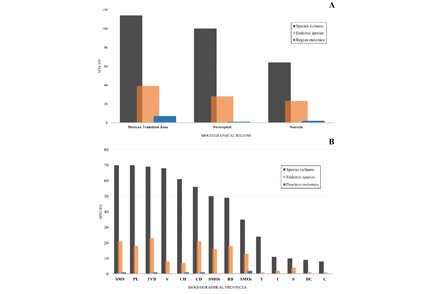
The spatial distribution of the species richness is not aleatory. It responds to evolutionary, geographical, and climatic events, and it is important to establish biodiversity management and conservation priorities. The mountainous zones around the globe have been identified as centers of plant diversification. In Mexico, the Mexican Transition Zone (MTZ) which comprises the main mountainous chains is recognized as an area of high species richness and endemism. The genus Solanum (Solanaceae) includes 1228 accepted species distributed all over the world, but with centers of species richness and endemism in the neotropical mountains. Based on patterns observed in geographical distribution of Mexican biodiversity, we expect the MTZ to host the highest species richness and endemism of Solanum. Here, we evaluated the spatial distribution of the species richness and endemism of Solanum in Mexico. For that purpose, we used 10043 unique georeferenced records obtained from herbarium specimens, specimens cited in literature and electronic databases. Then, we quantified species richness and endemism using biogeographical regions and provinces, a grid-cell of 50 × 50 km, political division, vegetation types, elevational, latitudinal, as well as longitudinal gradients. In addition, we analyzed endemism through weighted endemism and corrected weighted endemism. In Mexico, there were 134 species of Solanum including 43 endemics. The species richness and endemism were concentrated along the MTZ, specifically in the Chiapas Highlands, Sierra Madre del Sur (SMS), and Transmexican Volcanic Belt (TVB). Eight cells containing 63.43% of the species were obtained in the grid-cell analysis. The species richness distribution assessment by vegetation type, elevation, and political division confirmed the MTZ as the richest region. Likewise, the endemism was found along the MTZ in the Sierra Madre Oriental, SMS, TVB as well as in Chihuahuan Desert. Complex geological and paleoclimatic history, irregular topography, current climate diversity, dispersal, and persistence influenced these patterns. Lastly, we confirmed the remarkable importance of the MTZ as a center of origin, diversification and endemism of Mexican plants, using one of the most representative genera in Mexico.
References
Anguiano-Constante, M.A., Dean, E., Thomas, S., Rodríguez, A. & Munguía-Lino, G. (2021) Diversity, species richness distribution and centers of endemism of Lycianthes (Capsiceae, Solanaceae) in Mexico. Phytotaxa 514: 39–60. https://doi.org/10.11646/phytotaxa.514.1.3
Anguiano-Constante, M.A., Munguía-Lino, G., Ortiz, E., Villaseñor, J.L. & Rodríguez, A. (2018) Riqueza, distribución geográfica y conservación de Lycianthes serie Meizonodontae (Capsiceae, Solanaceae). Revista Mexicana de Biodiversidad 89: 516–529. https://doi.org/10.22201/ib.20078706e.2018.2.2340
Antonelli, A., Kissling, W.D., Flantua, S.G.A., Bermúdez, M.A., Mulch, A., Muellner-Riehl, A.N., Kreft, H., Linder, H.P., Badgley, C., Fjeldså, J., Fritz, S.A., Rahbek, C., Herman, F., Hooghiemstra, H. & Hoorn, C. (2018) Geological and climatic influences on mountain biodiversity. Nature Geoscience 11: 718–725. https://doi.org/10.1038/s41561-018-0236-z
Aragón-Parada, J., Carrillo-Reyes, P., Rodríguez, A. & Munguía-Lino, G. (2019) Diversidad y distribución geográfica del género Sedum (Crassulaceae) en la Sierra Madre del Sur, México. Revista Mexicana de Biodiversidad 90: 1–17. https://doi.org/10.22201/ib.20078706e.2019.90.2921
Aragón-Parada, J., Rodríguez, A., Munguía-Lino, G., De-Nova, J.A., Salinas-Rodríguez, M.M. & Carrillo-Reyes, P. (2021) Endemic vascular plants of the Sierra Madre del Sur, Mexico. Botanical Sciences 99: 643–660. https://doi.org/10.17129/BOTSCI.2682
Barthlott, W., Mutke, J., Rafiqpoor, D.M., Kier, G. & Kreft, H. (2005) Global centers of vascular plant diversity. Nova Acta Leopoldina NF 92: 61–83.
Bloom, T.D.S., Flower, A. & DeChaine, E.G. (2017) Why georeferencing matters: Introducing a practical protocol to prepare species occurrence records for spatial analysis. Ecology and Evolution 8: 765–777. https://doi.org/10.1002/ece3.3516
Carrasco-Ortiz, M., Munguía-Lino, G., Castro-Castro, A., Vargas-Amado, G., Harker, M. & Rodríguez, A. (2019) Riqueza, distribución geográfica y estado de conservación del género Dahlia (Asteraceae) en México. Acta Botanica Mexicana 2018: 1–24. https://doi.org/10.21829/abm126.2019.1354
Castro-Castro, A., Zavala-Pérez, J.G. & Cruz-Durán, R. (2020) The genus Manfreda (Asparagaceae; Agavoideae) in Guerrero, Mexico: richness, distribution and the description of a new species. Botanical Sciences 98: 612–623. https://doi.org/10.17129/botsci.2601
Clark, J.L., Nee, M., Bohs, L. & Knapp, S. (2015) A revision of Solanum section Aculeigerum (the Solanum wendlandii group, Solanaceae). Systematic Botany 40: 1102–1136. https://doi.org/10.1600/036364415X690148
Contreras-Medina, R. & Luna-Vega, I. (2007) Species richness, endemism and conservation of Mexican gymnosperms. Biodiversity and Conservation 16: 1803–1821. https://doi.org/10.1007/s10531-006-9072-3
Cruz-Cárdenas, G., Villaseñor, J.L., López-Mata, L. & Ortiz, E. (2013) Distribución espacial de la riqueza de especies de plantas vasculares en México. Revista Mexicana de Biodiversidad 84: 1189–1199. https://doi.org/10.7550/rmb.31811
Cuéllar-Martínez, M. & Sosa, V. (2016) Diversity patterns of monocotiledonous geophytes in Mexico. Botanical Sciences 94: 687–699. https://doi.org/10.17129/botsci.763
Cuevas-Guzmán, R. & Núñez-López, N.M. (2015) Solanum edmundoi (Solanaceae), una especie nueva de bejuco con aguijones del occidente de México. Revista Mexicana de Biodiversidad 86: 293–297. https://doi.org/10.1016/j.rmb.2015.04.014
Dupin, J., Matzke, N.J., Särkinen, T., Knapp, S., Olmstead, R.G., Bohs, L. & Smith, S.D. (2016) Bayesian estimation of the global biogeographical history of the Solanaceae. Journal of Biogeography 44: 887–899. https://doi.org/10.1111/jbi.12898
Echeverría-Londoño, S., Särkinen, T., Fenton, I.S., Purvis, A. & Knapp, S. (2020) Dynamism and context-dependency in diversification of the megadiverse plant genus Solanum (Solanaceae). Journal of Systematics and Evolution 58: 767–782. https://doi.org/10.1111/jse.12638
Escalante, T., Rodríguez, G. & Morrone, J.J. (2004) The diversification of Nearctic mammals in the Mexican transition zone. Biological Journal of the Linnean Society 83: 327–339. https://doi.org/10.1111/j.1095-8312.2004.00386.x
Escobedo-López, D., Campos-Rojas, E., Rodríguez-Núñez, J.R., Alia-Tejacal, I. & Núñez-Colín, C.A. (2019) Priority areas to collect germplasm of Annona (Annonaceae) in Mexico based on diversity and species richness indices. Genetic Resources and Crop Evolution 66: 401–413. https://doi.org/10.1007/s10722-018-0718-2
Espinosa, D., Ocegueda-Cruz, S. & Luna-Vega, I. (2016) Introducción al estudio de la Biodiversidad de la Sierra Madre del Sur: Una visión general. In: Luna-Vega, I., Espinosa, D., Contreras-Medina, R. (Eds.) Biodiversidad de la Sierra Madre del Sur: Una síntesis preliminar. Universidad Nacional Autónoma de México, Ciudad de México, pp. 23–36.
Fa, J.E. & Morales, L.M. (1991) Mammals and protected areas in the Trans-Mexican Neovolcanic Belt. In: Mares, M.L. & Schmidly, D.J. (Eds.) Latin American mammalogy: history, diversity and conservation. University of Oklahoma Press, Norman U.S.A., pp. 199–226.
Ferrari, L., Orozco-Esquivel, T., Manea, V. & Manea, M. (2012) The dynamic history of the Trans-Mexican Volcanic Belt and the Mexico subduction zone. Tectonophysics 522–523: 122–149. https://doi.org/10.1016/j.tecto.2011.09.018
Fischer, A.G. (1959) Latitudinal variations in organic diversity. Evolution 14: 64–81.
Frodin, D.G. (2004) History and concepts of big plant genera. Taxon 53: 753–776.
Gagnon, E., Hilgenhof, R., Orejuela, A., McDonell, A., Sablok, G., Aubriot, X., Giacomin, L., Gouvêa, Y., Bragionis, T., Stehmann, J.R., Bohs, L., Dodsworth, S., Martine, C., Poczai, P., Knapp, S., Särkinen, T. (2022) Phylogenomic discordance suggests polytomies along backbone of the large genus Solanum. American Journal of Botany 109: 580–601.
García-Martínez, M.A. (2018) Taxonomía, riqueza y distribución geográfica de Calochortus sección Cyclobothra (Liliaceae). Universidad de Guadalajara. Guadalajara, 91 pp.
Garcia-Milagros, E. & Funk, V.A. (2010) Improving the use of information from museum specimens: Using Google Earth© to georeference Guiana Shield specimens in the US National Herbarium. Frontiers of Biogeography 2: 71–77. https://doi.org/10.21425/f5fbg12348
GBIF (2020) The Global Biodiversity Information Facility. Available from: https://www.gbif.org/ (accessed 5 July 2020)
Gebrehiwot, K., Demissew, S., Woldu, Z., Fekadu, M., Desalegn, T. & Teferi, E. (2019) Elevational changes in vascular plants richness, diversity, and distribution pattern in Abune Yosef mountain range, Northern Ethiopia. Plant Diversity 41: 220–228. https://doi.org/10.1016/j.pld.2019.06.005
Hagen, O., Skeels, A., Onstein, R.E., Jetz, W. & Pellissier, L. (2021) Earth history events shaped the evolution of biodiversity across tropical rainforests. Pnas 118: 1–11. https://doi.org/10.1073/pnas.2026347118
Hijmans, R.J. & Spooner, D.M. (2001) Geographic distribution of wild potato species. American Journal of Botany 88: 2101–2112. https://doi.org/10.2307/3558435
Hijmans, R.J., Guarino, L., Bussink, C., Mathur, P., Cruz, M., Berrantes, I. & Rojas, E. (2004) DIVA-GIS versión 4. Un sistema de información geográfica para el análisis de distribución de especies: Manual. Lima, Perú: Centro Internacional de la Papa, Instituto Internacional de Recursos Genéticos Vegetales.
Hoorn, C., Mosbrugger, V., Mulch, A. & Antonelli, A. (2013) Biodiversity from mountain building. Nature Geoscience 6: 154. https://doi.org/10.1038/ngeo1742
Hughes, C.E. & Atchison, G.W. (2015) The ubiquity of alpine plant radiations: from the Andes to the Hengduan Mountains. New Phytologist 207: 275–282. https://doi.org/10.1111/nph.13230
INEGI (2000) Catálogo único de claves de áreas geoestadísticas estatales, municipales y localidades. Available from: https://www.inegi.org.mx/app/ageeml/ (accessed 25 November 2020)
Knapp, S. (2002) Solanum section Geminata (Solanaceae). Flora Neotropica 84: 1–404.
Knapp, S. (2013) A revision of the Dulcamaroid clade of Solanum L.(Solanaceae). PhytoKeys 22: 1–428. https://doi.org/10.3897/phytokeys.22.4041
Knapp, S., Sagona, E., Carbonell, A.K.Z. & Chiarini, F. (2017) A revision of the Solanum elaeagnifolium clade (Elaeagnifolium clade; subgenus Leptostemonum, Solanaceae). PhytoKeys 84: 1–104. https://doi.org/10.3897/phytokeys.84.12695
König, C., Weigelt, P., Schrader, J., Taylor, A., Kattge, J. & Kreft, H. (2019) Biodiversity data integration—the significance of data resolution and domain. PLoS Biology 17: 1–16. https://doi.org/10.1371/journal.pbio.3000183
Laffan, S.W. & Crisp, M.D. (2003) Assessing endemism at multiple spatial scales, with an example from the Australian vascular flora. Journal of Biogeography 30: 511–520. https://doi.org/10.1046/j.1365-2699.2003.00875.x
Laffan, S.W., Lubarsky, E. & Rosauer, D.F. (2010) Biodiverse, a tool for the spatial analysis of biological and related diversity. Ecography 33: 643–647. https://doi.org/10.1111/j.1600-0587.2010.06237.x
Luna-Vega, I. (2008) Aplicaciones de la biogeografía histórica a la distribución de las plantas mexicanas. Revista Mexicana de Biodiversidad 79: 217–241. https://doi.org/10.22201/ib.20078706e.2008.001.523
Luna-Vega, I., Espinosa, D., Rivas, G. & Contreras-Medina, R. (2013) Geographical patterns and determinants of species richness in Mexico across selected families of vascular plants: implications for conservation. Systematics and Biodiversity 11: 237–256. https://doi.org/10.1080/14772000.2013.797517
Manish, K., Pandit, M.K., Telwala, Y., Nautiyal, D.C., Koh, L.P. & Tiwari, S. (2017) Elevational plant species richness patterns and their drivers across non-endemics, endemics and growth forms in the Eastern Himalaya. Journal of Plant Research 130: 829–844. https://doi.org/10.1007/s10265-017-0946-0
Mannion, P.D., Upchurch, P., Benson, R.B.J. & Goswami, A. (2014) The latitudinal biodiversity gradient through deep time. Trends in Ecology and Evolution 29: 42–50. https://doi.org/10.1016/j.tree.2013.09.012
Manos, P.S. & Hipp, A.L. (2021) An updated infrageneric classification of the north american oaks (Quercus subgenus Quercus): review of the contribution of phylogenomic data to biogeography and species diversity. Forests 12: 1–26. https://doi.org/10.3390/f12060786
Martínez-Camilo, R., Pérez-Farrera, M.Á. & Martínez-Meléndez, N. (2012) Listado de plantas endémicas y en riesgo de la Reserva de la Biósfera El Triunfo, Chiapas, México. Botanical Sciences 90: 263–285.
Martínez, M., Vargas-Ponce, O., Rodríguez, A., Chiang, F. & Ocegueda, S. (2017) Solanceae family in Mexico. Botanical Sciences 95: 131–145. https://doi.org/10.17129/botsci.658
Mastretta-Yanes, A., Moreno-Letelier, A., Piñero, D., Jorgensen, T.H. & Emerson, B.C. (2015) Biodiversity in the Mexican highlands and the interaction of geology, geography and climate within the Trans-Mexican Volcanic Belt. Journal of Biogeography 42: 1586–1600. https://doi.org/10.1111/jbi.12546
McCain, C.M. (2005) Elevational gradients in diversity of small mammals. Ecology 86: 366–372.
McFadden, I.R., Sandel, B., Tsirogiannis, C., Morueta-Holme, N., Svenning, J.C., Enquist, B.J. & Kraft, N.J.B. (2019) Temperature shapes opposing latitudinal gradients of plant taxonomic and phylogenetic ? diversity. Ecology Letters 22: 1126–1135. https://doi.org/10.1111/ele.13269
Mishler, B.D., Guralnick, R., Soltis, P.S., Smith, S.A., Soltis, D.E., Barve, N., Allen, J.M. & Laffan, S.W. (2020) Spatial phylogenetics of the North American flora. Journal of Systematics and Evolution 58: 393–405. https://doi.org/10.1111/jse.12590
Mittelbach, G.G., Schemske, D.W., Cornell, H.V., Allen, A.P., Brown, J.M., Bush, M.B., Harrison, S.P., Hurlbert, A.H., Knowlton, N., Lessios, H.A., McCain, C.M., McCune, A.R., McDade, L.A., McPeek, M.A., Near, T.J., Price, T.D., Ricklefs, R.E., Roy, K., Sax, D.F., Schluter, D., Sobel, J.M., Turelli, M. (2007) Evolution and the latitudinal diversity gradient: speciation, extinction and biogeography. Ecology Letters 10: 315–331. https://doi.org/10.1111/j.1461-0248.2007.01020.x
Mittermeier, R.A., Turner, W.R., Larsen, F.W., Brooks, T.M. & Gascon, C. (2011) Global Biodiversity Conservation: the critical role of hotspots. In: Zachos, F. & Habel, J. (eds.) Biodiversity Hotspots. Springer, Berlin, Heidelberg. https://doi.org/10.1007/978-3-642-20992-5_1
Morrone, J.J. (2019) Regionalización biogeográfica y evolución biótica de México: encrucijada de la biodiversidad del Nuevo Mundo. Revista Mexicana de Biodiversidad 90: 1–68. https://doi.org/10.22201/ib.20078706e.2019.90.2980
Morrone, J.J. (2020) The Mexican Transition Zone. A natural biogeographic laboratory to study biotic assembly. Springer, Mexico City, 191 pp.
Morrone, J.J., Escalante, T. & Rodríguez-Tapia, G. (2017) Mexican biogeographic provinces: Map and shapefiles. Zootaxa 4277: 277–279. https://doi.org/10.11646/zootaxa.4277.2.8
Munguía-Lino, G., Escalante, T., Morrone, J.J. & Rodríguez, A. (2016) Areas of endemism of the North American species of Tigridieae (Iridaceae). Australian Systematic Botany 29: 142–156. https://doi.org/10.1071/SB16002
Munguía-Lino, G., Vargas-Amado, G., Vázquez-García, L.M. & Rodríguez, A. (2015) Riqueza y distribución geográfica de la tribu Tigridieae (Iridaceae) en Norteamérica. Revista Mexicana de Biodiversidad 86: 80–98. https://dx.doi.org/10.7550/rmb.44083
Murillo-Pérez, G. & Rodríguez, A. (2021) Claves dicotómicas para las especies de Solanum (Solanaceae) en México. Botanical Sciences 99: 413–446. https://doi.org/10.17129/botsci.2713
Mutke, J. & Barthlott, W. (2005) Patterns of vascular plant diversity at continental to global scales. Biologiske Skrifter 55: 521–531.
Myers, N., Mittermeler, R.A., Mittermeler, C.G., Da Fonseca, G.A.B. & Kent, J. (2000) Biodiversity hotspots for conservation priorities. Nature 403: 853–858. https://doi.org/10.1038/35002501
Navarro-Siguenza, A., Lira-Noriega, A., Peterson, A. & Oliveras de Ita, A. (2007) Diversidad, endemismo y conservación de las aves. In: Luna, I., Morrone, J.J., Espinosa, D. (eds.) Biodiversidad de la Faja Volcánica Transmexicana. UNAM. México, D.F. pp. 461–483.
Nee, M. (1993) Solanaceae Parte II. Flora de Veracruz (Volume 72). Instituto de Ecología, A. C., México, Veracruz, Xalapa, 52 pp.
Noroozi, J., Talebi, A., Doostmohammadi, M., Rumpf, S.B., Linder, H.P. & Schneeweiss, G.M. (2018) Hotspots within a global biodiversity hotspot-areas of endemism are associated with high mountain ranges. Scientific Reports 8: 1–10. https://doi.org/10.1038/s41598-018-28504-9
Ohlemüller, R., Anderson, B.J., Araújo, M.B., Butchart, S.H.M., Kudrna, O., Ridgely, R.S. & Thomas, C.D. (2008) The coincidence of climatic and species rarity: high risk to small-range species from climate change. Biology Letters 4: 568–572. https://doi.org/10.1098/rsbl.2008.0097
Olmstead, R.G. (2013) Phylogeny and biogeography in Solanaceae, Verbenaceae and Bignoniaceae: a comparison of continental and intercontinental diversification patterns. Botanical Journal of the Linnean Society 171: 80–102. https://doi.org/10.1111/j.1095-8339.2012.01306.x
Olmstead, R.G., Bohs, L., Migid, H.A., Santiago-Valentin, E., Garcia, V.F. & Collier, S.M. (2008) A molecular phylogeny of the Solanaceae. Taxon 57: 1159–1181. https://doi.org/10.1002/tax.574010
Olmstead, R.G. & Palmer, J.D. (1997) Implications for the phylogeny, classification, and biogeography of Solanum from cpDNA restriction site variation. Systematic Botany 22: 19–29. https://doi.org/10.2307/2419675
Ortiz-Brunel, J.P., Munguía-Lino, G., Castro-Castro, A. & Rodríguez, A. (2021) Biogeographic analysis of the American genus Echeandia (Agavoideae: Asparagaceae). Revista Mexicana de Biodiversidad 92: 1–17. https://doi.org/10.22201/ib.20078706e.2021.92.3739
Pérez-Farrera, M.A. (2004) Flora y vegetación de la Reserva de la Biósfera El Triunfo: diversidad, riqueza y endemismo. In: Pérez-Farrera, M.A., Martínez-Meléndez, N., Hernández-Yáñez, A. & Arreola-Muñoz, A.V. (eds.) La Reserva de la Biósfera El Triunfo, Tras una Década de Conservación. Universidad de Ciencias y Artes de Chiapas, Tuxtla Gutiérrez, pp. 77–100.
QGIS Development Team (2016) QGIS Geographic Information System, version 3.4.5 Madeira. Open Source Geospatial Foundation Project. Available from: http://qgis.osgeo.org (accessed 6 Agust 2020).
Qian, H. (1998) Large-scale biogeographic patterns of vascular plant richness in North America: an analysis at the generic level. Journal of Biogeography 25: 829–836. https://doi.org/10.1046/j.1365-2699.1998.00247.x
Rahbek, C., Borregaard, M.K., Antonelli, A., Colwell, R.K., Holt, B.G., Nogues-Bravo, D., Rasmussen, C.M.Ø., Richardson, K., Rosing, M.T., Whittaker, R.J. & Fjeldså, J. (2019a) Building mountain biodiversity: Geological and evolutionary processes. Science 365: 1114–1119. https://doi.org/10.1126/science.aax0151
Rahbek, C., Borregaard, M.K., Colwell, R.K., Dalsgaard, B., Holt, B.G., Morueta-Holme, N., Nogues-Bravo, D., Whittaker, R.J. & Fjeldså, J. (2019b) Humboldt’s enigma: What causes global patterns of mountain biodiversity? Science 365: 1108–1113. https://doi.org/10.1126/science.aax0149
Rios, N.E. & Bart, H.L. (2010) GEOLocate (Version 3.22) [Computer software]. Belle Chasse, LA: Tulane University Museum of Natural History.
Rodríguez, A. (2015) Riqueza de papas silvestres (Solanum sección Petota) y patrones de distribución geográfica en México. Agroproductividad 8: 3–8. [https://revista-agroproductividad.org/index.php/agroproductividad/article/view/631]
Rodríguez, A., Castro-Castro, A., Vargas-Amado, G., Vargas-Ponce, O., Zamora-Tavares, P., González-Gallegos, J., Carrillo-Reyes, P., Anguiano-Constante, M., Carrasco-Ortiz, M., García-Martínez, M., Gutiérrez-Rodríguez, B., Aragón-Parada, J., Valdes-Ibarra, C. & Munguía-Lino, G. (2018) Richness, geographic distribution patterns, and areas of endemism of selected angiosperm groups in Mexico. Journal of Systematics and Evolution 56: 537–549. https://doi.org/10.1111/jse.12457
Ruiz-Sanchez, E., Munguía-Lino, G., Vargas-Amado, G. & Rodríguez, A. (2020) Diversity, endemism and conservation status of native Mexican woody bamboos (Poaceae: Bambusoideae: Bambuseae). Botanical Journal of the Linnean Society 192: 281–295. https://doi.org/10.1093/botlinnean/boz062
Rzedowski, J. (1978) Vegetación de México. Limusa. CDMX, 432 pp.
Rzedowski, J. (2015) Catálogo preliminar de plantas vasculares de distribución restringida a la Sierra Madre Oriental. In: Rzedowski, J. & Hernández-Ledesma, P. (eds.) Flora del Bajío y de Regiones Adyacentes. Instituto de Ecología A. C. Pátzcuaro, Michoacán, 36 pp.
Rzedowski, J. (2019) Los géneros de fanerógamas que, sin ser exclusivos de México, dan carácter a su flora. Revista Mexicana de Biodiversidad 90: 1–15. https://doi.org/10.22201/ib.20078706e.2019.90.2946
Rzedowski, J. (2020) Catálogo preliminar de especies de plantas vasculares de distribución restringida al Eje Volcánico Transversal. In: Rzedowski, J. & Hernández-Ledesma, P. (eds.) Flora del Bajío y de Regiones Adyacentes. Instituto de Ecología A. C. Pátzcuaro, Michoacán, 48 pp.
Salinas-Rodríguez, M.M., Estrada-Castillón, E. & Villarreal-Quintanilla, J.A. (2017) Endemic vascular plants of the Sierra Madre Oriental, Mexico. Phytotaxa 328: 1–52. https://doi.org/10.11646/phytotaxa.328.1.1
Santa María-Díaz, A. (2016) Aspectos geológicos de la Sierra Madre del Sur. In: Luna-Vega, I., Espinosa, D. & Contreras-Medina, R., Biodiversidad de la Sierra Madre del Sur: Una síntesis preliminar. Universidad Nacional Autónoma de México, Ciudad de México, pp. 39–65.
Särkinen, T., Bohs, L., Olmstead, R.G. & Knapp, S. (2013) A phylogenetic framework for evolutionary study of the nightshades (Solanaceae): a dated 1000-tip tree. BMC Evolutionary Biology 13: 214. https://doi.org/10.1186/1471-2148-13-214
SEINet (2020) Southwest Enviromental Information Network. Available from: https://swbiodiversity.org/ (accessed 6 Agust 2020)
Sharma, N., Behera, M.D., Das, A.P. & Panda, R.M. (2019) Plant richness pattern in an elevation gradient in the Eastern Himalaya. Biodiversity and Conservation 28: 2085–2104. https://doi.org/10.1007/s10531-019-01699-7
Solanaceae Source (2020) Solanaceae Source: a global taxonomic resource for the nightshade family. http://solanaceaesource.org (accessed 6 Agust 2020)
Sosa, V. & De-Nova, J.A. (2012) Endemic angiosperm lineages in México: hostpost for conservation. Acta Botanica Mexicana 100: 293–315.
Sosa, V., De-Nova, J.A. & Vásquez-Cruz, M. (2018) Evolutionary history of the flora of Mexico: dry forests cradles and museums of endemism. Journal of Systematics and Evolution 56: 523–536. https://doi.org/10.1111/jse.12416
Sosa, V. & Loera, I. (2017) Influence of current climate, historical climate stability and topography on species richness and endemism in Mesoamerican geophyte plants. PeerJ 10: 1–20. https://doi.org/10.7717/peerj.3932
Spooner, D.M., van den Berg, R.G., Rodríguez, A., Bamberg, J., Hijmans, R.J. & Lara-Cabrera, S.I. (2004) Wild potatoes (Solanum section Petota; Solanaceae) of North and Central America. Systematic Botany Monographs100: 1–240. https://doi.org/10.2307/25027915
Steinbauer, M., Grytnes, J.A., Jurasinski, G., Kulonen, A., Lenoir, J., Pauli, H., Rixen, C., Winkler, M., Bardy-Durchhalter, M., Barni, E., Bjorkman, A.D., Breiner, F.T., Burg, S., Czortek, P., Dawes, M.A., Delimat, A., Dullinger, S., Erschbamer, B., Felde, V.A., Frenández-Arberas, O., Fossheim, K.F., Gómez-García, D., Georges, D., Grindrud, E.T., Haider, S., Haugum, S.V., Henriksen, H., Herreros, M.J., Jaroszewicz, B., Jaroszynska, F., Kanka, R., Kapfer, J., Klanderud, K., Kühn, I., Lamprecht, A., Matteodo, M., Morra di Cella, U., Normand, S., Odland, A., Olsen, S.L., Palacio, S., Petey, M., Piscová, V., Sedlakova, B., Steinbauer, K., Stöckli, V., Svenning, J.-C., Teppa, G., Theurillat, J.-P., Vittoz, P., Woodin, S.J., Zimmermann, N.E. & Wipf, S. (2018) Accelerated increase in plant species richness on mountain summits is linked to warming. Nature 556: 231–246. https://doi.org/10.1038/s41586-018-0005-6
Steinmann, V.W., Arredondo-Amezcua, L., Hernández-Cárdenas, R.A. & Ramírez-Amezcua, Y. (2021) Diversity and origin of the central mexican alpine flora. Diversity 13: 1–25. https://doi.org/10.3390/d13010031
Suárez-Mota, M.E., Téllez-Valdés, O., Lira-Saade, R. & Villaseñor, J. (2013) Una regionalización de la Faja Volcánica Transmexicana con base en su riqueza florística. Botanical Sciences 91: 93–105. https://doi.org/10.17129/botsci.405
Sullivan, D. (2009) Google Earth Pro. EContent 32: 16–18.
Thiers, B. (2020) Index herbariorum: a global directory of public herbaria and associated staff. New York Botanical Garden’s Virtual Herbarium. Available from: http://sweetgum.nybg.org/science/ih/ (accessed 10 October 2020)
Torres-Miranda, A., Luna-Vega, I. & Oyama, K. (2011) Conservation biogeography of red oaks (Quercus section Lobatae) in Mexico and Central America. American Journal of Botany 98: 290–305. https://doi.org/10.3732/ajb.1000218
Toledo, V.M. (1982) Pleistocene changes of vegetation in tropical México. In: Prance, G.T. (Ed.) Biological diversification in the tropics. Columbia University Press, New York, pp. 93–111.
Tovar, J.D., André, T., Wahlert, G.A., Bohs, L. & Giacomin, L.L. (2021) Phylogenetics and historical biogeography of Solanum section Brevantherum (Solanaceae). Molecular Phylogenetics and Evolution 162: 1–11. https://doi.org/10.1016/j.ympev.2021.107195
Tropicos (2020) Missouri Botanical Garden. Saint Louis, Missouri. Available from: https://tropicos.org/ (accessed 10 September 2020)
Valencia-A., S. (2004) Diversidad del género Quercus (Fagaceae) en México. Botanical Sciences 75: 33–53. https://doi.org/10.17129/botsci.1692
Vargas-Amado, G., Castro-Castro, A., Harker, M., Villaseñor, J.L., Ortiz, E. & Rodríguez, A. (2013) Geographic distribution and richness of the genus Cosmos (Asteraceae: Coreopsideae). Revista Mexicana de Biodiversidad 84: 536–555. https://doi.org/10.7550/rmb.31481
Vetaas, O.R. & Grytnes, J.-A. (2002) Distribution of vascular plant species richness and endemic richness along the Himalayan elevation gradient in Nepal. Global Ecology and Biogeography 11: 291–301. https://doi.org/10.1046/j.1466-822X.2002.00297.x
Villa-Vázquez, J.L. & Rodríguez, A. (2011) Cultivo de papas silvestres Solanum cardiophyllum y S. ehrenbergii en San Ignacio, municipio de Villa Hidalgo, Jalisco, México. Revista de Geografía Agrícola 46–47: 19–27. [https://www.redalyc.org/articulo.oa?id=75729625003]
Villarreal-Quintanilla, J.A., Bartolomé-Hernández, J.A., Estrada-Castillón, E., Ramírez-Rodríguez, H. & Martínez-Amador, S.J. (2017) El elemento endémico de la flora vascular del Desierto Chihuahuense. Acta Botanica Mexicana 118: 65–96. https://doi.org/10.21829/abm118.2017.1201
Villaseñor, J.L. (2016) Checklist of the native vascular plants of Mexico. Revista Mexicana de Biodiversidad 87: 559–902. https://doi.org/10.1016/j.rmb.2016.06.017
Villaseñor, J.L. & Ortiz, E. (2014) Biodiversidad de las plantas con flores (División Magnoliophyta) en México. Revista Mexicana de Biodiversidad 85: 134–142. https://doi.org/10.7550/rmb.31987
Whittaker, R.J., Araújo, M.B., Jepson, P., Ladle, R.J., Watson, J.E.M. & Willis, K.J. (2005) Conservation biogeography: assessment and prospect. Diversity and Distributions 11: 3–23. https://doi.org/10.1111/j.1366-9516.2005.00143.x
Zavala-Chávez, F. (1998) Observaciones sobre la ditribución de encinos en México. Polibotánica 8: 47–64.
Zunino, M. & Zullini, A. (2003) Biogeografía. La dimensión espacial de la evolución. Fondo de Cultura Económica, México, 359 pp.