
Abstract
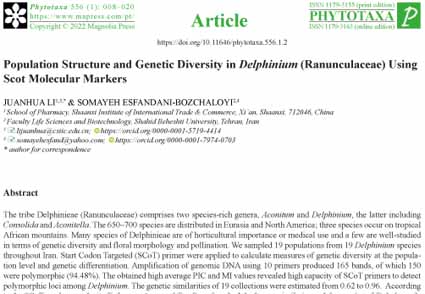
The tribe Delphinieae (Ranunculaceae) comprises two species-rich genera, Aconitum and Delphinium, the latter including Consolida and Aconitella. The 650–700 species are distributed in Eurasia and North America; three species occur on tropical African mountains. Many species of Delphinieae are of horticultural importance or medical use and a few are well-studied in terms of genetic diversity and floral morphology and pollination. We sampled 19 populations from 19 Delphinium species throughout Iran. Start Codon Targeted (SCoT) primer were applied to calculate measures of genetic diversity at the population level and genetic differentiation. Amplification of genomic DNA using 10 primers produced 165 bands, of which 150 were polymorphic (94.48%). The obtained high average PIC and MI values revealed high capacity of SCoT primers to detect polymorphic loci among Delphinium. The genetic similarities of 19 collections were estimated from 0.62 to 0.96. According to the SCoT markers analysis, D. lorestanicum and D. oliganthum had the lowest similarity and the species of D. hohenackeri and D. ajacis had the highest similarity.
References
Aarssen LW. (2000) Why are most selfers annuals? A new hypothesis for the fitness benefit of selfing. Oikos 89: 606–612. https://doi.org/10.1034/j.1600-0706.2000.890321.x
Boissier, E. (1867) Flora Orientalis, vol. 1. Basel: H. Georg.
Brütting, Christine, Wesche, Karsten; Meyer, Stefan & Hensen, I. (2012) Genetic diversity of six arable plants in relation to their Red List status. Biodiversity and Conservation 21: 745–761. https://doi.org/10.1007/s10531-011-0212-z
Collard, B.C.Y. & Mackill, D.J. (2009) Start codon targeted (SCoT) polymorphism: a simple novel DNA marker technique for generating gene-targeted markers in plants. Plant Molecular Biology Report 27: 86–93. https://doi.org/10.1007/s11105-009-0118-z
Charlesworth, D. (2003) Effects of Inbreeding on the Genetic Diversity of Populations. Philosophical Transactions: Biological Sciences 358 (1434): 1051–1070. [http://www.jstor.org/stable/3558250]
De Candolle, A.P. (1824) Prodromus Systematis Naturalis Regni Vegetabilis. Vol. 2. Paris, Strasbourg, London.
Esfandani-Bozchaloyi, S. & Sheidai, M. (2019) Comparison Of Dna Extraction Methods From Geranium (Geraniaceae). Acta Botanica Hungarica 61 (3–4): 251–266. https://doi.org/10.1556/034.61.2019.3-4.3
Esfandani Bozchaloyi, S., Sheidai, M., Keshavarzi, M. & Noormohammadi, Z. (2017a) Genetic diversity and morphological variability in Geranium purpureum Vill. (Geraniaceae) Of Iran. Genetika 49: 543–557.
Esfandani Bozchaloyi, S., Sheidai, M., Keshavarzi, M. & Noormohammadi, Z. (2017b) Species delimitation in Geranium Sect. Batrachioidea: Morphological and molecular. Acta Botanica Hungarica 59 (3–4): 319–334. https://doi.org/10.1556/034.59.2017.3-4.3
Esfandani Bozchaloyi, S., Sheidai, M., Keshavarzi, M. & Noormohammadi, Z. (2017c) Genetic and morphological diversity in Geranium dissectum (Sec. Dissecta, Geraniaceae) populations. Biologia 72 (10): 1121–1130. https://doi.org/10.1515/biolog-2017-0124
Esfandani Bozchaloyi, S., Sheidai, M., Keshavarzi, M. & Noormohammadi, Z. (2017d) Analysis of genetic diversity in Geranium robertianum by ISSR markers. Phytologia Balcanica 23 (2): 157–166.
Esfandani Bozchaloyi, S., Sheidai, M., Keshavarzi, M. & Noormohammadi, Z. (2018a) Species Relationship and Population Structure Analysis In Geranium Subg. Robertium (Picard) Rouy with The Use of ISSR Molecular Markers. Acta Botanica Hungarica 60 (1–2): 47–65. https://doi.org/10.1556/034.60.2018.1-2.4
Esfandani Bozchaloyi, S., Sheidai, M., Keshavarzi, M. & Noormohammadi, Z. (2018b) Species identification and population structure analysis in Geranium Subg. Geranium (Geraniaceae). Hacquetia 17/2: 235–246. https://doi.org/10.1515/hacq-2017-0007
Esfandani Bozchaloyi, S., Sheidai, M., Keshavarzi, M. & Noormohammadi, Z. (2018c) Morphometric and ISSR-analysis of local populations of Geranium molle L. from the southern coast of the Caspian Sea. Cytology and Genetics 52 (4): 309–321. https://doi.org/10.3103/S0095452718040102
Evanno, G., Regnaut, S. & Goudet, J. (2005) Detecting the number of clusters of individuals using the software STRUCTURE: a simulation study. Molecular Ecology 14: 2611–2620. https://doi.org/10.1111/j.1365-294X.2005.02553.x
Freeland, J.R., Kirk, H. & Peterson, S.D. (2011) Molecular Ecology 2<sup>nd</sup> ed. Wiley-Blackwell, UK, 449 pp. https://doi.org/10.1002/9780470979365
Gholamin, R. & Khayatnezhad, M. (2020a) Assessment of the Correlation between Chlorophyll Content and Drought Resistance in Corn Cultivars (Zea Mays). Helix 10 (05): 93–97. https://doi.org/10.29042/2020-10-5-93-97
Gholamin, R. & Khayatnezhad, M. (2020b) The effect of dry season stretch on Chlorophyll Content and RWC of Wheat Genotypes (Triticum Durum L.). Bioscience Biotechnology Research Communications 13 (4): 1833–1829. https://doi.org/10.21786/bbrc/13.4/28
Gholamin, R. & Khayatnezhad, M. (2020c) Study of Bread Wheat Genotype Physiological and Biochemical Responses to Drought Stress. Helix 10 (05): 87–92. https://doi.org/10.29042/2020-10-5-87-92
Guo, L.-N., She, C., Kong, D.-B., Yan, S.-L., Xu, P., Khayatnezhad, M. & Gholinia, F. (2021) Prediction of the effects of climate change on hydroelectric generation, electricity demand, and emissions of greenhouse gases under climatic scenarios and optimized ANN model. Energy Reports 7: 5431–5445. https://doi.org/10.1016/j.egyr.2021.08.134
Gray, S.F. (1821) A natural arrangement of British plants. vol. 2. London.
Hong, De-Y. (1986) Biosystematic observation on 5 species of Consolida (Ranunculaceae). Acta Botanica Sinica 28: 1–10.
Hou, R., Li, S., Wu, M., Ren, G., Gao, W., Khayatnezhad, M. & Gholinia, F. (2021) Assessing of impact climate parameters on the gap between hydropower supply and electricity demand by RCPs scenarios and optimized ANN by the improved Pathfinder (IPF) algorithm. Energy 237: 601–621. https://doi.org/10.1016/j.energy.2021.121621
Huang, D., Wang, J. & Khayatnezhad, M. (2021) Estimation of Actual Evapotranspiration Using Soil Moisture Balance and Remote Sensing. Iranian Journal of Science and Technology, Transactions of Civil Engineering 45: 2779–2786. https://doi.org/10.1007/s40996-020-00575-7
Hammer, Ø., Harper, Dat. & Ryan, P.D. (2001) PAST: Paleontological Statistics software package for education and data analysis. Palaeontologia Electronica 4: 1?9.
Iranshahr, M., Rechinger f., K.H. & Riedl, H. (1992) Delphinium L. (Ranunculaceae). In: Rechinger, K.H. (Ed.) Flora Iranica. no. 171: Akademische Druckund-Verlagsanstalt, Graz, pp. 89–114.
Jia, Y., Khayatnezhad, M. & Mehri, S. (2020) Population differentiation and gene flow in Rrodium cicutarium: A potential medicinal plant. Genetika 52 (3): 1127–1144. https://doi.org/10.2298/GENSR2003127J
Jabbour, F. & Renner, S.S. (2011) Consolida and Aconitella are an annual clade of Delphinium (Ranunculaceae) that diversified in the Mediterranean basin and the Irano-Turanian region. Taxon 60: 1029–1040. https://doi.org/10.1002/tax.604007
Jabbour, F. & Renner, S. (2012) A phylogeny of Delphinieae (Ranunculaceae) shows that Aconitum is nested within Delphinium and that Late Miocene transitions to long life cycles in the Himalayas and Southwest China coincide with bursts in diversification. Molecular Phylogenetic Evolution 62: 928–942. https://doi.org/10.1016/j.ympev.2011.12.005
Karasakal, A., Khayatnezhad, M. & Gholamin, R. (2020a) The Durum Wheat Gene Sequence Response Assessment of Triticum durum for Dehydration Situations Utilizing Different Indicators of Water Deficiency. Bioscience Biotechnology Research Communications 13 (4): 2050–2057. https://doi.org/10.21786/bbrc/13.4/62
Karasakal, A., Khayatnezhad, M. & Gholamin, R. (2020b) The Effect of Saline, Drought, and Presowing Salt Stress on Nitrate Reductase Activity in Varieties of Eleusine coracana (Gaertn). Bioscience Biotechnology Research Communications 13 (4): 2087–2091. https://doi.org/10.21786/bbrc/13.4/68
Khayatnezhad, M. & Gholamin, R. (2020) Study of Durum Wheat Genotypes’ Response to Drought Stress Conditions. Helix 10 (05): 98–103. https://doi.org/10.29042/2020-10-5-98-103
Khayatnezhad, M. & Gholamin, R. (2021a) The Effect of Drought Stress on the Superoxide Dismutase and Chlorophyll Content in Durum Wheat Genotypes. Advancements in Life Sciences 8 (2): 119–123.
Khayatnezhad, M. & Gholamin, R. (2021b) Impacts of Drought Stress on Corn Cultivars (Zea mays L.) At the Germination Stage. Bioscience Research 18 (1): 409–414.
Leimu, R., Vergeer, P., Angeloni, F. & Ouborg, N.J. (2010) Habitat fragmentation, climate change and inbreeding in plants. Annals of the New York Academy of Sciences 1195: 84–98. https://doi.org/10.1111/j.1749-6632.2010.05450.x
Ma, S., Khayatnezhad, M. & Minaeifar, A.A. (2021b) Genetic diversity and relationships among Hypericum L. species by ISSR Markers: A high value medicinal plant from Northern of Iran. Caryologia 74 (1): 97–107. https://doi.org/10.36253/caryologia-968
Nybom, H. (2004) Comparison of different nuclear DNA markers for estimating intraspecific genetic diversity in plants. Molecular and Ecology 13: 1143–1155. https://doi.org/10.1111/j.1365-294X.2004.02141.x
Orellana, M.R., Blanché, C., Simon, J. & Bosch, M. (2009) Genetic diversity within and among disjunct populations of the Mediterranean Island endemic Delphinium pictum and D. requienii (Ranunculaceae). Folia Geobotanic 44: 47–63. https://doi.org/10.1007/s12224-009-9028-y
Potts, G.R., Ewald, J.A. & Aebischer, N.J. (2010a) Long-term changes in the flora of the cereal ecosystem on the Sussex Downs, England, focusing on the years 1968–2005. Journal of Applied Ecology 47: 215–226. https://doi.org/10.1111/j.1365-2664.2009.01742.x
Peakall, R. & Smouse, P.E. (2006) GENALEX 6: genetic analysis in Excel. Population genetic software for teaching and research. Molecular Ecology Notes 6: 288–295. https://doi.org/10.1111/j.1471-8286.2005.01155.x
Peng, X., Khayatnezhad, M. & Ghezeljehmeidan, L. (2021) Rapd profiling in detecting genetic variation in stellaria l. (caryophyllaceae). Genetika 53 (1): 349–362. https://doi.org/10.2298/GENSR2101349P
Podani, J. (2000) Introduction to the Exploration of Multivariate Data English translation. Backhuyes Publisher, Leide, 407 pp.
Ren, J. & Khayatnezhad, M. (2021) Evaluating the stormwater management model to improve urban water allocation system in drought conditions. Water Supply 21 (4): 1514–1524. https://doi.org/10.2166/ws.2021.027
Si, X., Gao, L. Song, Y. Khayatnezhad, M. & Minaeifar, A.A. (2020) Understanding population differentiation using geographical, morphological and genetic characterization in Erodium cicunium. Indian Journal of Genetic 80 (4): 459–467. https://doi.org/10.31742/IJGPB.80.4.12
Sun, Q., Lin, D., Khayatnezhad, M. & Taghavi, M. (2021) Investigation of phosphoric acid fuel cell, linear Fresnel solar reflector and Organic Rankine Cycle polygeneration energy system in different climatic conditions. Process Safety and Environmental Protection 147: 993–1008. https://doi.org/10.1016/j.psep.2021.01.035
Sun, X. & Khayatnezhad, M. (2021) Fuzzy-probabilistic modeling the flood characteristics using bivariate frequency analysis and ?-cut decomposition. Water Supply 21 (8): 4391–4403. https://doi.org/10.2166/ws.2021.186
Svensson, R. & Wigren, M. (1986) History and biology of Consolida regalis in Sweden. Svensk Botanisk Tidskrift 80: 31–53.
Sivaprakash, K.R., Prasanth, S.R., Mohanty, B.P. & Parida, A. (2004) Genetic diversity of black gram landraces as evaluated by AFLP markers. Current Science 86: 1411–1415.
Turabekova, M.A., Rasulev, B.F., Dzhakhangirov, F.N., Leszczynska, D., Leszczynski, J., (2010) Aconitum and Delphinium alkaloids of curare-like activity. QSAR analysis and molecular docking of alkaloids into AChBP. European Journal of Medicinal Chemistry 45: 3885–3894. https://doi.org/10.1016/j.ejmech.2010.05.042
Tamura, M. (1966) Morphology, ecology and phylogeny of the Ranunculaceae VI. Science Reports South College, North College, Osaka University 15: 13–35.
Trifonova, VI. (1990) Comparative biomorphological study of the taxonomy and phylogeny of the genera Consolida (DC.) S.F. Gray and Aconitella Spach. Collect Bot (Barcelona) 19: 97–110. https://doi.org/10.3989/collectbot.1990.v19.119
Tams, S.H., Melchinger, A.E. & Bauer, E. (2005) Genetic similarity among European winter triticale elite germplasms assessed with AFLP and comparisons with SSR and pedigree data. Plant Breeding 124: 154–160. https://doi.org/10.1111/j.1439-0523.2004.01047.x
Wang, C., Shang, Y. & Khayatnezhad, M. (2021) Fuzzy Stress-based Modeling for Probabilistic Irrigation Planning Using Copula-NSPSO. Water Resources Management 35 (14): 4943–4959. https://doi.org/10.1007/s11269-021-02981-6
Yin, J., Khayatnezhad, M. & Shakoor, A. (2021) Evaluation Of Genetic Diversity In Geranium (Geraniaceae) Using Rapd Marker. Genetika 53 (1): 363–378. https://doi.org/10.2298/GENSR2101363Y
Zheng, R., Zhao, S. Khayyatnezhad, M. & Afzal Shah, S. (2021) Comparative study and genetic diversity in Salvia (Lamiaceae) using RAPD Molecular Markers. Caryologia 74 (2): 45–56. https://doi.org/10.36253/caryologia-1236
Zhu, K., Liu, L. Li, S. Li, B., Khayatnezhad, M. & Shakoor, A. (2021) Morphological method and molecular marker determine genetic diversity and population structure in Allochrusa. Caryologia 74 (2): 121–130. https://doi.org/10.36253/caryologia-958