

Abstract
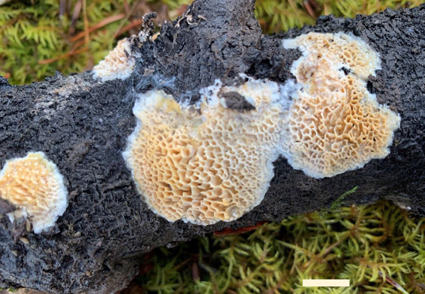
A new poroid fungus in the family Steccherinaceae, Antella tibetica sp. nov., is described from southwest China based on morphology, and phylogenetic analysis. The species was found in the Tibet Autonomous Region of southwest China, growing on angiosperm wood of a low decay stage. It is characterized by an annual growth habit, resupinate basidiocarps with buff yellow to yellowish brown pores, 0.5–1.5 per mm, a dimitic hyphal system composed of clamped generative hyphae and subicular skeletal hyphae encrusted with fine crystals, abundant gloeocystidia that are variable in shape, and oblong-ellipsoid basidiospores. The phylogenetic analysis based on ITS + nLSU rDNA sequences shows that A. tibetica nests in Antella, forming a monophyletic lineage with strong support (100 % BS, 100 % BP, 1.00 BPP). The differences between A. tibetica and other members of the genus are discussed. A key to accepted species of Antella is provided.
References
Felsenstein, J. (1985) Confidence intervals on phylogenetics: an approach using bootstrap. Evolution 39: 783–791. https://doi.org/10.2307/2408678
Fiasson, J.L. & Niemelä, T. (1984) The Hymenochaetales: a revision of the European poroid taxa. Karstenia 24: 14–28. https://doi.org/10.29203/ka.1984.224
Gilbertson, R.L. & Ryvarden, L. (1986) North American polypores 1. Abortiporus – Lindtneria. Oslo. pp 1–433.
Hall, T.A. (1999) Bioedit: A user-friendly biological sequence alignment editor and analysis program for Windows 95/98/NT. Nucleic Acids Symposium Series 41: 95–98.
Katoh, K. & Toh, H. (2008) Recent developments in the MAFFT multiple sequence alignment program. Briefings in bioinformatics 9: 286–298. https://doi.org/10.1093/bib/bbn013
Kout, J., Vlasák, J. & Spirin, V. (2014) Contribution to the Antrodiella americana species complex (Basidiomycota, Polyporales). Czech Mycology 66: 53–60.
Liu, Z.B. & Dai, Y.C. (2021) Steccherinum fragile sp. nov. and S. subcollabens comb. nov. (Steccherinaceae, Polyporales), evidenced by morphological characters and phylogenetic analysis. Phytotaxa 483 (2): 106–116. https://doi.org/10.11646/phytotaxa.483.2.3
Liu, Z.B. & Yuan, Y. (2020) Luteoporia citriniporia sp. nov. (Polyporales, Basidiomycota), evidenced by morphological characters and phylogenetic analysis. Phytotaxa 461 (1): 31–39. https://doi.org/10.11646/phytotaxa.461.1.4
Liu, Z.B., Zhou, M., Yuan, Y. & Dai, Y.C. (2021) Global diversity and taxonomy of Sidera (Hymenochaetales, Basidiomycota): Four new species and keys to species of the genus. Journal of Fungi 7: 251. https://doi.org/10.3390/jof7040251
Maddison, W.P. & Maddison, D.R. (2010) Mesquite: A modular system for evolutionary analysis. Evolution 11 (5).
Miettinen, O., Niemelä, T. & Spirin, W. (2006) Northern Antrodiella species: the identity of A. semisupina, and type studies of related taxa. Mycotaxon 96: 211–239.
Miettinen, O. & Ryvarden, L. (2016) Polypore genera Antella, Austeria, Butyrea, Citripora, Metuloidea and Trulla (Steccherinaceae, Polyporales). Ann. Bot. Fennici 53: 157–172.
Miller, M.A., Holder, M.T., Vos, R., Midford, P.E., Liebowitz, T., Chan, L., Hoover, P. & Warnow, T. (2009) The CIPRES Portals. CIPRES. Homepage from: http://www.phylo.org/sub_sections/portal (accessed 4 August 2009) [Archived by WebCite® at: http://www.webcitation.org/5 imQlJeQa)122]
Niemelä, T. (1998) The Skeletocutis subincarnata complex (Basidiomycetes), a revision. Acta Botanica Fennica 161: 1–35.
Nylander, J.A.A. (2004) MrModeltest v2. Program distributed by the author. Evolutionary Biology Centre, Uppsala University.
Petersen, J.H. (1996) The Danish Mycological Society´s colour-chart. Foreningen til Svampekundskabens Fremme, Greve. pp. 1–6.
Posada, D. & Crandall, K.A. (1998) Modeltest: testing the model of DNA substitution. Bioinformatics 14: 817–818. https://doi.org/10.1093/bioinformatics/14.9.817
Rambaut, A. (2012) Molecular Evolution, Phylogenetics and Epidemiology. FigTree ver. 1.4 Software. Available at: http://tree.bio.ed.ac.uk/software/figtree/ (accessed 21 April 2022)
Ronquist, F. & Huelsenbeck, J.P. (2003) Mrbayes 3: Bayesian phylogenetic inference under mixed models. Bioinformatics 19: 1572–1574. https://doi.org/10.1093/bioinformatics/btg180
Ryvarden, L. & Gilbertson, R.L. (1993) European polypores. Part 1. Synopsis Fungorum 6: 1–387.
Ryvarden, L. & Melo, I. (2017) Poroid fungi of Europe 2<sup>nd</sup> Edition. Synopsis Fungorum 37: 1–430.
Swofford, D.L. (2002) PAUP*: Phylogenetic analysis using parsimony (*and other methods). Version 4.0b10. Sinauer Associates, Massachusetts.
Vampola, P. & Vlasák, J. (2011) Antrodiella niemelaei, a new polypore species related to Antrodiella americana. Czech Mycology 63: 195–201.
White, T.J., Bruns, T., Lee, S. & Taylor, J. (1990) Amplification and direct sequencing of fungal ribosomal RNA genes for phylogenetics. In: Innis, M.A., Gelfand, D.H., Sninsky, J.J. & White, T.J. (Eds.) PCR protocols, a guide to methods and applications. Academic Press, New York. pp. 315–322. https://doi.org/10.1038/srep34568
Yuan, H.S. (2013) Antrodiella chinensis sp. nov., a Chinese representative of the Antrodiella americana complex. Mycological Progress 12: 437–443.