

Abstract
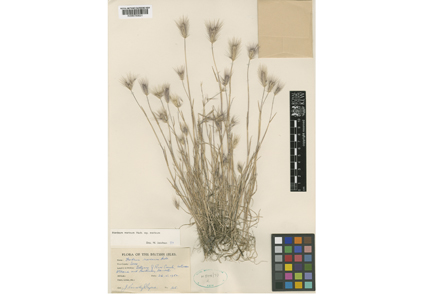
The typification of the name Hordeum marinum Hudson (Poaceae) is discussed. The name is lectotypified using an original illustration from Morison’s Plantarum historiae universalis Oxoniensis, and an epitype is also selected. The type of the name H. gussoneanum is also discussed, and a specimen preserved at FI is designated as second step lectotype.
References
Alamri, S.A., Barrettlennard, E.G., Teakle, N.L. & Colmer, T.D. (2013) Improvement of salt and waterlogging tolerance in wheat: comparative physiology of Hordeum marinum-Triticum aestivum amphiploids with their H. marinum and wheat parents. Functional Plant Biology 40: 1168–1178. https://doi.org/ 10.1071/FP12385
Allioni, C. (1785) Flora Pedemontana sive Enumeratio Methodica Stirpium Indigenarum Pedemontii, vol. 2. J.M. Briolus, Torino, 366 pp.
Anonymous (1805) Acts and votes of Parliament relating to the British Museum with the Statutes and rules thereof, and the succession of trustees and officers. W. Bulmer and Co., London, 129 pp. https://doi.org/10.5962/bhl.title.83982
Blattner, F.R. (2009) Progress in phylogenetic analysis and a new infrageneric classification of the barley genus Hordeum (Poaceae: Triticeae). Breeding Science 59: 471–480. https://doi.org/10.1270/jsbbs.59.471
Blattner, F.R. (2018) Taxonomy of the genus Hordeum and barley (Hordeum vulgare). In: Stein, N. & Muehlbauer, G.J. (eds.) The barley genome. Springer International Publishing, Cham, pp. 11–23. https://doi.org/10.1007/978-3-319-92528-8_210.1007/978-3-319-92528-8_2.
Brassac, J. & Blattner, F.R. (2015) Species-level phylogeny and polyploid relationships in Hordeum (Poaceae) inferred by next-generation sequencing and in silico cloning of multiple nuclear loci. Systematic Biology 64: 792–808. https://doi.org/10.1093/sysbio/syv035
Bothmer, R.V., Flink, J., Jacobsen, N. & Jorgensen, R.B. (1989) Variation and differentiation in Hordeum marinum (Poaceae). Nordic Journal of Botany 9: 1–10. https://doi.org/10.1111/j.1756-1051.1989.tb00975.x
Bothmer, R.V., Jacobsen, N., Baden, C., Jorgensen, R.B. & Linde-Laursen, I. (1995) An ecogeographical study of the genus Hordeum. 2nd ed. IPGRI, Rome, 129 pp.
Bowden, W.M. (1962) Cytotaxonomy of the native and adventive species of Hordeum, Eremopyrum, Secale, Sitanion, and Triticum in Canada. Canadian Journal of Botany 40: 1675–1711. https://doi.org/10.1139/b62-160
Broughton, S., Zhou, G., Teakle, N., Matsuda, R., Zhou, M., O’Leary, R., Colmer, T. & Li, C. (2015) Waterlogging tolerance is associated with root porosity in barley (Hordeum vulgare L.). Molecular Breeding 35 (1): 27. https://doi.org/10.1007/s11032-015-0243-3
Chin, T.C. (1941) The cytology of some wild species of Hordeum. Annals of Botany (London) 11 (5): 535–545. https://doi.org/10.1093/oxfordjournals.aob.a087405
Colmer, T.D., Flowers, T.J. & Munns, R. (2006) Use of wild relatives to improve salt tolerance in wheat. Journal of Experimental Botany 57 (5): 1059–1078. https://doi.org/10.1093/jxb/erj124
Covas, G. (1949) Taxonomic observations on the North American species of Hordeum. Madroño 10: 1–21.
Dandy, J.E. (Ed.) (1958) The Sloane herbarium: an annotated list of the horti sicci composing it; with biographical accounts of the principal contributors. Trustees of the British Museum, London, 246 pp. https://doi.org/10.5962/bhl.title.137366
De Bustos, A. & Loarce, J.Y. (2002) Species relationships between antifungal chitinase and nuclear rDNA (internal transcribed spacer) sequences in the genus Hordeum. Genome 45: 339–347. https://doi.org/10.1139/g01-158
Dixon, P.S. (1959) Notes on two important algal herbaria. British Phycological Bulletin 7: 35–42. https://doi.org/10.1080/00071615900650071
Fabado, J. & Ferrer-Gallego, P.P. (2021) Typification of four species names published by William Hudson. Kew Bulletin 76: 1–6. https://doi.org/10.1007/S12225-021-09932-9
Garthwaite, A.J., Bothmer, R.V. & Colmer, T.D. (2005) Salt tolerance in wild Hordeum species associated with restricted entry of Na+ and Cl- into the shoots. Journal of Experimental Botany 56: 2365–2378. https://doi.org/10.1093/jxb/eri229
Guadagnuolo, R., Savova-Bianchi, D., Keller-Senften, J. & Felber, F. (2001) Search for evidence of introgression of wheat (Triticum aestivum L.) traits into sea barley (Hordeum marinum s.str. Huds.) and bearded wheatgrass (Elymus caninus L.) in central and northern Europe, using isozymes, RAPD and microsatellite markers. Theoretical and Applied Genetics 103: 191–196. https://doi.org/10.1007/s001220100635
Huang, L., Kuang, L.H., Li, X., Wu, L.Y., Wu, D.Z. & Zhang, G.P. (2018) Metabolomic and transcriptomic analyses reveal the reasons why Hordeum marinum has higher salt tolerance than Hordeum vulgare. Environmental and Experimental Botany 156: 48–61. https://doi.org/10.1016/j.envexpbot.2018.08.019
Huang, L., Kuang, L., Wu, L.Y. & Wu, D.Z. (2019) Comparisons in functions of HKT1; 5 transporters between Hordeum marinum and Hordeum vulgare in responses to salt stress. Plant Growth Regulators 89: 309–319. https://doi.org/10.1007/s10725-019-00538-7
Hudson, W. (1760) William Hudson to Carl Linnaeus, 3 July 1760. Letter L2764 in: from Hudson, William to Linnaeus, Carl. 3 July 1760. The Linnaean correspondence, an electronic edition prepared by the Swedish Linnaeus Society, Uppsala, and published by The Linnean Society of London, London, UK. Available from: http://linnean-online.org/777771652/ (accessed on: 14 June 2021).
Hudson, W. (1778) Flora Anglica, Exhibens Plantas per Regnum Angliae Sponte Crescentes, Distributas Secundum Systema Sexuale. 2nd ed. Nourse & Moran, London, 690 pp.
Humphries, C.J. (1980) Hordeum L. In: Tutin, T.G., Heywood, V.H., Burges, N.A., Moore, D.M., Valentine, D.H., Walters, S.M. & Webb, D.A. (Eds.) Flora Europaea 5. Cambridge University Press, Cambridge, pp. 204–205.
IPNI (2021) International Plant Names Index. The Royal Botanic Gardens, Kew, Harvard University Herbaria & Libraries and Australian National Botanic Gardens. Available from: http://www.ipni.org (accessed 22 June 2021).
Islam, A.K. & Colmer, T.D. (2008) Attempts to transfer salt- and waterlogging tolerances from sea barleygrass (Hordeum marinum Huds.) to wheat. In: Appels, R., Eastwood, R., Lagudah, E., Langridge, P., Mackay, M., McIntyre, L. & Sharp, P. (Eds.) Proceedings of the 11th international wheat genetics symposium. Sydney University Press, Brisbane, QLD, pp. 336–338.
Islam, S., Malik, A.I., Islam, A.K. & Colmer, T.D. (2007) Salt tolerance in a Hordeum marinum-Triticum aestivum amphiploid, and its parents. Journal of Experimental Botany 58: 1219–1229. https://doi.org/10.1093/jxb/erl293
Jakob, S.S., Ihlow, A. & Blattner, F.R. (2007) Combined ecological niche modelling and molecular phylogeography revealed the evolutionary history of Hordeum marinum (Poaceae)—niche differentiation, loss of genetic diversity, and speciation in Mediterranean Quaternary refugia. Molecular Ecology 16: 1713–1727. https://doi.org/10.1111/j.1365-294X.2007.03228.x
Jaaska, V. (1994) Isoenzyme evidence on the systematics of Hordeum section Marina (Poaceae). Plant Systematics and Evolution 191 (3–4): 213–226. https://doi.org/10.1007/BF00984666
Jarvis, C. (2007) Order out of chaos: Linnaean plant names and their types. Linnean Society of London and the Natural History Museum, London, 1016 pp.
Langridge, P. (2018) Economic and academic importance of barley. In: Stein, N. & Muehlbauer, G.J. (Eds.) The barley genome. Springer International Publishing, Cham, pp. 1–10. https://doi.org/10.1007/978-3-319-92528-8_1.
Linnaeus, C. (1753) Species plantarum, vol. 2. L. Salvius, Stockholm, pp. 561–1200. https://doi.org/10.5962/bhl.title.669
Löve, Á. & Löwe, D. (1961) Chromosome numbers of central and northwest European plant species. Opera Botanica a Societate Botanica Lundensi 5: 1–581.
Mano, Y. & Takeda, K. (1998) Genetic resources of salt tolerance in wild Hordeum species. Euphytica 103: 137–141. https://doi.org/10.1023/A:1018302910661
Marillia, E.F. & Scoles, G.J. (1996) The use of RAPD markers in Hordeum phylogeny. Genome 39: 646–654. https://doi.org/10.1139/g96-082
Maršálová, L., Vítámvás, P., Hynek, R., Prášil, I.T. & Kosová, K. (2016) Proteomic response of Hordeum vulgare cv. Tadmor and Hordeum marinum to salinity stress: similarities and differences between a glycophyte and a halophyte. Frontiers in Plant Science 7: 1154. https://doi.org/10.3389/fpls.2016.01154
Medini, W. & Farhat, N., Al-Rawi, S., Mahto, H., Qasim, H., Ben-Halima, E., Bessrour, M., Chibani, F., Abdelly, C., Fettke, J. & Rabhi, M. (2019) Do carbohydrate metabolism and partitioning contribute to the higher salt tolerance of Hordeum marinum compared to Hordeum vulgare?. Acta Physiologiae Plantarum 41: 190. https://doi.org/10.1007/s11738-019-2983-x
Morison, R. (1699) Plantarum historiae universalis Oxoniensis, vol. 3. E Theatro Sheldoniano, Oxford, 657 pp. + Tab. 1–22.
Munns, R., James, R., Islam, A. & Colmer, T. (2011) Hordeum marinum wheat amphiploids maintain higher leaf K+: Na+ and suffer less leaf injury than wheat parents in saline conditions. Plant Soil 348: 365–377. https://doi.org/10.1007/s11104-011-0934-4
Parlatore, F. (1845) Flora Palermitana ossia Descrizione delle Piante che Crescono Spontanee nella Valle di Palermo, vol. 1. Per La Societa Tipografica, Firenze, 442 pp.
Pershina, L., Trubacheeva, N., Rakovtseva, T., Belova, L., Devyatkina, E. & Kravtsova, L. (2006) Features of the formation of self-fertile euploid lines (2 n = 42) by self-pollination of the 46-chromosome barley-wheat BC 1 hybrid Hordeum marinum subsp. gussoneanum Hudson (= H. geniculatum All.) (2 n = 28) × Triticum aestivum L. (2 n = 42). Russian Journal of Genetics 42: 1422–1427. https://doi.org/10.1134/S102279540612009X.
Petersen, G. & Seberg, O. (2003) Phylogenetic analyses of the diploid species of Hordeum (Poaceae) and a revised classification of the genus. Systematic Botany 28: 293–306. https://doi.org/10.1043/0363-6445-28.2.293
Pignatti, S. (2018) Flora d’Italia, vol. 1. Edagricole, Rome, 1064 pp.
Pujadas, A. (2021) Hordeum L. In: Romero Zarco, C., Rico, E., Crespo, M.B., Devesa, J.A., Buira, A. & Aedo, C. (Eds.) Flora iberica, vol. 29 (2). Gramineae (partim). Real Jardín Botánico, CSIC, Madrid, pp. 1051–1065.
Ray, J. (1724) Synopsis methodica stirpium Britannicarum, 3<sup>rd</sup> ed. Innys, London, 696 pp.
Romero Zarco, C. (2015) Las gramíneas de la Península Iberica e Islas Baleares. Monografías de Botánica Ibérica, no. 15, Jolube, Jaca, 170 pp.
Seckin, B., Turkan, I., Sekmen, A.H. & Ozfi?dan, C. (2010) The role of antioxidant defense systems at differential salt tolerance of Hordeum marinum Huds. (sea barleygrass) and Hordeum vulgare L. (cultivated barley). Environmental and Experimental Botany 69: 76–85. https://doi.org/10.1016/j.envexpbot.2010.02.013.
Soreng, R.J., Peterson, P.M., Romaschenko, K., Davidse, G., Zuloaga, F.O., Judziewicz, E.J., Filgueiras, T.S., Davis, J.I. & Morrone, O. (2017) A worldwide phylogenetic classification of the Poaceae (Gramineae) II: An update and a comparison of two 2015 classifications. Journal Systematics and Evolution 55: 259–290. https://doi.org/10.1111/jse.12262
Stafleu, F.A. & Cowan, R.S. (1979) Taxonomic literature, ed. 2, vol. 2: H–Le. Bohn, Scheltema & Holkema, Utrecht. Dr. W. Junk b.v. Publishers, The Hague, 991 pp. https://doi.org/10.5962/bhl.title.48631
Svitashev, S., Bryngelsson, T., Vershinin, A., Pedersen, C., Säll, T. & Bothmer, R.V. (1994) Phylogenetic analysis of the genus Hordeum using repetitive DNA sequences. Theoretical and Applied Genetics 89: 801–810. https://doi.org/10.1007/BF00224500
Thellung, A. (1907) Beitäge zur Kenntnis der Schweizerflora (VII). Vierteljahrsschrift der Naturforschenden Gesellschaft in Zürich 52: 434–483.
Thiers, B. (2021 [continuously updated]) Index herbariorum: a global directory of public herbaria and associated staff. New York Botanical Garden’s Virtual Herbarium. Available from: https://sweetgum.nybg.org/ih/ (accessed 16 May 2021)
Tison, J.M. & de Foucault, B. (2014) Flora Gallica: Flore de France. Biotope, Mèze, 1195 pp.
Tison, J.-M., Jauzein, P. & Michaud, H. (2014) Flore de la France méditerranéenne continentale. Naturalia publications, Turriers, 2078 pp.
Turland, N.J., Wiersema, J.H., Barrie, F.R., Greuter, W., Hawksworth, D.L., Herendeen, P.S., Knapp, S., Kusber, W.H., Li, D.Z., Marhold, K., May, T.W., McNeill, J., Monro, A.M., Prado, J., Price, M.J. & Smith, G.F. (Eds.) (2018) International code of nomenclature for algae, fungi, and plants (Shenzhen Code). Koeltz, Königstein, 254 pp. https://doi.org/10.12705/Code.2018
Wang, R. R-C., von Bothmer, R., Dvorak, J., Fedak, G., Linde-Laursen, I. & Muramatsu, M. (1994) Genome Symbols in the Triticeae (Poaceae). Herbarium Publications 20: 29–34.
WFO (2021) Hordeum marinum Huds. Published on the Internet. Available from: http://worldfloraonline.org/taxon/wfo-0000874872 (accessed: 17 November 2021)
Allioni, C. (1785) Flora Pedemontana sive Enumeratio Methodica Stirpium Indigenarum Pedemontii, vol. 2. J.M. Briolus, Torino, 366 pp.
Anonymous (1805) Acts and votes of Parliament relating to the British Museum with the Statutes and rules thereof, and the succession of trustees and officers. W. Bulmer and Co., London, 129 pp. https://doi.org/10.5962/bhl.title.83982
Blattner, F.R. (2009) Progress in phylogenetic analysis and a new infrageneric classification of the barley genus Hordeum (Poaceae: Triticeae). Breeding Science 59: 471–480. https://doi.org/10.1270/jsbbs.59.471
Blattner, F.R. (2018) Taxonomy of the genus Hordeum and barley (Hordeum vulgare). In: Stein, N. & Muehlbauer, G.J. (eds.) The barley genome. Springer International Publishing, Cham, pp. 11–23. https://doi.org/10.1007/978-3-319-92528-8_210.1007/978-3-319-92528-8_2.
Brassac, J. & Blattner, F.R. (2015) Species-level phylogeny and polyploid relationships in Hordeum (Poaceae) inferred by next-generation sequencing and in silico cloning of multiple nuclear loci. Systematic Biology 64: 792–808. https://doi.org/10.1093/sysbio/syv035
Bothmer, R.V., Flink, J., Jacobsen, N. & Jorgensen, R.B. (1989) Variation and differentiation in Hordeum marinum (Poaceae). Nordic Journal of Botany 9: 1–10. https://doi.org/10.1111/j.1756-1051.1989.tb00975.x
Bothmer, R.V., Jacobsen, N., Baden, C., Jorgensen, R.B. & Linde-Laursen, I. (1995) An ecogeographical study of the genus Hordeum. 2nd ed. IPGRI, Rome, 129 pp.
Bowden, W.M. (1962) Cytotaxonomy of the native and adventive species of Hordeum, Eremopyrum, Secale, Sitanion, and Triticum in Canada. Canadian Journal of Botany 40: 1675–1711. https://doi.org/10.1139/b62-160
Broughton, S., Zhou, G., Teakle, N., Matsuda, R., Zhou, M., O’Leary, R., Colmer, T. & Li, C. (2015) Waterlogging tolerance is associated with root porosity in barley (Hordeum vulgare L.). Molecular Breeding 35 (1): 27. https://doi.org/10.1007/s11032-015-0243-3
Chin, T.C. (1941) The cytology of some wild species of Hordeum. Annals of Botany (London) 11 (5): 535–545. https://doi.org/10.1093/oxfordjournals.aob.a087405
Colmer, T.D., Flowers, T.J. & Munns, R. (2006) Use of wild relatives to improve salt tolerance in wheat. Journal of Experimental Botany 57 (5): 1059–1078. https://doi.org/10.1093/jxb/erj124
Covas, G. (1949) Taxonomic observations on the North American species of Hordeum. Madroño 10: 1–21.
Dandy, J.E. (Ed.) (1958) The Sloane herbarium: an annotated list of the horti sicci composing it; with biographical accounts of the principal contributors. Trustees of the British Museum, London, 246 pp. https://doi.org/10.5962/bhl.title.137366
De Bustos, A. & Loarce, J.Y. (2002) Species relationships between antifungal chitinase and nuclear rDNA (internal transcribed spacer) sequences in the genus Hordeum. Genome 45: 339–347. https://doi.org/10.1139/g01-158
Dixon, P.S. (1959) Notes on two important algal herbaria. British Phycological Bulletin 7: 35–42. https://doi.org/10.1080/00071615900650071
Fabado, J. & Ferrer-Gallego, P.P. (2021) Typification of four species names published by William Hudson. Kew Bulletin 76: 1–6. https://doi.org/10.1007/S12225-021-09932-9
Garthwaite, A.J., Bothmer, R.V. & Colmer, T.D. (2005) Salt tolerance in wild Hordeum species associated with restricted entry of Na+ and Cl- into the shoots. Journal of Experimental Botany 56: 2365–2378. https://doi.org/10.1093/jxb/eri229
Guadagnuolo, R., Savova-Bianchi, D., Keller-Senften, J. & Felber, F. (2001) Search for evidence of introgression of wheat (Triticum aestivum L.) traits into sea barley (Hordeum marinum s.str. Huds.) and bearded wheatgrass (Elymus caninus L.) in central and northern Europe, using isozymes, RAPD and microsatellite markers. Theoretical and Applied Genetics 103: 191–196. https://doi.org/10.1007/s001220100635
Huang, L., Kuang, L.H., Li, X., Wu, L.Y., Wu, D.Z. & Zhang, G.P. (2018) Metabolomic and transcriptomic analyses reveal the reasons why Hordeum marinum has higher salt tolerance than Hordeum vulgare. Environmental and Experimental Botany 156: 48–61. https://doi.org/10.1016/j.envexpbot.2018.08.019
Huang, L., Kuang, L., Wu, L.Y. & Wu, D.Z. (2019) Comparisons in functions of HKT1; 5 transporters between Hordeum marinum and Hordeum vulgare in responses to salt stress. Plant Growth Regulators 89: 309–319. https://doi.org/10.1007/s10725-019-00538-7
Hudson, W. (1760) William Hudson to Carl Linnaeus, 3 July 1760. Letter L2764 in: from Hudson, William to Linnaeus, Carl. 3 July 1760. The Linnaean correspondence, an electronic edition prepared by the Swedish Linnaeus Society, Uppsala, and published by The Linnean Society of London, London, UK. Available from: http://linnean-online.org/777771652/ (accessed on: 14 June 2021).
Hudson, W. (1778) Flora Anglica, Exhibens Plantas per Regnum Angliae Sponte Crescentes, Distributas Secundum Systema Sexuale. 2nd ed. Nourse & Moran, London, 690 pp.
Humphries, C.J. (1980) Hordeum L. In: Tutin, T.G., Heywood, V.H., Burges, N.A., Moore, D.M., Valentine, D.H., Walters, S.M. & Webb, D.A. (Eds.) Flora Europaea 5. Cambridge University Press, Cambridge, pp. 204–205.
IPNI (2021) International Plant Names Index. The Royal Botanic Gardens, Kew, Harvard University Herbaria & Libraries and Australian National Botanic Gardens. Available from: http://www.ipni.org (accessed 22 June 2021).
Islam, A.K. & Colmer, T.D. (2008) Attempts to transfer salt- and waterlogging tolerances from sea barleygrass (Hordeum marinum Huds.) to wheat. In: Appels, R., Eastwood, R., Lagudah, E., Langridge, P., Mackay, M., McIntyre, L. & Sharp, P. (Eds.) Proceedings of the 11th international wheat genetics symposium. Sydney University Press, Brisbane, QLD, pp. 336–338.
Islam, S., Malik, A.I., Islam, A.K. & Colmer, T.D. (2007) Salt tolerance in a Hordeum marinum-Triticum aestivum amphiploid, and its parents. Journal of Experimental Botany 58: 1219–1229. https://doi.org/10.1093/jxb/erl293
Jakob, S.S., Ihlow, A. & Blattner, F.R. (2007) Combined ecological niche modelling and molecular phylogeography revealed the evolutionary history of Hordeum marinum (Poaceae)—niche differentiation, loss of genetic diversity, and speciation in Mediterranean Quaternary refugia. Molecular Ecology 16: 1713–1727. https://doi.org/10.1111/j.1365-294X.2007.03228.x
Jaaska, V. (1994) Isoenzyme evidence on the systematics of Hordeum section Marina (Poaceae). Plant Systematics and Evolution 191 (3–4): 213–226. https://doi.org/10.1007/BF00984666
Jarvis, C. (2007) Order out of chaos: Linnaean plant names and their types. Linnean Society of London and the Natural History Museum, London, 1016 pp.
Langridge, P. (2018) Economic and academic importance of barley. In: Stein, N. & Muehlbauer, G.J. (Eds.) The barley genome. Springer International Publishing, Cham, pp. 1–10. https://doi.org/10.1007/978-3-319-92528-8_1.
Linnaeus, C. (1753) Species plantarum, vol. 2. L. Salvius, Stockholm, pp. 561–1200. https://doi.org/10.5962/bhl.title.669
Löve, Á. & Löwe, D. (1961) Chromosome numbers of central and northwest European plant species. Opera Botanica a Societate Botanica Lundensi 5: 1–581.
Mano, Y. & Takeda, K. (1998) Genetic resources of salt tolerance in wild Hordeum species. Euphytica 103: 137–141. https://doi.org/10.1023/A:1018302910661
Marillia, E.F. & Scoles, G.J. (1996) The use of RAPD markers in Hordeum phylogeny. Genome 39: 646–654. https://doi.org/10.1139/g96-082
Maršálová, L., Vítámvás, P., Hynek, R., Prášil, I.T. & Kosová, K. (2016) Proteomic response of Hordeum vulgare cv. Tadmor and Hordeum marinum to salinity stress: similarities and differences between a glycophyte and a halophyte. Frontiers in Plant Science 7: 1154. https://doi.org/10.3389/fpls.2016.01154
Medini, W. & Farhat, N., Al-Rawi, S., Mahto, H., Qasim, H., Ben-Halima, E., Bessrour, M., Chibani, F., Abdelly, C., Fettke, J. & Rabhi, M. (2019) Do carbohydrate metabolism and partitioning contribute to the higher salt tolerance of Hordeum marinum compared to Hordeum vulgare?. Acta Physiologiae Plantarum 41: 190. https://doi.org/10.1007/s11738-019-2983-x
Morison, R. (1699) Plantarum historiae universalis Oxoniensis, vol. 3. E Theatro Sheldoniano, Oxford, 657 pp. + Tab. 1–22.
Munns, R., James, R., Islam, A. & Colmer, T. (2011) Hordeum marinum wheat amphiploids maintain higher leaf K+: Na+ and suffer less leaf injury than wheat parents in saline conditions. Plant Soil 348: 365–377. https://doi.org/10.1007/s11104-011-0934-4
Parlatore, F. (1845) Flora Palermitana ossia Descrizione delle Piante che Crescono Spontanee nella Valle di Palermo, vol. 1. Per La Societa Tipografica, Firenze, 442 pp.
Pershina, L., Trubacheeva, N., Rakovtseva, T., Belova, L., Devyatkina, E. & Kravtsova, L. (2006) Features of the formation of self-fertile euploid lines (2 n = 42) by self-pollination of the 46-chromosome barley-wheat BC 1 hybrid Hordeum marinum subsp. gussoneanum Hudson (= H. geniculatum All.) (2 n = 28) × Triticum aestivum L. (2 n = 42). Russian Journal of Genetics 42: 1422–1427. https://doi.org/10.1134/S102279540612009X.
Petersen, G. & Seberg, O. (2003) Phylogenetic analyses of the diploid species of Hordeum (Poaceae) and a revised classification of the genus. Systematic Botany 28: 293–306. https://doi.org/10.1043/0363-6445-28.2.293
Pignatti, S. (2018) Flora d’Italia, vol. 1. Edagricole, Rome, 1064 pp.
Pujadas, A. (2021) Hordeum L. In: Romero Zarco, C., Rico, E., Crespo, M.B., Devesa, J.A., Buira, A. & Aedo, C. (Eds.) Flora iberica, vol. 29 (2). Gramineae (partim). Real Jardín Botánico, CSIC, Madrid, pp. 1051–1065.
Ray, J. (1724) Synopsis methodica stirpium Britannicarum, 3<sup>rd</sup> ed. Innys, London, 696 pp.
Romero Zarco, C. (2015) Las gramíneas de la Península Iberica e Islas Baleares. Monografías de Botánica Ibérica, no. 15, Jolube, Jaca, 170 pp.
Seckin, B., Turkan, I., Sekmen, A.H. & Ozfi?dan, C. (2010) The role of antioxidant defense systems at differential salt tolerance of Hordeum marinum Huds. (sea barleygrass) and Hordeum vulgare L. (cultivated barley). Environmental and Experimental Botany 69: 76–85. https://doi.org/10.1016/j.envexpbot.2010.02.013.
Soreng, R.J., Peterson, P.M., Romaschenko, K., Davidse, G., Zuloaga, F.O., Judziewicz, E.J., Filgueiras, T.S., Davis, J.I. & Morrone, O. (2017) A worldwide phylogenetic classification of the Poaceae (Gramineae) II: An update and a comparison of two 2015 classifications. Journal Systematics and Evolution 55: 259–290. https://doi.org/10.1111/jse.12262
Stafleu, F.A. & Cowan, R.S. (1979) Taxonomic literature, ed. 2, vol. 2: H–Le. Bohn, Scheltema & Holkema, Utrecht. Dr. W. Junk b.v. Publishers, The Hague, 991 pp. https://doi.org/10.5962/bhl.title.48631
Svitashev, S., Bryngelsson, T., Vershinin, A., Pedersen, C., Säll, T. & Bothmer, R.V. (1994) Phylogenetic analysis of the genus Hordeum using repetitive DNA sequences. Theoretical and Applied Genetics 89: 801–810. https://doi.org/10.1007/BF00224500
Thellung, A. (1907) Beitäge zur Kenntnis der Schweizerflora (VII). Vierteljahrsschrift der Naturforschenden Gesellschaft in Zürich 52: 434–483.
Thiers, B. (2021 [continuously updated]) Index herbariorum: a global directory of public herbaria and associated staff. New York Botanical Garden’s Virtual Herbarium. Available from: https://sweetgum.nybg.org/ih/ (accessed 16 May 2021)
Tison, J.M. & de Foucault, B. (2014) Flora Gallica: Flore de France. Biotope, Mèze, 1195 pp.
Tison, J.-M., Jauzein, P. & Michaud, H. (2014) Flore de la France méditerranéenne continentale. Naturalia publications, Turriers, 2078 pp.
Turland, N.J., Wiersema, J.H., Barrie, F.R., Greuter, W., Hawksworth, D.L., Herendeen, P.S., Knapp, S., Kusber, W.H., Li, D.Z., Marhold, K., May, T.W., McNeill, J., Monro, A.M., Prado, J., Price, M.J. & Smith, G.F. (Eds.) (2018) International code of nomenclature for algae, fungi, and plants (Shenzhen Code). Koeltz, Königstein, 254 pp. https://doi.org/10.12705/Code.2018
Wang, R. R-C., von Bothmer, R., Dvorak, J., Fedak, G., Linde-Laursen, I. & Muramatsu, M. (1994) Genome Symbols in the Triticeae (Poaceae). Herbarium Publications 20: 29–34.
WFO (2021) Hordeum marinum Huds. Published on the Internet. Available from: http://worldfloraonline.org/taxon/wfo-0000874872 (accessed: 17 November 2021)