

Abstract
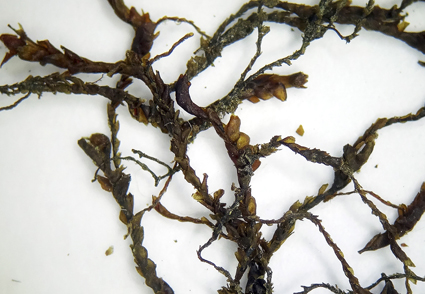
Two Sino-Himalayan taxa of Gymnomitrion are reviewed, based on materials from South China and North Vietnam. Gymnomitrion sichuanicum is newly described from Sichuan Province of China and is characterized by the dioicous inflorescence, very short semi-crescentic leaf sinus and acute to obtuse leaf lobes. The habit of the species is superficially similar to Marsupella sprucei, but it differs in a number of features including perianth absence, dioicy, smaller leaf cells and distribution pattern. The genetically closely related Gymnomitrion africanum differs in its deeply gibbous sinus and rounded leaf lobes. Another taxon, Gymnomirion rubidum – still a poorly-known species, although described much earlier – is found to be genetically polymorphous with two defined haplotypes which are not easily distinguished morphologically; one of these is described as a new subspecies. The species is newly recorded from North Vietnam; collected in a degenerating relict Abies delavayi stand on a substrate very unusual for Gymnomitriaceae (decaying wood). Both taxa are described, discussed and supplemented with illustrations. These findings extend a series of similar records showing the great importance of the Eastern Sino-Himalaya and its surroundings in the survival of a unique complex of narrowly distributed montane taxa.
References
Bakalin, V.A., Fedosov, V.E., Fedorova, A.V. & Nguyen, V.S. (2019) Integrative taxonomic revision of Marsupella (Gymnomitriaceae, Hepaticae) reveals neglected diversity in Pacific Asia. Cryptogamie, Bryologie 40 (7): 59–85. https://doi.org/10.5252/cryptogamie-bryologie2019v40a7
Bakalin, V., Vilnet, A., Ma, W.Z. & Klimova, K. (2019) The differentiation and speciation of Scapania javanica and S. undulata complexes in the Eastern Sino-Himalayas and perimeters for Scapania sect. Stephania (Scapaniaceae, Hepaticae). Phytotaxa 400 (3): 123–144. https://doi.org/10.11646/phytotaxa.400.3.2
Bakalin, V.A., Klimova, K.G. & Nguyen, V.S. (2020a) A review of Calypogeia (Marchantiophyta) in the eastern Sino-Himalaya and Meta-Himalaya based mostly on types. PhytoKeys 153: 111–154. https://doi.org/10.3897/phytokeys.153.52920
Bakalin, V., Vilnet, A. & Nguyen, V.S. (2020b) Vietnamiella epiphytica – a new genus and species of Anastrophyllaceae (Hepaticae). The Bryologist 123 (1): 48–63. https://doi.org/10.1639/0007-2745-123.1.048
Bakalin, V., Fedosov, V., Long, D.G., Fedorova, A. & Maltseva, Yu. (2021) Protoharpanthus gen. nov. (Harpanthaceae) – a relict relative of Harpanthus from the Sino-Himalaya. The Bryologist 124 (2): 218–229. https://doi.org/10.1639/0007-2745-124.2.218
Bernet, H. (1888) Catalogue des hépatiques du sud-ouest de la Suisse. H. Georg. Bale et Lyon, Genève, 135 pp.
Buch, H. (1932) Vorarbeiten zu einer Lebermoosflora Fenno-scandias. I. Ein Versuch zur Aufspaltung der Gattungen Lophozia Dum. und Sphenolobus Steph. Memoranda Societatis pro Fauna et Flora Fennica 8: 282–297.
Chang, D.H.S. (1981) The vegetation zonation of the Tibetan Plateau. Mountain Research and Development 1 (1): 29–48.
Corda, A.J.C. (1829) Genera Hepaticarum. In: Opiz, P.M. (Ed.) Beiträge zur Naturgeschichte als Fortsetzung des Naturalientausches No. 12. C.W. Enders, Praha, pp. 643–655.
Corda, A.J.C. (1830) Deutschlands Jungermannien, Heft 19–20. In: Sturm, J. (Ed.) Deutschlands Flora in Abbildungen nach der Natur mit Beschreibungen. Abtheilung II Cryptogamie. Privately published by author, Nürnberg, pp. 1–62.
Duhamel du Monceau, H.L. (1755) Traité des Arbres et Arbustes qui se cultivent en France en pleine terre, T. 2. Guerin & Delatour, Paris, 479 pp.
Dumortier, B.C.J. (1822) Commentationes botanicae. Ch. Casterman-Dien, Tournay, 118 pp. https://doi.org/10.5962/bhl.title.10534
Dumortier, B.C.J. (1831) Sylloge Jungermannidearum Europae indigenarum. J. Casterman, Tournay, 100 pp. https://doi.org/10.5962/bhl.title.22343
Dumortier, B.C.J. (1835) Recueil d’Observations sur les Jungermanniacées. J.-A. Blanquart, Tournay, 27 pp. https://doi.org/10.5962/bhl.title.731
Figtree (2022) FigTree version 1.4.4. Available from: http://tree.bio.ed.ac.uk/software/figtree/ (accessed 18 January 2022)
Franchet, A (1899) Plantarium Sinensium. Ecloge Tertia. Journal de Botanique (Morot) 13 (8): 253–260.
Goloboff, P.A. & Catalano, S. (2016) T.N.T. version 1.5, including a full implementation of phylogenetic morphometrics. Cladistics 32: 221–238. https://doi.org/10.1111/cla.12160
Gray, S.F. (1821) Natural arrangement of British plants, Vol. 1. Baldwin, Craddock, and Joy, London, 824 pp. https://doi.org/10.5962/bhl.title.43804
Grolle, R. (1966a) Die Lebermoose Nepals. Khumbu Himal, Ergebnisse des Forschungsunternehmens Nepal Himalaya 1 (4): 262–298.
Grolle, R. (1966b) Gymnomitrion crenulatum und Verwandte. Transactions of the British Bryological Society 5 (1): 86–94. https://doi.org/10.1179/006813866804804567
Guindon, S., Dufayard, J.F., Lefort, V., Anisimova, M., Hordijk, W. & Gascuel, O. (2010) New algorithms and methods to estimate maximum-likelihood phylogenies: Assessing the performance of PhyML 3.0. Systematic Biology 59: 307–321. https://doi.org/10.1093/sysbio/syq010
Hall, T.A. (1999) BioEdit: a user-friendly biological sequence alignment editor and analysis program for Windows 95/98/NT. Nucleic Acids Symposium Series 41: 95–98.
Hartman, C.J. (1871) Handbok i Skandinaviens flora, tionde upplagan, sednare delen: mossor. Zacharias Hæggströms förlag, Stockholm, 179 pp.
Hattori, S. (1966) Anthocerotae and Hepaticae. In: Hara, H. (Ed.) The flora of eastern Himalaya. Results of the botanical expedition to eastern Himalaya organized by the University of Tokyo 1960 and 1963. University of Tokyo Press, Tokyo, pp. 501–536.
Horikawa, Y. (1943) Notulae hepaticologicae. Acta Phytotaxonomica et Geobotanica 13: 212–214.
Kaalaas, B. (1893) Levermosernes udbredelse i Norge. Nyt Magazin for Naturvidenskaberne 33 (4/5): 289–490.
Keane, T.M., Creevey, C.J., Pentony, M.M., Naughton, T.J. & McInerney, J.O. (2006) Assessment of methods for amino acid matrix selection and their use on empirical data shows that ad hoc assumption for choice of matrix are not justified. BMC Evolutionary Biology 6: 29. https://doi.org/10.1186/1471-2148-6-29.
Kitagawa, N. (1959) New or interesting species of Gymnomitrion (Hepaticae) in Japan. Acta Phytotaxonomica et Geobotanica 18 (2/3): 33–38.
Kitagawa, N. (1962) Status of Gymnomitrion concinnatum var. mucronulatum. Acta Phytotaxonomica et Geobotanica 19 (2/3): 53.
Lightfoot, J. (1777) Flora Scotica: or, a Systematic Arrangement, in the Linnaean Method, of the Native Plants of Scotland and the Hebrides, vol. 2. B. White, London, pp. 531–1151. https://doi.org/10.5962/bhl.title.22163
Limpricht, K.G. (1877) Laubmoose und Lebermoose. In: Cohn, F. (ed.) Kryptogamen-Flora von Schlesien. Breslau, pp. 225–352.
Limpricht, K.G. (1880) Neue und Kritische Lebermoose. Jahresbericht der Schlesischen Gesellschaft für Vaterländische Cultur 57: 312–316.
Limpricht, K.G. (1881) Ueber Gymnomitrium adustum N. v. E. Flora 64 (5): 71–76.
Lindberg, S.O. (1877) Sällskapets pro Fauna et Flora fennica sammanträde den 3 dennes. Morgonbladet (Helsinki) 1877 (30, 6 Feb): 2.
Linnaeus, C. (1753) Species plantarum, ed. 1–2. Impensis Laurentii Salvii, Holmiæ [Stockholm], 1200 pp. https://doi.org/10.5962/bhl.title.669
Mamontov, Yu.S., Konstantinova, N.A., Vilnet, A.A., Potemkin, A.D., Sofronova, E.V. Gamova, N.S. (2018) On resurrection of Marsupella parvitexta Steph. (Gymnomitriaceae, Marchantiophyta) as a semi cryptic species of the genus Gymnomitrion. Nova Hedwigia 106 (1–2): 81–101. https://doi.org/10.1127/nova_hedwigia/2017/0466
Mamontov, Yu.S., Vilnet, A.A., Konstantinova, N.A. & Bakalin, V.A. (2019) Two new species of Gymnomitriaceae (Marchantiophyta) in the North Pacific. Botanica Pacifica 8 (1): 67–80. https://doi.org/10.17581/bp.2019.08113
Miller, P. (1754) The gardeners dictionary, 4 Ed., 2. Published by the author, London, 529 pp.
Mitten, W. (1860) Hepaticae Indiae Orientalis. Journal of the Proceedings of the Linnean Society. Botany 5 (18): 89–128.
Müller, K. (1951) Neue Lebermoose. Revue Bryologique et Lichénologique 20 (1/2): 176–178.
Müller, K. (2005) SeqState. Primer design and sequence statistics for phylogenetic DNA datasets. Applied Bioinformatics 4: 65–69. https://doi.org/10.2165/00822942-200504010-00008
Nakai, T. (1925) Two new genera of Bambusaceae, with special remarks on the related genera growing in Eastern Asia. Journal of the Arnold Arboretum 6 (3): 145–153.
Nees, C.G. (1833) Naturgeschichte der Europäischen Lebermoose, vol. 1. August Rücker, Berlin, 347 pp.
Nees, C.G. (1836) Naturgeschichte der Europäischen Lebermoose, vol. 2. August Rücker, Berlin, 499 pp.
Nicholson, W.E., Herzog, T. & Verdoorn, F. (1930) Hepaticae. In: Handel-Mazzetti, H.M. (Ed.) Symbolae Sinicae, Part 5. Hepaticae. Springer Verlag, Berlin, pp. 1–60.
Pattengale, N.D., Alipour, M., Bininda-Emonds, O.R.P., Moret, B.M.E. & Stamatakis, A. (2010) How many bootstrap replicates are necessary? Journal of Computational Biology 17: 337–354. https://doi.org/10.1089/cmb.2009.0179
Philibert, H. (1890) Sur la fructification du Marsupella revoluta Dumortier. Revue Bryologique 17 (3): 33–34.
Potemkin, A.D., Mamontov, Yu.S. & Gamova, N.S. (2017) Gymnomitrion fissum (Gymnomitriaceae, Marchantiophyta)—a new species with fissured leaf surface from China. Novosti sistematiki nizshikh rastenii 51: 274–280. https://doi.org/10.31111/nsnr/2017.51.274
Rambaut, A. & Drummond, A.J. (2007) Tracer v1.4. Available from: http://beast.bio.ed.ac.uk/Tracer. (accessed 10 November 2021 )
Ronquist, F., Teslenko, M., Mark, P. van der, Ayres, D.L., Darling, A., Höhna, S., Larget, B., Liu, L., Suchard, M.A. & Hülsenbeck, J.P. (2012) MrBayes 3.2: Efficient Bayesian phylogenetic inference and model choice across a large model space. Systematic Biology 61: 539–542. https://doi.org/10.1093/sysbio/sys029
Schiffner, V. (1903) Studien über kritische Arten der Gattungen Gymnomitrium und Marsupella (Fortsetzung). Österreichische Botanische Zeitschrift 53 (6): 246–252. https://doi.org/10.1007/BF01679557
Schuster, R.M. (1996) Studies on antipodal hepaticae. XII. Gymnomitriaceae. Journal of the Hattori Botanical Laboratory 80: 1–147.
Schuster, R.M. (2002) Austral hepaticae. Part II. Beihefte zur Nova Hedwigia 119: 1–606.
Shaw, B., Crandall-Stotler, B., Vá?a, J., Stotler, R.E., von Konrat, M., Engel, J.J., Davis, E.C., Long, D.G., Sova, P. & Shaw, A.J. (2015) Phylogenetic relationships and morphological evolution in a major clade of leafy liverworts (phylum Marchantiophyta, order Jungermanniales): suborder Jungermanniineae. Systematic Botany 40: 27–45. https://doi.org/10.1600/036364415X686314
Stamatakis, A. (2006) RAxML-VI-HPC: Maximum Likelihood-based Phylogenetic Analyses with Thousands of Taxa and Mixed Models. Bioinformatics 22: 2688–2690. https://doi.org/10.1093/bioinformatics/btl446
Stephani, F. (1901) Species Hepaticarum 2. Bulletin de l’Herbier Boissier (sér. 2) 1 (2): 140–177.
Stephani, F. (1917) Species hepaticarum 6. George & Cie, Genève & Bale, pp. 1–128. https://doi.org/10.5962/bhl.title.95494
Taberlet, P., Gielly, L., Pautou, G. & Bouvet, J. (1991) Universal primers for amplification of three non-coding regions of chloroplast DNA. Plant Molecular Biology 17: 1105–1109. https://doi.org/10.1007/BF00037152
Takhtajan, A. (1986) Floristic regions of the world (translated by T.J. Crovello & A. Cronquist). Berkeley, University of California Press, 544 pp.
Tamura, K., Peterson, D., Peterson, N., Stecher, G., Nei, M. & Kumar, S. (2011) MEGA 5: Molecular evolutionary genetics analysis using maximum likelihood, evolutionary distance, and maximum parsimony methods. Molecular Biology and Evolution 28: 2731–2739. https://doi.org/10.1093/molbev/msr121
Trevisan,V.B.A. (1877) Schema di una nuova classificazione delle Epatiche. Memorie del Reale Istituto Lombardo de Scienze e Lettere (Serie 3), Classe di Scienze Matematiche e Naturali 4 (13): 383–451.
Vá?a, J. (1985) Notes on Some African Hepatic Genera 6-9. Folia Geobotanica et Phytotaxonomica 20: 81–99.
Vá?a, J. & Long, D.G. (2008) Hamatostrepta concinna gen. et sp. nov. (Jungermanniopsida, Scapaniaceae), a new Asiatic leafy liverwort from the Sino-Burmese border. Fieldiana: Botany (n.ser.) 47: 133–138. https://doi.org/ 10.3158/0015-0746-47.1.133
Vá?a, J. & Long, D.G. (2009) Jungermanniaceae of the Sino-Himalayan region. Nova Hedwigia 89 (3/4): 485–517. https://doi.org/10.1127/0029-5035/2009/0089-0485
Vá?a, J. & Long, D.G. (2010) Gymnomitriaceae of the Sino-Himalayan region. Nova Hedwigia, Beih. 138: 199–204.
Vá?a, J. & Long, D.G. (2011) Cephaloziaceae of the Sino-Himalayan region. Nova Hedwigia 93: 153 –164.
Va?a, J., Söderström, L., Hagborg, A., Von Konrat, M.J. & Engel, J.J. (2010) Early Land Plants Today: Taxonomy, systematics and nomenclature of Gymnomitriaceae. Phytotaxa 11: 1–80. https://doi.org/10.11646/phytotaxa.11.1.1
Vilnet, A.A., Konstantinova, N.A. & Troitsky, A.V. (2007) On molecular phylogeny of Gymnomitriaceae H. Klinggr. (Hepaticae). In: Antonov, A.S. (Ed.) Conference proceedings Computational Phylogenetics and molecular systematics “CPMS’ 2007”. KMK Scientific Press Ltd, Moscow, pp. 27–29.
White, T.J., Bruns, T., Lee, S. & Taylor, J. (1990) Amplification and direct sequencing of fungal ribosomal RNA genes for phylogenetics. In: Innis, M.A., Gelfand, D.H., Snisky, J.J. & White, T.J. (Eds.) PCR protocols: a guide to methods and applications. San Diego, pp. 315–322.
Worldclim (2021) WorldClim: bioclimate database. Available from: https://www.worldclim.org/data/bioclim.html (accessed 22 June 2021)