

Abstract
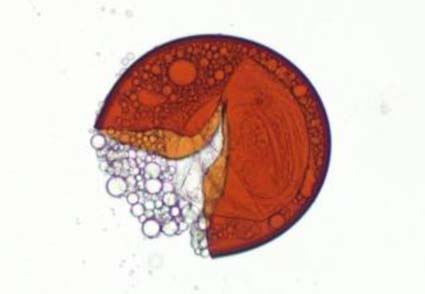
Acaulospora fanjing is here described as a new species of arbuscular mycorrhizal fungi (AMF; Glomeromycota) based on morphological and phylogenetic analyses. It was associated with roots of Acer flabellatum colonizing of the massy dwarf forest to fanjing Mountain, China, and this is the only site of its occurrence known to date. A.fanjing is characterized by forming reddish orange to reddish brown globose spores of (109–)123(–138) µm diam and three layers of outer spore walls (SWL1–SWL3) and two layers of germinal walls (MW and IW). SWL1 hyaline, short–lived, evanescent, SWL2 laminate, orange to reddish orange, 2.0–3.5 μm thick and SWL3 thin, difficult to observe; MW is hyaline, bilayered (MWL1–MWL2), semiflexible; IW is hyaline, with three layers and not “beaded” structure, only the IWL2 were stained light pink in Melzer’s reagent. A.fanjing can be distinguished from all other Acaulospora species by spore size, color and spore wall structure. Phylogenetic analysis based on the AMF extended DNA barcode covering a 1.5-kb fragment of the small subunit (SSU), internal transcribed spacer region (ITS), and the large subunit (LSU) of rRNA genes places A.fanjing in the genus Acaulospora, separated from other described Acaulospora species. All available sequences in public databases suggest that this new fungal species has not yet been previously detected.
References
B?aszkowski, J., Kovacs, G.M., Gaspar, B.K., Balazs, T.K., Buscot, F. & Ryszka, P. (2012) The arbuscular mycorrhizal Paraglomus majewskii sp. nov. represents a new distinct basal lineage in Paraglomeraceae (Glomeromycota). Mycologia 104: 148–156. https://doi.org/10.3852/10-430
Barni, E., Siniscalco, C. (2000) Vegetation dynamics and arbuscular mycorrhiza in old-field successions of the western Italian Alps. Mycorrhiza 10: 63–72. https://doi.org/10.1007/s005720000059
B?aszczykowski, J., Tadych, M., Madej, I., Adamska, I., Czerniawska, B. & Iwaniuk, A. (1999) Acaulospora mellea and A.trappei, fungi new for Poland. Acta Mycologica 34 (1). https://doi.org/10.5586/am.1999.002
Baszkowski, J. & Polish, E. (1990) Acaulospora Capsicula Sp. nov. Mycologia 82 (6): 794–798. https://doi.org/10.1080/00275514.1990.12025965
Crossay, T., Cilia, A., Cavaloc, Y., Amir, H. & Redecker, D. (2018) Four new species of arbuscular mycorrhizal fungi (Glomeromycota) associated with endemic plants from ultramafic soils of New Caledonia. MYCOL PROG 17 (6): 729–744. https://doi.org/10.1007/s11557-018-1386-5
Chaudhary, V,B., Bowker, M.A., O’Dell, T.E., Grace, J.B., Redman, A.E., Rillig, M.C. & Johnson, N.C. (2009) Untangling the biological contributions to soil stability in semiarid shrublands. Ecological Applications 19: 110–122. https://doi.org/10.1890/07-2076.1
Dandan, Z. & Zhiwei, Z. (2007) Biodiversity of arbuscular mycorrhizal fungi in the hot-dry valley of the Jinsha River, southwest China. Applied Soil Ecology 37 (1–2): 118–128. https://doi.org/10.1016/j.apsoil.2007.06.003
Eduardo, C.S., Carolina, S.G., Lucía, V. & Montao, N.M. (2020) Septoglomus mexicanum, a new species of arbuscular mycorrhizal fungi from semiarid regions in Mexico. Mycologia 112 (1): 1–12. https://doi.org/10.1080/00275514.2019.1671147
Gerdemann, J.W. & Nicolson, H.T. (1963) Spores of mycorrhizal Endogone species extracted from soil by wet sieving and decanting. British Mycological Society 46: 235–244. https://doi.org/10.1016/S0007-1536(63)80079-0
Klironomos, J.N., Zobel, M., Tibbett, M., Stock, W.D., Rillig, M.C., Parrent, J.L., Moora, M., Koch, A.M., Facelli, J.M., Facelli, E., Dickie, I.A. & Bever, J.D. (2011) Forces that structure plant communities: quantifying the importance of the mycorrhizal symbiosis. New Phytol 189: 366–370. https://doi.org/10.2307/40983838
Kaonongbua, W., Morton, J.B. & Bever, J.D. (2010) Taxonomic revision transferring species in Kuklospora to Acaulospora (Glomeromycota) and a description of Acaulospora colliculosa sp. nov. from field collected spores. Mycologia 102 (6): 1497–1509. https://doi.org/10.3852/10-011
Koide, R.T. & Mosse, B. (2004) A history of research on arbuscular mycorrhiza. Mycorrhiza 14: 145–163. https://doi.org/10.1007/s00572-004-0307-4
Lee, E.H., Park, S.H., Eo, J.K., Ka, K.H. & Eom, A.H. (2018) Acaulosproa koreana, a New Species of Arbuscular Mycorrhizal Fungi (Glomeromycota) Associated with Roots of Woody Plants in Korea, Mycobiology 46: 4, 341–348, https://doi.org/10.1080/12298093.2018.1548805
Lv, Y., Xiong, K.N., Rong, L., Chen, H., Gao, Y. & Ying, B. (2016) Comparative analysis of the World Natural Heritage value of the bioecological evolution of Fanjing Mountain. World Geography Research 25 (05): 131–141.
Manuela, K., Walker, C. & Arthur, S. (2011) Acaulospora brasiliensis comb. nov. and Acaulospora alpina (Glomeromycota) from upland Scotland: morphology, molecular phylogeny and DNA–based detection in roots. Mycorrhiza 21 (6): 577–587. https://doi.org/10.1007/s00572-011-0361-7
Miaoyan, W., Zhikai, D., Meixia, L. & Runjin, L. (2005) Advances in the study of AMF diversity in agroecosystems. Acta ecologica sinica 25 (10): 2744–2749. https://doi.org/10.3321/j.issn:1000-0933.2005.10.041
Oehl, F., Sykorová, Z., Redecker, D., Wiemken, A. & Sieverding, E. (2006) Acaulospora alpina, a new arbuscular mycorrhizal fungal species characteristic for high mountainous and alpine regions of the Swiss Alps. Mycologia 98 (2): 286–294. https://doi.org/10.1080/15572536.2006.11832701
Palenzuela, J., Azcon–Aguilar, C., Barea, J.M., Gladstone, A.S. & Oehl, F. (2013) Acaulospora pustulata and Acaulospora tortuosa, two new species in the Glomeromycota from Sierra Nevada National Park (southern Spain). Nova Hedwigia 97 (3–4): 305–319. https://doi.org/10.1127/0029-5035/2013/0129
Phillips, J.M. & Hayman, D.S. (1970) Improved procedures for clearing roots and staining parasitic and vesicular-arbuscular mycorrhizal fungi for rapid assessment of infection. Transactions of the British Mycological Society 55: 158–161. https://doi.org/10.1016/S0007-1536(70)80110-3
Qin, M., Shi, G. & Zhang, Q. (2019) Arbuscular mycorrhizal fungi serve as keystone taxa for revegetation on the Tibetan Plateau. Journal of Basic Microbiology.59: 6. https://doi.org/10.1002/jobm.201900060
Reid, D.A., Gerdemann, J.W. & Trappe, J.M. (1974) The Endogonaceae in the Pacific Northwest. Kew Bulletin 30 (4): 716. https://doi.org/10.2307/4102919
Shang, K., Shi, L., Li, H.B., Yao, L.M., Zhou, G.R. & Jiang, L. (2020) Diversity of mycorrhizal fungi from different elevations in Fanjing Mountain. Journal of Northeast Forestry University 48 (02): 76–80. https://doi.org/10.13759/j.cnki.dlxb.2020.02.014
Smith, S.E. & Read, D.J. (2008) Mycorrhizal symbiosis. Academic Press, San Diego, California, 787 pp.
Stürmer, S.L. & Morton, J.B. (1997) Developmental patterns defining morphological characters in spores of four species in Glomus. Mycologia 89: 72–81. https://doi.org/10.2307/3761174
Wagg, C., Bender, S.F., Widmer, F. & Heijden, M.G. (2014) Soil biodiversity and soil community composition determine ecosystem Multifunctionality. Proceedings of the National Academy of Sciences 111 (14): 5266–5270. https://doi.org/10.1073/pnas.1320054111
Wang, F.Y. (2003) Comparison of diversity of arbuscular mycorrhizal fungi in different ecological environments. Acta Ecologica Sinica 23 (12): 2666–2671. https://doi.org/10.1023/A:1022289509702
Yao, L.M., Shi, L., Li, H.B., Shang, K., Zhu, Q.Q., Zhou, G.R. & Jiang, L. (2019) Three new Chinese species of Mycorrhizal fungi from Fanjing Mountain. Journal of Guizhou University (Natural Science Edition) 36 (05): 28–32. https://doi.org/10.15958/j.cnki.gdxbzrb.2019.05.06
Yang, X.L., Yan, W., Bao, Y.Y., Fan, Y.J. & Jiang, H.Y. (2010) Diversity of mycorrhizal fungi in larch forests of the Daxingan Mountains. Journal of Ecology 29 (03): 504–510. https://doi.org/10.13292/j.1000-4890.2010.0091
Zhu, Q.Q., Shi, L., Li, H.B., Yao, L.M., Shang, K. & Jiang, L. (2021) Three new recorded species of AMF from China in Fanjing Mountain. Mycological Research 19 (01): 24–28. https://doi.org/10.13341/j.jfr.2020.1314
Zhu, S.Q. & Yang, Y.Q. (1987) Preliminary study on moss dwarf forest on the summit of Fanjing Mountain, Guizhou. Journal of Plant Ecology and Geobotany 2: 92–105. https://doi.org/CNKI:SUN:ZWSB.0.1987-02-001