

Abstract
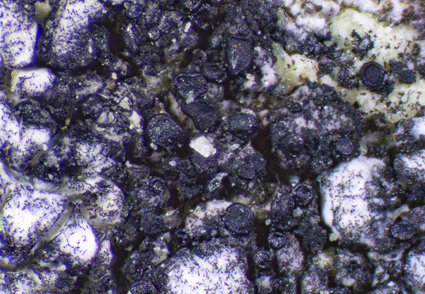
Carbonea is a widely distributed genus of lecideoid fungi, including both lichenized and non-lichenized, often parasitic species. We describe the new, non-lichenized species Carbonea tephromelae, based on material collected in the Swedish part of the Scandes. The new species is characterized by a colourless hypothecium, broadly ellipsoid to globose ascospores, and by growing on the thallus of the common saxicolous lichen Tephromela atra. It is similar to the likewise lichenicolous species C. supersparsa and C. vitellinaria, but is clearly separated from these species by anatomy and in a phylogenetic analysis based on four markers (mrSSU, ITS, RPB1, RPB2). Carbonea tephromelae is apparently specific to T. atra, but the use of host specificity as a character for species delimitation in lichenicolous species of Carbonea needs further evaluation.
References
Andreev, M.P. (2003) Lecanoraceae. In: Andreev, M.P., Bredinka, L.I., Golbukova, N.S., Dobrysh, A.A., Kotlov, Y.V., Makarova, I.I., Urbanavichene, I.N. & Urbanavichus, G.P. Handbook of the lichens of Russia. 8. Bacidiaceae, Catillariaceae, Lecanoraceae, Megalariaceae, Mycobilimbiaceae, Rhizocarpaceae, Trapeliaceae. Nauka, St. Petersburg, pp. 111–184.
Chambers, S.B., Galloway, D.J. & James, P.W. (2009) Carbonea (Hertel) Hertel (1983). In: Smith, C.W., Aptroot, A., Coppins, B.J., Fletcher, A, Gilbert, O.L., James, P.W. & Wolseley, P.A. (eds.) The lichens of Great Britain and Ireland. The British Lichen Society, London, pp. 278–280.
Chernomor, O., von Haeseler, A. & Minh, B.Q. (2016) Terrace aware data structure for phylogenomic inference from supermatrices. Systematic Biology 65: 997–1008. https://doi.org/10.1093/sysbio/syw037
Ekman, S. & Blaalid, R. (2011) The devil in the details: interactions between the branch length prior and likelihood model affect model support and branch length in the phylogeny of the Psoraceae. Systematic Biology 60: 541–561. https://doi.org/10.1093/sysbio/syr022
Ferencova, Z., Rico, V.J. & Hawksworth, D.L. (2017) Extraction of DNA from lichen-forming and lichenicolous fungi: a low-cost fast protocol using Chelex. Lichenologist 49: 521–525. https://doi.org/10.1017/S0024282917000329
Fryday, A. (2011) How should we deal with the Antarctic and Subantarctic taxa published by Carroll William Dodge? Opuscula Philolichenum 9: 89–98.
Fryday, A., Printzen, C. & Ekman, S. (2014) Bryobilimbia, a new generic name for Lecidea hypnorum and closely related species. Lichenologist 46: 25–37. https://doi.org/10.1017/S0024282913000625
Fryday, A. & Øvstedal, D.O. (2012) New species, combinations and records of lichenized fungi from the Falkland Islands (Islas Malvinas). Lichenologist 44: 483–500. https://doi.org/10.1017/S0024282912000163
Gardes, M. & Bruns, T.D. (1993) ITS primers with enhanced specificity for basidiomycetes – application to the identification of mycorrhizae and rusts. Molecular Ecology 2: 113–118. https://doi.org/10.1111/j.1365-294X.1993.tb00005.x
Grube, M., Baloch, E. & Arup, U. (2004) A phylogenetic study of the Lecanora rupicola group (Lecanoraceae, Ascomycota). Mycological Research 108: 506–514. https://doi.org/10.1017/S0953756204009888
Hafellner, J. (1999) Beiträge zu einem Prodromus der lichenicolen Pilze Österreichs und angrenzender Gebiete. IV. Drei neue Arten und weitere bemerkenswerte Funde hauptsächlich in der Steiermark. Linzer biologische Beiträge 31: 507–532.
Hertel, H. (1969) Beiträge zur Kenntnis der Flechtenfamilie Lecideaceae II. Herzogia 1: 321–329.
Hertel, H. (1983) Über einige aus Lecidea und Melanolecia (Ascomycetes lichenisati) auszuschliessende Arten. Mitteilungen aus der Botanischen Staatssammlung München 19: 441–447.
Hertel, H. (1984a) Lecideaceae Exsiccatae ausgegeben von der Botanischen Staatssammlung München. Fasc. VI (Nr. 101–120).
Hertel, H. (1984b) Über saxicole, lecideoide Flechten der Subantarktis. Beiheft zur Nova Hedwigia 79: 399–499.
Hertel, H. (2001) Floristic and taxonomic notes on saxicolous lecideoid lichens. Sendtnera 7: 93–136.
Hertel, H. (2007) Notes on and records of Southern Hemisphere lecideoid lichens. Bibliotheca Lichenologica 95: 267–296.
Hoang, D.T., Chernomor, O., von Haeseler, A., Minh, B.Q. & Vinh, L.S. (2018) UFBoot2: Improving the ultrafast bootstrap approximation. Molecular Biology and Evolution 35: 518–522. https://doi.org/10.1093/molbev/msx281
Kalyaanamoorthy, S., Minh, B.Q., Wong, T.K.F., von Haeseler, A. & Jermiin, L.S. (2017) ModelFinder: fast model selection for accurate phylogenetic estimates. Nature Methods 14: 587–589. https://doi.org/10.1038/nmeth.4285
Leavitt, S.D., Fernández-Mendoza, F., Pérez-Ortega, S., Sohrabi, M., Divakar, P.K., Vondrák, J., Lumbsch, H.T. & St. Clair, L. (2013) Local representation of global diversity in a cosmopolitan lichen-forming fungal species complex (Rhizoplaca, Ascomycota). Journal of Biogeography 40: 1792–1806. https://doi.org/10.1111/jbi.12118
Liu, Y.J., Whelen, S. & Hall, B.D. (1999) Phylogenetic relationships among ascomycetes: evidence from an RNA polymerase II subunit. Molecular Biology and Evolution 16: 1799–1808. https://doi.org/10.1093/oxfordjournals.molbev.a026092
Meyer, B. & Printzen, C. (2000) Proposal for a standardized nomenclature and characterization of insoluble lichen pigments. Lichenologist 32: 571–583. https://doi.org/10.1006/lich.2000.0294
Miadlikowska, J., Kauff, F., Högnabba, F., Oliver, J.C., Molnár, K., Fraker, E., Gaya, E., Hafellner, J., Hofstetter, V., Gueidan, C., Otálora, M.A.G., Hodkinson, B., Kukwa, M., Lücking, R., Björk, C., Sipman, H.J.M., Burgaz, A.R., Thell, A., Passo, A., Myllys, L., Goward, T., Fernández-Brime, S., Hestmark, G., Lendemer, J., Lumbsch, H.T., Schmull, M., Schoch, C.L., Sérusiaux, E., Maddison, D.R., Arnold, A.E., Lutzoni, F. & Stenroos, S. (2014) A multigene phylogenetic synthesis for the class Lecanoromycetes (Ascomycota): 1307 fungi representing 1139 infrageneric taxa, 317 genera and 66 families. Molecular Phylogenetics and Evolution 79: 132–168. https://doi.org/10.1016/j.ympev.2014.04.003
Mirarab, S., Nguyen, N., Guo, S., Wang, L.-S., Kim, J. & Warnow, T. (2015) PASTA: Ultra-large multiple sequence alignment for nucleotide and amino-acid sequences. Journal of Computational Biology 22: 377–386. https://doi.org/10.1089/cmb.2014.0156
Nguyen, T., Schmidt, H.A., von Haeseler, A. & Minh, B.Q. (2015) IQ-TREE: A fast and effective stochastic algorithm for estimating maximum likelihood phylogenies. Molecular Biology and Evolution 32: 268–274. https://doi.org/10.1093/molbev/msu300
Øvstedal, D.O. & Lewis Smith, R.I. (2001) Lichens of Antarctica and South Georgia: A guide to their identification and ecology. Studies in Polar Research, Cambridge University Press, Cambridge, England.
Parnmen, S., Rangsiruji, A., Mongkolsuk, P., Boonpragob, K., Elix, J. & Lumbsch, H.T. (2010) Morphological disparity in Cladoniaceae: The foliose genus Heterodea evolved from fruticose Cladia species (Lecanorales, lichenized Ascomycota). Taxon 59: 841–849. https://doi.org/10.1002/tax.593013
Pérez-Ortega, S., Ortiz-Àlvarez, R., Green, T.G.A. & de los Ríos, A. (2012) Lichen myco- and photobiont diversity and their relationships at the edge of life (McMurdo Dry Valleys, Antarctica). FEMS Microbiology Ecology 82: 429–448. https://doi.org/10.1111/j.1574-6941.2012.01422.x
Pino-Bodas, R., Martín, M.P., Burgaz, A.R. & Lumbsch, H.T. (2013) Species delimitation in Cladonia (Ascomycota): a challenge to the DNA barcoding philosophy. Molecular Ecology Resources 13: 1058–1068. https://doi.org/10.1111/1755-0998.12086
Pirogov, M., Chepelevska, N. & Vondrák, J. (2014) Carbonea in Ukraine. Studia Biologica 8: 137–148. https://doi.org/10.30970/sbi.0801.317
Reeb, V., Lutzoni, F. & Roux, C. (2004) Contribution of RPB2 to multilocus phylogenetic studies of the Pezizomycotina (Euascomycetes, Fungi) with special emphasis on the lichen-forming Acarosporaceae and evolution of polyspory. Molecular Phylogenetics and Evolution 32: 1036–1060. https://doi.org/10.1016/j.ympev.2004.04.012
Rodriguez Flakus, P. & Printzen, C. (2014) Palicella, a new genus of lichenized fungi and its phylogenetic position within Lecanoraceae. Lichenologist 46: 535–552. https://doi.org/10.1017/S0024282914000127
Ruprecht, U., Lumbsch, H.T., Brunauer, G., Green, T.G.A. & Türk, R. (2012) Insights into the diversity of Lecanoraceae (Lecanorales, Ascomycota) in continental Antarctica (Ross Sea region). Nova Hedwigia 94: 287–306. https://doi.org/10.1127/0029-5035/2012/0017
Singh, G., Dal Grande, F., Divakar, P.K., Otte, J., Leavitt, S.D., Szczepanska, K., Crespo, A., Rico, V.J., Aptroot, A., Silva Cáceres, M.E., Lumbsch, H.T. & Schmitt, I. (2015) Coalescent-based species delimitation approach uncovers high cryptic diversity in the cosmopolitan lichen-forming fungal genus Protoparmelia (Lecanorales, Ascomycota). PLoS ONE 10 (5): e0124625. https://doi.org/10.1371/journal.pone.0124625
Spribille, T., Fryday, A.M., Pérez-Ortega, S., Svensson, M., Tønsberg, T., Ekman, S., Holien, H., Resl, P., Schneider, K., Stabentheiner, E., Thüs, H., Vondrák, J. & Sharman, L. (2020) Lichens and associated fungi from Glacier Bay National Park, Alaska. Lichenologist 52: 61–181. https://doi.org/10.1017/S0024282920000079
Svensson, M. & Owe-Larsson, B. (2019) Taxonomic notes on saxicolous lecideoid lichens (Ascomycota, Lecanoromycetes), mainly from Fennoscandia. Phytotaxa 416: 43–50. https://doi.org/10.11646/phytotaxa.416.1.5
Szczepanska, K. (2020) Carbonea assimilis and Rinodina aspersa, new to Poland. Mycotaxon 135: 355–363. https://doi.org/10.5248/135.355
Wagner, M., Bathke, A.C., Cary, S.C., Green, T.G.A., Junker, R.R., Trutschnig, W. & Ruprecht, U. (2020) Myco- and photobiont associations in crustose lichens in the McMurdo Dry Valleys (Antarctica) reveal high differentiation along an elevational gradient. Polar Biology 43: 1967–1983. https://doi.org/10.1007/s00300-020-02754-8
White, T.J., Bruns, T., Lee, S. & Taylor, J. (1990) Amplification and direct sequencing of fungal ribosomal RNA genes for phylogenetics. In: Innis, M.A., Gelfand, D.H., Sinsky, J.J. & White, T.J. (Eds.) PCR Protocols: a guide to Methods and Applications. Academic Press New York, pp. 315–32. https://doi.org/10.1016/B978-0-12-372180-8.50042-1
Wijayawardene, N.N., Hyde, K.D., Lumbsch, H.T., Liu, J.K., Maharachchikumbura, S.S.N., Ekanayaka, A.H., Tian, Q. & Phookamsak, R. (2018) Outline of Ascomycota: 2017. Fungal Diversity 88: 167–263. https://doi.org/10.1007/s13225-018-0394-8
Zhao, X., Leavitt, S.D., Zhao, Z.T., Zhang, L.L., Arup, U., Grube, M., Pérez-Ortega, S., Printzen, C., ?liwa, L., Kraichak, E., Divakar, P.K., Crespo, A. & Lumbsch, H.T. (2016) Towards a revised generic classification of lecanoroid lichens (Lecanoraceae, Ascomycota), based on molecular, morphological and chemical evidence. Fungal Diversity 78: 293–304. https://doi.org/10.1007/s13225-015-0354-5
Zhurbenko, M.P. (2009) Lichenicolous fungi and lichens from the Holarctic. Part II. Opuscula Philolichenum 7: 121–186.
Zoller, S., Scheidegger, C. & Sperisen, C. (1999) PCR primers for the amplification of mitochondrial small subunit ribosomal DNA of lichen-forming ascomycetes. Lichenologist 31: 511–516. https://doi.org/10.1006/lich.1999.0220