

Abstract
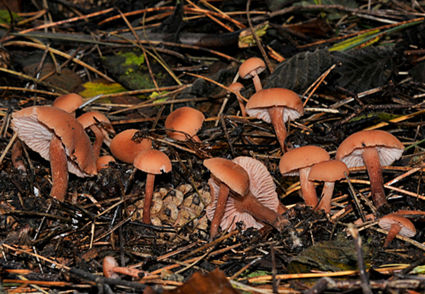
Laccaria macrocystidiata, a marasmioid species, originally described as Laccaria affinis f. macrocystidiata from Central Italy, was synonymised with the North American taxon Laccaria laccata var. pallidifolia, but only on a morphological basis. In this paper, the independent position of L. macrocystidiata from L. laccata var. pallidifolia and other species of Laccaria is pointed out on the basis of ITS-LSU phylogenetic analyses. According to our results, Laccaria macrocystidiata var. longispinosa is considered a synonym of Laccaria macrocystidiata. Laccaria macrocystidiata holotype consists of only one basidioma in poor condition; thus, a new epitype from an Italian collection was designated.
References
Berkeley, M.J. & Broome, C.E. (1883) Notices of British fungi (1989–2027). Annals and Magazine of Natural History 12: 370–374. https://doi.org/10.1080/00222938309459647
Bolton, J. (1788) An history of funguses, growing about Halifax, Vol. 1. Huddersfield, Halifax, pp. 1?44. https://doi.org/10.5962/bhl.title.5394
Bon, M. (1983) Tricholomataceae de France et d’Europe occidentale (6éme partie: Tribu Clitocybeae Fay.). Documents Mycologiques 13 (51): 1–53.
Bon, M. & Contu, M. (1985).Taxons nouveaux. Documents Mycologiques 15 (59): 53.
Cho, H.J., Park, M.S., Lee, H., Oh, S.Y., Wilson, A.W., Mueller, G.M. & Lim, Y.W. (2018) A systematic revision of the ectomycorrhizal genus Laccaria from Korea. Mycologia 110 (5): 948–961. https://doi.org/10.1080/00275514.2018.1507542
Contu, M. (1992) Taxa nova Agaricalium. Boletín de la Sociedade Broteriana, Sér. 2, 65: 79–82.
Contu, M. (2003) Il genere Laccaria (Basidiomycotina, Agaricales) in Italia, con note sulle rimanenti specie in Europa. Bollettino del Gruppo Micologico “G. Bresadola” 46 (1): 5–58.
Cooke, M.C. (1884) New British fungi. Grevillea 12 (63): 65–70.
Dovana, F., Contu, M., Angeli, P., Brandi, A. & Mucciarelli, M. (2017) Leucoagaricus ariminensis sp. nov., a lilac species from Italy. Mycotaxon 132 (1): 205–216. https://doi.org/10.5248/132.205
Doyle, J.J. & Doyle, J.L. (1987) A rapid DNA isolation procedure for small quantities of fresh leaf material. Phytochem Bull 19: 11–15.
Felsenstein, J. (1985) Confidence limits on phylogenies: an approach using the bootstrap. Evolution 39: 783–791. https://doi.org/10.1111/j.1558-5646.1985.tb00420.x
Gardes, M. & Bruns, T.D. (1993) ITS primers with enhanced specificity for Basidiomycetes application to the identification of mycorrhizae and rusts. Molecular Ecology 2: 113–118. https://doi.org/10.1111/j.1365-294X.1993.tb00005.x
Katoh, K., Misawa, K., Kuma, K. & Miyata, T. (2002) MAFFT: a novel method for rapid multiple sequence alignment based on fast Fourier transform. Nucleic Acids Research 30: 3059–3066. https://doi.org/10.1093/nar/gkf436
Kearse, M., Moir, R., Wilson, A., Stones-Havas, S., Cheung, M., Sturrock, S., Buxton, S., Cooper, A., Markowitz, S., Duran, C., Thierer, T., Ashton, B., Meintjes, P. & Drummond, A. (2012) Geneious Basic: an integrated and extendable desktop software platform for the organisation and analysis of sequence data. Bioinformatics 28: 1647–1649. https://doi.org/10.1093/bioinformatics/bts199
Kirk, P.M., Cannon, P.F., Minter, D.W. & Stalpers, J.A. (2008) Ainsworth & Bisby’s dictionary of the fungi. 10th Edition. CABI, Europe, UK, 492 pp. https://doi.org/10.1079/9780851998268.0000
Kjøller, R. (2006) Disproportionate abundance between ectomycorrhizal root tips and their associated mycelia. FEMS Microbiology Ecology 58 (2): 214–224. https://doi.org/10.1111/j.1574-6941.2006.00166.x
Kumar, S., Stecher, G., Li, M., Knyaz, C. & Tamura, K. (2018) MEGA X: Molecular Evolutionary Genetics Analysis across computing platforms. Molecular Biology and Evolution 35: 1547–1549. https://doi.org/10.1093/molbev/msy096
Lanfear, R., Frandsen, P.B., Wright, A.M., Senfeld, T. & Calcott, B. (2017) PartitionFinder 2: new methods for selecting partitioned models of evolution for molecular and morphological phylogenetic analyses. Molecular Biology and Evolution 34: 772–773. https://doi.org/10.1093/molbev/msw260
Luo, X., Ye, L., Chen, J., Karunarathna, S.C., Xu, J., Hyde, K.D. & Mortimer, P.E. (2016) Laccaria rubroalba sp.nov. (Hydnangiaceae, Agaricales) from Southwestern China. Phytotaxa 284 (1): 41–50. https://doi.org/10.11646/phytotaxa.284.1.4
Migliozzi, V. & Lavorato, C. (1988) Appunti di micoflora mediterranea. 6. Laccaria affinis fo. macrocystidiata fo. nov. Micologia Italiana 17 (2): 3–6.
Miller, M.A., Pfeiffer, W. & Schwartz, T. (2010) Creating the CIPRES Science Gateway for inference of large phylogenetic trees. In: Proceedings of the Gateway Computing Environments Workshop (GCE). 14 Nov. 2010, New Orleans, LA, pp. 1–8. https://doi.org/10.1109/GCE.2010.5676129
Moreno, G., Castillo, A. & Thüs, H. (2018) Critical revision of type material of Stemonitales (Myxogastria) at the Natural History Museum London (BM). Phytotaxa 344: 149–159. https://doi.org/10.11646/phytotaxa.344.2.3
Mueller, G.M. (1992) Systematics of Laccaria (Agaricales) in the continental United States and Canada, with discussion on extralimital taxa and descriptions of extant types. Fieldiana Botany New Series 30: 1–158. https://doi.org/10.5962/bhl.title.2598
Pázmány, D. (1994) Zur Systematik der Gattung Laccaria Bk. et Br. Zeitschrift für Mykologie 60 (1): 5–12.
Peck, C.H. (1890) Report of the State Botanist (1889). Annual Report on the New York State Museum of Natural History 43: 51–97.
Peck, C.H. (1912) Report of the State Botanist 1911. Bulletin of the New York State Museum 157: 1–139.
Popa, F., Rexer, K.H., Donges, K., Yang, Z.L. & Kost, G. (2014) Three new Laccaria species from Southwest China (Yunnan) Mycological Progress 13: 1105–1117. https://doi.org/10.1007/s11557-014-0998-7
Popa, F., Jimenéz, S.Y.C., Weisenborn, J., Donges, K., Rexer, K.H. & Piepenbring, M. (2016) A new Laccaria species from cloud forest of Fortuna, Panama. Mycological Progress 15: 1–8. https://doi.org/10.1007/s11557-015-1139-7
Rambaut, A., Drummond, A.J., Xie, D., Baele, G. & Suchard, M.A. (2018) Posterior summarisation in Bayesian phylogenetics using Tracer 1.7. Systematic Biology 67 (5): 901–904. https://doi.org/10.1093/sysbio/syy032
Ramos, A., Bandala, V.M. & Montoya, L. (2017) A new species and a new record of Laccaria (Fungi, Basidiomycota) found in a relict forest of the endangered Fagus grandifolia var. mexicana. MycoKeys 27: 77–94. https://doi.org/10.3897/mycokeys.27.21326
Redhead, S.A. & Smith, A.H. (1986) Two new genera of agarics based on Psilocybe corneipes and Phaeocollybia perplexa. Canadian Journal of Botany 64 (3): 643–647. https://doi.org/10.1139/b86-082
Ronquist, F., Teslenko, M., van der Mark, P., Ayres, D.L., Darling, A., Höhna, S., Larget, B., Liu, L., Suchard, M.A. & Huelsenbeck, J.P. (2012) MrBayes 3.2: efficient Bayesian phylogenetic inference and model choice across a large model space. Systematic Biology 61: 539–542. https://doi.org/10.1093/sysbio/sys029
Sesli, E., Contu, M. & Helfer, S. (2012) A new record for the Turkish Mycota from Trabzon: Laccaria macrocystidiata (Migl. & Lavorato) Pázmány. Mantar Dergisi/The Journal of Fungus 3 (1–2): 1–3.
Singer, R. (1967) Notes sur le genre Laccaria. Bulletin de la Société Mycologiquesde la France 83 (1): 104–123.
Stamatakis, A. (2014) RAxML Version 8: A tool for Phylogenetic Analysis and Post-Analysis of Large Phylogenies. Bioinformatics 30 (9): 1312–1313. https://doi.org/10.1093/bioinformatics/btu033
Vellinga, E.C. (1988) Glossary. In: Bas, C., Kuyper, T.W., Noordeloos, M.E. & Vellinga, E.C. (Eds.) Flora Agaricina Neerlandica. Critical monographs on families of agarics and boleti occurring in the Netherlands, vol 1. A.A. Balkema, Rotterdam, pp. 54–64.
Vellinga, E.C. & Mueller, G.M. (1987) Taxonomic and nomenclatural notes on Laccaria B. & Br. II. Laccaria bicolor, L. fraterna, and L. laccata var. pallidifolia. Persoonia 13: 383–385.
Vincenot, L., Popa, F., Laso, F., Donges, K., Rexer, K.H., Kost, G., Yang, Z.L., Nara, K. & Selosse, M.A. (2017) Out of Asia: bio-geography of fungal populations reveals Asian origin of diversification of the Laccaria amethystine complex, and two new species of violet Laccaria. Fungal Biology 121 (11): 939–955. https://doi.org/10.1016/j.funbio.2017.08.001
Vilgalys, R. & Hester, M. (1990) Rapid genetic identification and mapping of enzymatically amplified ribosomal DNA from several Cryptococcus species. Journal of Bacteriology 172: 4238–4246. https://doi.org/10.1128/jb.172.8.4238-4246.1990
Vizzini, A., Contu, M., Kalamees, K., Ercole, E., Musumeci, E., Moreno, G., Manjón, J.L. & Alvarado, P. (2011) On the variability of spore ornamentation in Laccaria tortilis (Basidiomycota, Agaricales). Mycotaxon 116: 217–225. https://doi.org/10.5248/116.217
Wa?ny, R. & Kowalski, S. (2017) Ectomycorrhizal fungal communities of silver-fir seedlings regenerating in fir stands and larch forecrops. Trees 31: 929–939. https://doi.org/10.1007/s00468-016-1518-y
Wang, X.H., Das, K., Bera, I., Chen, Y.H., Bhatt, R.P., Ghosh, A., Hembrom, M.E., Hofstetter, V., Parihar, A., Vizzini, A., Xu, T.M., Zhao, C.L. & Buyck, B. (2019) Fungal Biodiversity Profiles 81–90. Cryptogamie Mycologie 40: 57–95. https://doi.org/10.5252/cryptogamie-mycologie2019v40a5
White, T.J., Bruns, T.D., Lee, S. & Taylor, J. (1990) Amplification and direct sequencing of fungal ribosomal RNA genes for phylogenetics. In: Innis, M.A., Gelfand, D.H., Sninsky, J.J. & White, T.J. (Eds.) PCR Protocols, a guide to methods and applications. Academic press, Orlando, pp. 315–322. https://doi.org/10.1016/B978-0-12-372180-8.50042-1
Wilson, A.W., Hosaka, K., Perry, B.A. & Mueller, G. (2013) Laccaria (Agaricomycetes, Basidiomycota) from Tibet (Xizang Autonomous Region, China). Mycoscience 54 (6): 406–419. https://doi.org/10.1016/j.myc.2013.01.006
Wilson, A.W., Hosaka, K. & Mueller, G.M. (2016) Evolution of ectomycorrhizas as a driver of diversification and biogeographic patterns in the model mycorrhizal mushroom genus Laccaria. New Phytologist 213 (4): 1862–1873. https://doi.org/10.1111/nph.14270
Zimmer, K., Hynson, N.A., Gebauer, G., Allen, E.B., Allen, M.F. & Read, D.J. (2007) Wide geographical and ecological distribution of nitrogen and carbon gains from fungi in pyroloids and monotropoids (Ericaceae) and in orchids. New Phytologist 175: 166–175. https://doi.org/10.1111/j.1469-8137.2007.02065.x
Bolton, J. (1788) An history of funguses, growing about Halifax, Vol. 1. Huddersfield, Halifax, pp. 1?44. https://doi.org/10.5962/bhl.title.5394
Bon, M. (1983) Tricholomataceae de France et d’Europe occidentale (6éme partie: Tribu Clitocybeae Fay.). Documents Mycologiques 13 (51): 1–53.
Bon, M. & Contu, M. (1985).Taxons nouveaux. Documents Mycologiques 15 (59): 53.
Cho, H.J., Park, M.S., Lee, H., Oh, S.Y., Wilson, A.W., Mueller, G.M. & Lim, Y.W. (2018) A systematic revision of the ectomycorrhizal genus Laccaria from Korea. Mycologia 110 (5): 948–961. https://doi.org/10.1080/00275514.2018.1507542
Contu, M. (1992) Taxa nova Agaricalium. Boletín de la Sociedade Broteriana, Sér. 2, 65: 79–82.
Contu, M. (2003) Il genere Laccaria (Basidiomycotina, Agaricales) in Italia, con note sulle rimanenti specie in Europa. Bollettino del Gruppo Micologico “G. Bresadola” 46 (1): 5–58.
Cooke, M.C. (1884) New British fungi. Grevillea 12 (63): 65–70.
Dovana, F., Contu, M., Angeli, P., Brandi, A. & Mucciarelli, M. (2017) Leucoagaricus ariminensis sp. nov., a lilac species from Italy. Mycotaxon 132 (1): 205–216. https://doi.org/10.5248/132.205
Doyle, J.J. & Doyle, J.L. (1987) A rapid DNA isolation procedure for small quantities of fresh leaf material. Phytochem Bull 19: 11–15.
Felsenstein, J. (1985) Confidence limits on phylogenies: an approach using the bootstrap. Evolution 39: 783–791. https://doi.org/10.1111/j.1558-5646.1985.tb00420.x
Gardes, M. & Bruns, T.D. (1993) ITS primers with enhanced specificity for Basidiomycetes application to the identification of mycorrhizae and rusts. Molecular Ecology 2: 113–118. https://doi.org/10.1111/j.1365-294X.1993.tb00005.x
Katoh, K., Misawa, K., Kuma, K. & Miyata, T. (2002) MAFFT: a novel method for rapid multiple sequence alignment based on fast Fourier transform. Nucleic Acids Research 30: 3059–3066. https://doi.org/10.1093/nar/gkf436
Kearse, M., Moir, R., Wilson, A., Stones-Havas, S., Cheung, M., Sturrock, S., Buxton, S., Cooper, A., Markowitz, S., Duran, C., Thierer, T., Ashton, B., Meintjes, P. & Drummond, A. (2012) Geneious Basic: an integrated and extendable desktop software platform for the organisation and analysis of sequence data. Bioinformatics 28: 1647–1649. https://doi.org/10.1093/bioinformatics/bts199
Kirk, P.M., Cannon, P.F., Minter, D.W. & Stalpers, J.A. (2008) Ainsworth & Bisby’s dictionary of the fungi. 10th Edition. CABI, Europe, UK, 492 pp. https://doi.org/10.1079/9780851998268.0000
Kjøller, R. (2006) Disproportionate abundance between ectomycorrhizal root tips and their associated mycelia. FEMS Microbiology Ecology 58 (2): 214–224. https://doi.org/10.1111/j.1574-6941.2006.00166.x
Kumar, S., Stecher, G., Li, M., Knyaz, C. & Tamura, K. (2018) MEGA X: Molecular Evolutionary Genetics Analysis across computing platforms. Molecular Biology and Evolution 35: 1547–1549. https://doi.org/10.1093/molbev/msy096
Lanfear, R., Frandsen, P.B., Wright, A.M., Senfeld, T. & Calcott, B. (2017) PartitionFinder 2: new methods for selecting partitioned models of evolution for molecular and morphological phylogenetic analyses. Molecular Biology and Evolution 34: 772–773. https://doi.org/10.1093/molbev/msw260
Luo, X., Ye, L., Chen, J., Karunarathna, S.C., Xu, J., Hyde, K.D. & Mortimer, P.E. (2016) Laccaria rubroalba sp.nov. (Hydnangiaceae, Agaricales) from Southwestern China. Phytotaxa 284 (1): 41–50. https://doi.org/10.11646/phytotaxa.284.1.4
Migliozzi, V. & Lavorato, C. (1988) Appunti di micoflora mediterranea. 6. Laccaria affinis fo. macrocystidiata fo. nov. Micologia Italiana 17 (2): 3–6.
Miller, M.A., Pfeiffer, W. & Schwartz, T. (2010) Creating the CIPRES Science Gateway for inference of large phylogenetic trees. In: Proceedings of the Gateway Computing Environments Workshop (GCE). 14 Nov. 2010, New Orleans, LA, pp. 1–8. https://doi.org/10.1109/GCE.2010.5676129
Moreno, G., Castillo, A. & Thüs, H. (2018) Critical revision of type material of Stemonitales (Myxogastria) at the Natural History Museum London (BM). Phytotaxa 344: 149–159. https://doi.org/10.11646/phytotaxa.344.2.3
Mueller, G.M. (1992) Systematics of Laccaria (Agaricales) in the continental United States and Canada, with discussion on extralimital taxa and descriptions of extant types. Fieldiana Botany New Series 30: 1–158. https://doi.org/10.5962/bhl.title.2598
Pázmány, D. (1994) Zur Systematik der Gattung Laccaria Bk. et Br. Zeitschrift für Mykologie 60 (1): 5–12.
Peck, C.H. (1890) Report of the State Botanist (1889). Annual Report on the New York State Museum of Natural History 43: 51–97.
Peck, C.H. (1912) Report of the State Botanist 1911. Bulletin of the New York State Museum 157: 1–139.
Popa, F., Rexer, K.H., Donges, K., Yang, Z.L. & Kost, G. (2014) Three new Laccaria species from Southwest China (Yunnan) Mycological Progress 13: 1105–1117. https://doi.org/10.1007/s11557-014-0998-7
Popa, F., Jimenéz, S.Y.C., Weisenborn, J., Donges, K., Rexer, K.H. & Piepenbring, M. (2016) A new Laccaria species from cloud forest of Fortuna, Panama. Mycological Progress 15: 1–8. https://doi.org/10.1007/s11557-015-1139-7
Rambaut, A., Drummond, A.J., Xie, D., Baele, G. & Suchard, M.A. (2018) Posterior summarisation in Bayesian phylogenetics using Tracer 1.7. Systematic Biology 67 (5): 901–904. https://doi.org/10.1093/sysbio/syy032
Ramos, A., Bandala, V.M. & Montoya, L. (2017) A new species and a new record of Laccaria (Fungi, Basidiomycota) found in a relict forest of the endangered Fagus grandifolia var. mexicana. MycoKeys 27: 77–94. https://doi.org/10.3897/mycokeys.27.21326
Redhead, S.A. & Smith, A.H. (1986) Two new genera of agarics based on Psilocybe corneipes and Phaeocollybia perplexa. Canadian Journal of Botany 64 (3): 643–647. https://doi.org/10.1139/b86-082
Ronquist, F., Teslenko, M., van der Mark, P., Ayres, D.L., Darling, A., Höhna, S., Larget, B., Liu, L., Suchard, M.A. & Huelsenbeck, J.P. (2012) MrBayes 3.2: efficient Bayesian phylogenetic inference and model choice across a large model space. Systematic Biology 61: 539–542. https://doi.org/10.1093/sysbio/sys029
Sesli, E., Contu, M. & Helfer, S. (2012) A new record for the Turkish Mycota from Trabzon: Laccaria macrocystidiata (Migl. & Lavorato) Pázmány. Mantar Dergisi/The Journal of Fungus 3 (1–2): 1–3.
Singer, R. (1967) Notes sur le genre Laccaria. Bulletin de la Société Mycologiquesde la France 83 (1): 104–123.
Stamatakis, A. (2014) RAxML Version 8: A tool for Phylogenetic Analysis and Post-Analysis of Large Phylogenies. Bioinformatics 30 (9): 1312–1313. https://doi.org/10.1093/bioinformatics/btu033
Vellinga, E.C. (1988) Glossary. In: Bas, C., Kuyper, T.W., Noordeloos, M.E. & Vellinga, E.C. (Eds.) Flora Agaricina Neerlandica. Critical monographs on families of agarics and boleti occurring in the Netherlands, vol 1. A.A. Balkema, Rotterdam, pp. 54–64.
Vellinga, E.C. & Mueller, G.M. (1987) Taxonomic and nomenclatural notes on Laccaria B. & Br. II. Laccaria bicolor, L. fraterna, and L. laccata var. pallidifolia. Persoonia 13: 383–385.
Vincenot, L., Popa, F., Laso, F., Donges, K., Rexer, K.H., Kost, G., Yang, Z.L., Nara, K. & Selosse, M.A. (2017) Out of Asia: bio-geography of fungal populations reveals Asian origin of diversification of the Laccaria amethystine complex, and two new species of violet Laccaria. Fungal Biology 121 (11): 939–955. https://doi.org/10.1016/j.funbio.2017.08.001
Vilgalys, R. & Hester, M. (1990) Rapid genetic identification and mapping of enzymatically amplified ribosomal DNA from several Cryptococcus species. Journal of Bacteriology 172: 4238–4246. https://doi.org/10.1128/jb.172.8.4238-4246.1990
Vizzini, A., Contu, M., Kalamees, K., Ercole, E., Musumeci, E., Moreno, G., Manjón, J.L. & Alvarado, P. (2011) On the variability of spore ornamentation in Laccaria tortilis (Basidiomycota, Agaricales). Mycotaxon 116: 217–225. https://doi.org/10.5248/116.217
Wa?ny, R. & Kowalski, S. (2017) Ectomycorrhizal fungal communities of silver-fir seedlings regenerating in fir stands and larch forecrops. Trees 31: 929–939. https://doi.org/10.1007/s00468-016-1518-y
Wang, X.H., Das, K., Bera, I., Chen, Y.H., Bhatt, R.P., Ghosh, A., Hembrom, M.E., Hofstetter, V., Parihar, A., Vizzini, A., Xu, T.M., Zhao, C.L. & Buyck, B. (2019) Fungal Biodiversity Profiles 81–90. Cryptogamie Mycologie 40: 57–95. https://doi.org/10.5252/cryptogamie-mycologie2019v40a5
White, T.J., Bruns, T.D., Lee, S. & Taylor, J. (1990) Amplification and direct sequencing of fungal ribosomal RNA genes for phylogenetics. In: Innis, M.A., Gelfand, D.H., Sninsky, J.J. & White, T.J. (Eds.) PCR Protocols, a guide to methods and applications. Academic press, Orlando, pp. 315–322. https://doi.org/10.1016/B978-0-12-372180-8.50042-1
Wilson, A.W., Hosaka, K., Perry, B.A. & Mueller, G. (2013) Laccaria (Agaricomycetes, Basidiomycota) from Tibet (Xizang Autonomous Region, China). Mycoscience 54 (6): 406–419. https://doi.org/10.1016/j.myc.2013.01.006
Wilson, A.W., Hosaka, K. & Mueller, G.M. (2016) Evolution of ectomycorrhizas as a driver of diversification and biogeographic patterns in the model mycorrhizal mushroom genus Laccaria. New Phytologist 213 (4): 1862–1873. https://doi.org/10.1111/nph.14270
Zimmer, K., Hynson, N.A., Gebauer, G., Allen, E.B., Allen, M.F. & Read, D.J. (2007) Wide geographical and ecological distribution of nitrogen and carbon gains from fungi in pyroloids and monotropoids (Ericaceae) and in orchids. New Phytologist 175: 166–175. https://doi.org/10.1111/j.1469-8137.2007.02065.x