

Abstract
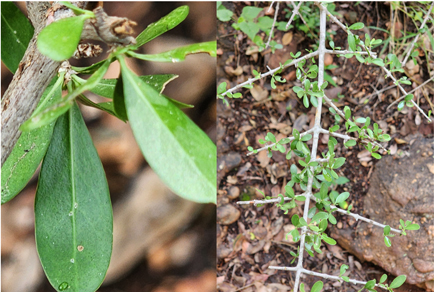
This contribution aims to clarify the correct typification of Pyrostria hystrix, showing that the accepted type is a lectotype rather than a holotype. A second-step lectotype is designated here to limit the typification to a single specimen. A further aim is to confirm the presence of domatia on the leaves of Pyrostria hystrix. Careful observation of the leaf morphology of numerous herbarium specimens, while revisiting the original Latin description of the leaves in the protologue, demonstrates that domatia are clearly present in this species, contrary to statements in later literature that explicitly report domatia as being absent. This highlights an important and diagnostic morphological character for the species that have been overlooked for decades.
References
- Bremekamp, C.E.B. (1933) New or otherwise noteworthy plants from the Northern Transvaal. Annals of the Transvaal Museum 15: 233–264. [https://hdl.handle.net/10520/AJA00411752_605]
- Bridson, D. (1987) Studies in African Rubiaceae−Vanguerieae: a new circumscription of Pyrostria and a new subgenus, Canthium subgen. Bullockia. Kew Bulletin 42 (3): 611–639. https://doi.org/10.2307/4110068
- Bridson, D. (1998) Rubiaceae: Tribe Vanhuerieae. In: Pope, G.V. (Ed.) Flora Zambesiaca 5 (2). Flora Zambesiaca Managing Committee, Royal Botanic Gardens, Kew, pp. 211–377.
- Burrows, J.E. (2018) Rubiaceae. In: Burrows, J.E., Burrows, S.M., Lötter, M.C. & Schmidt, E. (Eds.) Trees and shrubs of Mozambique. Print Matters (Pty.) Ltd., Noordhoek, Cape Town, pp. 1114.
- De Jussieu, A.L. (1789) Genera Plantarum: secundum ordines naturales disposita, juxta methodum in Horto regio parisiensi exaratam. Parisiis, apud viduam Herissant et Theophilum Barrois, 498 pp. https://doi.org/10.5962/bhl.title.747
- Matheka, K.W., Goyder, D. & Darbyshire, I. (2024) Expanding our knowledge of the coffee family in continental Africa: a synopsis of the genus Pyrostria (Rubiaceae). Kew Bulletin 79: 283–315. https://doi.org/10.1007/s12225-024-10173-9
- Moll, E. (1992) Trees of Natal: a comprehensive field guide to over eight hundred indigenous and naturalized species. University of Cape Town, Eco-Lab Trust Fund, Cape Town, 542 pp.
- Palgrave, K.C. (1977) Trees Southern Africa. Struik, Cape Town, 959 pp.
- Palgrave, K.C. (2002) Trees Southern Africa. 3rd edition. Struik, Cape Town, 1212 pp.
- Palmer, E. & Pitman, N. (1972) Trees of southern Africa: covering all known indigenous species in the Republic of South Africa, South West Africa, Botswana, Lesotho and Swaziland, Vols 1–3. A.A. Balkema, Cape Town, 2235 pp.
- Pooley, E. (1993) The complete field guide to trees of Natal, Zululand & Transkei. Natal Flora Publications Trust, Durban, 512 pp.
- Schmidt, E., Lötter, M. & McCleland, W. (2002) Trees and shrubs of Mpumalanga and Kruger National Park. Jacana, Johannesburg, 702 pp.
- Thiers, B. (2026 [continuously updated]) Index herbariorum: a global directory of public herbaria and associated staff. New York Botanical Garden’s Virtual Herbarium. Available from: http://sweetgum.nybg.org/ih/ (accessed 1 January 2026)
- Turland, N.J., Wiersema, J.H., Barrie, F.R., Gandhi, K.N., Gravendyck, J., Greuter, W., Hawksworth, D.L., Herendeen, P.S., Klopper, R.R., Knapp, S., Kusber, W.-H., Li, D.-Z., May, T.W., Monro, A.M., Prado, J., Price, M.J., Smith, G.F. & Zamora Señoret, J.C. (2025) International Code of Nomenclature for algae, fungi, and plants (Madrid Code). University of Chicago Press, Chicago, 303 pp. https://doi.org/10.7208/chicago/9780226839479.001.0001
- Von Breitenbach, F. (1985) Miscellaneous taxonomic notes (Hyperacanthus, Canthium−Psydrax−Keetia, Dinocanthium−Pyrostria). Journal of Dendrology 5 (3–4): 78–93.