
Abstract
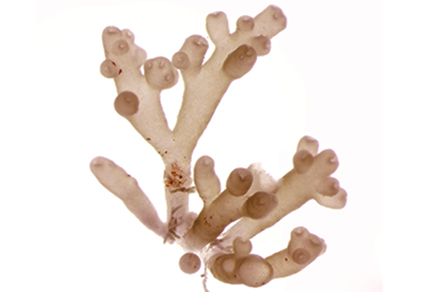
We describe a new species from Tamil Nadu, India, Chondrophycus minutus sp. nov. based on molecular and morphological data. Chondrophycus minutus is characterized by 1) a small, terete, cartilaginous thallus up to 0.6 cm in height, 2) an alternate branching pattern, 3) thick-walled and obconical cortical cells, 4) appearing polygonal to irregularly angular in surface view, 5) lacking secondary pit connections, 6) tetrasporangia with right-angle arrangement. Molecular phylogenetic analyses confirmed our C. minutus as a distinct species, showing sequence divergences from other Chondrophycus species ranging from 5.3–9.6% for rbcL gene and 7.4–10.9% for COI-5P. Chondrophycus minutus sp. nov. is distinguished from two species known to occur in India, C. brandenii and C. ceylanicus. It differs from C. brandenii, which has terete to partially compressed thalli, irregular radial branching, and thin-walled medullary cells, and from C. ceylanicus, which is characterized by a compressed thallus with palisade-arranged, elongated cortical cells. This study identifies Chondrophycus minutus as a newly described species in the Indian macroalgal flora, supported by molecular and morphological evidence.
References
- Agardh, C.A. (1817) Synopsis algarum Scandinaviae, adjecta dispositione universali algarum. Ex officina Berlingiana, Lundae, 135 pp. https://doi.org/10.5962/bhl.title.45465
- Agardh, J.G. (1876) Species, genera et ordines algarum: Seu descriptiones succinctae specierum, generum et rodinum, quibus algarum regnum constituitur. Epicrisis systematis Floridearum, Lipsiae, 744 pp.
- Barros-Barreto, M.B., Jaramillo, M.A., Hommersand, M.H., Ferreira, P.C.G. & Maggs, C.A. (2023) Phylogenetic analysis of the red algal tribe Ceramieae reveals multiple morphological homoplasies but defines new genera. Cryptogamie, Algologie 44: 13–33. https://doi.org/10.5252/cryptogamie-algologie2023v44a2
- Bornet, É. (1892) Les algues de P. K. A. Schousboe, récoltées au Maroc & dans la Méditerranée de 1815 a 1829, et déterminées par M. Édouard Bornet. Mémoires de la Société Nationale des Sciences naturelles et Mathématiques de Cherbourg 28: 165–376.
- Børgesen, F. (1945) Some marine algae from Mauritius. III. Rhodophyceae. Part 4. Ceramiales. Kongelige Danske Videnskabernes Selskab, Biologiske Meddelelser 19: 1–68.
- Cassano, V., Oliveira, M.C., Gil-Rodríguez, M.C., Sentíes, A., Díaz-Larrea, J. & Fujii, M.T. (2012) Molecular support for the establishment of the new genus Laurenciella within the Laurencia complex (Ceramiales, Rhodophyta). Botanica Marina 55: 349–357. https://doi.org/10.1515/bot-2012-0133
- Cassano, V., Soares, L.P., Vera-Vegas, B.E., Ardito, S., Gómez, S., Sentíes, A. & Fujii, M.T. (2020) Chondrophycus anabeliae and Laurencia digitata (Ceramiales, Rhodophyta) are recorded for the first time for Venezuela expanding their geographic distributions beyond the type localities. Botanical Sciences 98: 624–643. https://doi.org/10.17129/botsci.2610
- Cribb, A.B. (1958) Records of marine algae from south-eastern Queensland. III. Laurencia Lamx. University of Queensland Papers, Department of Botany 3: 159–191.
- Díaz-Tapia, P., McIvor, L., Freshwater, D.W., Verbruggen, H., Wynne, M.J. & Maggs, C.A. (2017) The genera Melanothamnus Bornet & Falkenberg and Vertebrata S.F. Gray constitute well-defined clades of the red algal tribe Polysiphonieae (Rhodomelaceae, Ceramiales). European Journal of Phycology 52: 1–20. https://doi.org/10.1080/09670262.2016.1256436
- Edler, D., Klein, J., Antonelli, A. & Silvestro, D. (2021) raxmlGUI 2.0: A graphical interface and toolkit for phylogenetic analyses using RAxML. Methods in Ecology and Evolution 12: 373–377. https://doi.org/10.1111/2041-210X.13512
- Freshwater, D.W. & Rueness, J. (1994) Phylogenetic relationships of some European Gelidium (Gelidiales, Rhodophyta) species, based on rbcL nucleotide sequence analysis. Phycologia 33: 187–194. https://doi.org/10.2216/i0031-8884-33-3-187.1
- Ganzon-Fortes, E.T. (1982) Laurencia tronoi (Rhodophyta, Ceramiales), a new species from Calatagan, Batangas, Philippines. Kalikasan, Philippine Journal of Biology 11: 404–409.
- Garbary, D.J. & Harper, J.T. (1998) A phylogenetic analysis of the Laurencia complex (Rhodomelaceae) of the red algae. Cryptogamie. Algologie 19: 185–200. https://doi.org/10.5962/p.309511
- Guindon, S., Dufayard, J.-F., Lefort, V., Anisimova, M., Hordijk, W. & Gascuel, O. (2010) New Algorithms and Methods to Estimate Maximum-Likelihood Phylogenies: Assessing the Performance of PhyML 3.0. Systematic biology 59: 307–321. https://doi.org/10.1093/sysbio/syq010
- Guiry, M.D. & Guiry, G.M. (2025) AlgaeBase. World-Wide Electronic Publication, National University of Ireland, Galway. Available from: http://www.algaebase.org/ (accessed 25 October 2025)
- Hudson, W. (1778) Flora anglica; exhibens plantas per regnum Britanniæ sponte crescentes, distributas secundum systema sexuale: cum differentiis specierum, synonymis auctorum, nominibus incolarum, solo locorum, tempore florendi, officinalibus pharmacopæorum. Tomus II. Editio altera, emendata et aucta. pp. 335–690.
- Lanfear, R., Calcott, B., Ho, S.Y.W. & Guindon, S. (2012) Partitionfinder: Combined selection of partitioning schemes and substitution models for phylogenetic analyses. Molecular Biology and Evolution 29: 1695–1701. https://doi.org/10.1093/molbev/mss020
- Lanfear, R., Frandsen, P.B., Wright, A.M., Senfeld, T. & Calcott, B. (2017) PartitionFinder 2: New Methods for Selecting Partitioned Models of Evolution for Molecular and Morphological Phylogenetic Analyses. Molecular Biology and Evolution 34: 772–773. https://doi.org/10.1093/molbev/msw260
- Martin-Lescanne, J., Rousseau, F., De Reviers, B., Payri, C., Couloux, A., Cruaud, C. & Le Gall, L. (2010) Phylogenetic analyses of the Laurencia complex (Rhodomelaceae, Ceramiales) support recognition of five genera: Chondrophycus, Laurencia, Osmundea, Palisada and Yuzurua stat. nov. European Journal of Phycology 45: 51–61. https://doi.org/10.1080/09670260903314292
- Nam, K.W. (1999) Morphology of Chondrophycus undulata and C. parvipapillata and its implications for the taxonomy of the Laurencia (Ceramiales, Rhodophyta) complex. European Journal of Phycology 34: 455–468. https://doi.org/10.1080/09541449910001718811
- Nam, K.W. (2006) Phylogenetic re-evaluation of the Laurencia complex (Rhodophyta) with a description of L. succulenta sp. nov. from Korea. Journal of Applied Phycology 18: 679–697. https://doi.org/10.1007/s10811-006-9073-3
- Nam, K.W. (2011) Algal flora of Korea. Volume 4, Number 3. Rhodophyta: Florideophyceae, Ceramiales: Rhodomelaceae: Laurencia, Chondrophycus, Palisada, Chondria. Marine red algae. National Institute of Biological Resources, Incheon, 198 pp.
- Nam, K.W. & Sohn, C.H. (1994) Laurencia kangjaewonii sp. nov. (Ceramiales, Rhodophyta) from Korea. Phycologia 33: 397–403. https://doi.org/10.2216/i0031-8884-33-6-397.1
- Nam, K.W. & Saito, Y. (1995) Vegetative and reproductive anatomy of some Laurencia (Ceramiales, Rhodophyta) species with a description of L. maris-rubri sp. nov. From the Red Sea. Phycologia 34: 157–165. https://doi.org/10.2216/i0031-8884-34-2-157.1
- Nam, K.W., Maggs, C.A. & Garbary, D.J. (1994) Resurrection of the genus Osmundea with an emendation of the generic delineation of Laurencia (Ceramiales, Rhodophyta). Phycologia 33: 384–395. https://doi.org/10.2216/i0031-8884-33-5-384.1
- Popolizio, T., Schneider, C., Jongbloed, W., Saunders, G. & Lane, C. (2022) Molecular Analysis Resolves the Taxonomy of the Laurencia Complex (Rhodomelaceae, Ceramiales) in Bermuda and Uncovers Novel Species of Chondrophycus and Laurenciella. Cryptogamie, Algologie 43: 1–30. https://doi.org/10.5252/cryptogamie-algologie2022v43a1
- Romero-Orozco, P., Won, B.Y. & Cho, T.O. (2025) Revision of Chondrophycus in Korea with description of Chondrophycus coreanus sp. nov. (Ceramiales, Rhodophyta). Algae 40: 1–14. https://doi.org/10.4490/algae.2025.40.3.10
- Ronquist, F., Teslenko, M., van der Mark, P., Ayres, D.L., Darling, A., Höhna, S., Larget, B., Liu, L., Suchard, M.A. & Huelsenbeck, J.P. (2012) MrBayes 3.2: Efficient Bayesian Phylogenetic Inference and Model Choice Across a Large Model Space. Systematic Biology 61: 539–542. https://doi.org/10.1093/sysbio/sys029
- Sahoo, D. (2001) Seaweeds of Indian Coast. APH Publishing Corporation, New Delhi, 283 pp.
- Saito, Y. (1967) Studies on Japanese Species of Laurencia, with special reference to their comparative morphology. Memoirs of the Faculty of Fisheries Hokkaido University 15: 1–81.
- Saito, Y. (1969) The Algal Genus Laurencia from the Hawaiian Islands, the Philippine Islands and Adjacent Areas. Pacific Science 23: 148–160.
- Saito, Y. & Womersley, H.B.S. (1974) The southern Australian species of Laurencia (Ceramiales: Rhodophyta). Australian Journal of Botany 22: 815–874. https://doi.org/10.1071/bt9740815
- Saunders, G.W. (2005) Applying DNA barcoding to red macroalgae: A preliminary appraisal holds promise for future applications. Philosophical Transactions of the Royal Society B: Biological Sciences 360: 1879–1888. https://doi.org/10.1098/rstb.2005.1719
- Saunders, G.W. & McDevit, D.C. (2012) Methods for DNA Barcoding Photosynthetic Protists Emphasizing the Macroalgae and Diatoms. In: Kress, W. & Erickson, D. (Eds.) DNA Barcodes. Methods in Molecular Biology. Humana Press, Clifton, pp. 207–222. https://doi.org/10.1007/978-1-61779-591-6_10
- Schneider, C.A., Rasband, W.S. & Eliceiri, K.W. (2012) NIH Image to ImageJ: 25 years of image analysis. Nature Methods 9: 671–675. https://doi.org/10.1038/nmeth.2089
- Sentíes, A., Cassano, V., Dreckmann, K.M., Gil-Rodríguez, M.C., Stein, E.M. & Fujii, M.T. (2016) Chondrophycus anabeliae (Rhodomelaceae, Ceramiales), a new species in the Laurencia complex from the Mexican Caribbean. Phytotaxa 283: 259–270. https://doi.org/10.11646/phytotaxa.283.3.2
- Tamura, K., Stecher, G. & Kumar, S. (2021) MEGA11: Molecular Evolutionary Genetics Analysis Version 11. Molecular Biology and Evolution 38: 3022–3027. https://doi.org/10.1093/molbev/msab120
- Tseng, C.K. (1943) Marine algae of Hong Kong. IV. The genus Laurencia. Papers of the Michigan Academy of Sciences, Arts and Letters 28: 185–208.
- Woodward, T.J. (1794) Description of Fucus dasyphyllus. Transactions of the Linnean Society of London 2: 239–241. https://doi.org/10.1111/j.1096-3642.1794.tb00253.x
- Wynne, M.J. (1991) A change in the name of the type of Chondria C. Agardh (Rhodomelaceae, Rhodophyta). Taxon 40: 316–318. https://doi.org/10.2307/1222986
- Wynne, M.J., Serio, D., Cormaci, M. & Furnari, G. (2005) The species of Chondrophycus and Laurencia (Rhodomelaceae, Ceramiales) occurring in Dhofar, the Sultanate of Oman. Phycologia 44: 497–509. https://doi.org/10.2216/0031-8884(2005)44[497:TSOCAL]2.0.CO;2
- Yamada, Y. (1931) Notes on Laurencia, with special reference to the Japanese species. University of California Publications in Botany 16: 185–310.
- Yendo, K. (1920) Novae algae japoniae. Decas I-III. Botanical Magazine, Tokyo 34: 1–12. https://doi.org/10.15281/jplantres1887.34.397_1b
- Zhang, J. & Xia, B. (1980) Two new species of Laurencia from Xisha Islands, Guangdong Province, China. Oceanologia et Limnologia Sinica 11: 267–274.